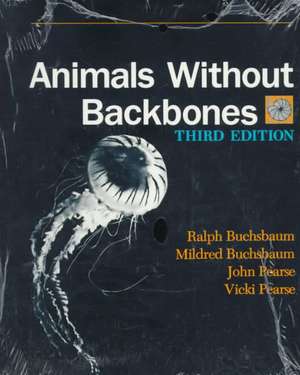
Animals Without Backbones: An Introduction to the Invertebrates: New Plan Texts at the University of Chicago
Autor Ralph Buchsbaum, Mildred Buchsbaum, John Pearse, Vicki Pearseen Limba Engleză Paperback – 15 iul 1987
Animals Without Backbones has been considered a classic among biology textbooks since it was first published to great acclaim in 1938. It was the first biology textbook ever reviewed by Time and was also featured with illustrations in Life. Harvard, Stanford, the University of Chicago, and more than eighty other colleges and universities adopted it for use in courses. Since then, its clear explanations and ample illustrations have continued to introduce hundreds of thousands of students and general readers around the world to jellyfishes, corals, flatworms, squids, starfishes, spiders, grasshoppers, and the other invertebrates that make up ninety-seven percent of the animal kingdom.
This new edition has been completely rewritten and redesigned, but it retains the same clarity and careful scholarship that have earned this book its continuing readership for half a century. It is even more lavishly illustrated than earlier editions, incorporating many new drawings and photographs. Informative, concise legends that form an integral part of the text accompany the illustrations. The text has been updated to include findings from recent research. Eschewing pure morphology, the authors use each group of animals to introduce one or more biological principles.
In recent decades, courses and texts on invertebrate zoology at many universities have been available only for advanced biology majors specializing in this area. The Third Edition of Animals Without Backbones remains an ideal introduction to invertebrates for lower-level biology majors, nonmajors, students in paleontology and other related fields, junior college and advanced high school students, and the general reader who pursues the rewarding study of the natural world.
This new edition has been completely rewritten and redesigned, but it retains the same clarity and careful scholarship that have earned this book its continuing readership for half a century. It is even more lavishly illustrated than earlier editions, incorporating many new drawings and photographs. Informative, concise legends that form an integral part of the text accompany the illustrations. The text has been updated to include findings from recent research. Eschewing pure morphology, the authors use each group of animals to introduce one or more biological principles.
In recent decades, courses and texts on invertebrate zoology at many universities have been available only for advanced biology majors specializing in this area. The Third Edition of Animals Without Backbones remains an ideal introduction to invertebrates for lower-level biology majors, nonmajors, students in paleontology and other related fields, junior college and advanced high school students, and the general reader who pursues the rewarding study of the natural world.
Preț: 492.26 lei
Puncte Express: 738
Carte tipărită la comandă
Livrare economică 19 noiembrie-03 decembrie
Livrare prin curier în România Termenul estimat este afișat lângă disponibilitate.
Transport gratuit pentru acest produs Plată online sau ramburs, în funcție de opțiunile comenzii.
Retur gratuit în 14 zile Comandă securizată și suport în română.
Specificații
ISBN-13: 9780226078748
ISBN-10: 0226078744
Pagini: 582
Ilustrații: 554 halftones, 266 line drawings
Dimensiuni: 191 x 226 x 38 mm
Greutate: 1.18 kg
Ediția:Third Edition
Editura: University of Chicago Press
Colecția University of Chicago Press
Seria New Plan Texts at the University of Chicago
ISBN-10: 0226078744
Pagini: 582
Ilustrații: 554 halftones, 266 line drawings
Dimensiuni: 191 x 226 x 38 mm
Greutate: 1.18 kg
Ediția:Third Edition
Editura: University of Chicago Press
Colecția University of Chicago Press
Seria New Plan Texts at the University of Chicago
V-ar putea interesa
-
 -23%Preț: 768.40 lei997.92 lei
 -
 -5%Preț: 447.06 lei470.60 lei
 -
 Synthetic: How Life Got MadeSophia RoosthPreț: 291.22 lei
 -
 The Evolutionary Biology of PlantsKarl J. NiklasPreț: 266.54 lei
 -
 The Cow with Ear Tag #1389Kathryn GillespiePreț: 207.07 lei
 -
 Preț: 459.64 lei
 -
 The Story of Alice - Lewis Carroll and the Secret History of WonderlandRobert Douglas-fairhurPreț: 223.60 lei
 -
 Cytogenetic Laboratory ManagementSusan Mahler Zneimer-9%Preț: 814.12 lei894.64 lei
 -
 Bed Bugs CDoggett-9%Preț: 1229.09 lei1350.65 lei
 -
 Biology For Dummies 3eRene Fester KratzPreț: 115.77 lei
 -
 Ecology of Urban EnvironmentsKirsten M. ParrisPreț: 477.97 lei
 -
 Live Cell AssaysChristophe Furger-9%Preț: 986.52 lei1084.09 lei
Notă biografică
Ralph Buchsbaum was professor emeritus of biology at the University of Pittsburgh. Mildred Buchsbaum has collaborated on previous editions of Animals Without Backbones. John Pearse, a professor of biology at the University of California, Santa Cruz, and Vicki Pearse, a research associate in biology at the University of California, Santa Cruz, are coeditors with A. C. Giese of the multivolume Reproduction of Marine Invertebrates and have published many papers in invertebrate zoology.
Cuprins
Preface
1. Introduction: Sorting Out Living Things
2. Life Activities
3. Simple and Complex Protozoans
4. Variations on a One-Celled Theme
5. A Side Issue: Sponges
6. Two Layers of Cells
7. Stinging-Celled Animals
8. Comb Jellies
9. Three Layers of Cells
10. New Parts from Old
11. Messmates and Parasites
12. One-Way Traffic: Proboscis Worms
13. Roundworms
14. Lesser Lights
15. Soft-Bodied Animals
16. Segmented Worms
17. Lobsters and Other Arthropods: Crustaceans
18. Arthropods on Land: Arachnids
19. Airborne Anthropods: Insects
20. Annelid-Arthropod Allies
21. Spiny-Skinned Animals
22. Chordate Beginnings
23. Records of the Invertebrate Past
24. Invertebrate Relationships
25. Further Knowledge
Selected Bibliography
Appendix: Classification
Index
1. Introduction: Sorting Out Living Things
2. Life Activities
3. Simple and Complex Protozoans
4. Variations on a One-Celled Theme
5. A Side Issue: Sponges
6. Two Layers of Cells
7. Stinging-Celled Animals
8. Comb Jellies
9. Three Layers of Cells
10. New Parts from Old
11. Messmates and Parasites
12. One-Way Traffic: Proboscis Worms
13. Roundworms
14. Lesser Lights
15. Soft-Bodied Animals
16. Segmented Worms
17. Lobsters and Other Arthropods: Crustaceans
18. Arthropods on Land: Arachnids
19. Airborne Anthropods: Insects
20. Annelid-Arthropod Allies
21. Spiny-Skinned Animals
22. Chordate Beginnings
23. Records of the Invertebrate Past
24. Invertebrate Relationships
25. Further Knowledge
Selected Bibliography
Appendix: Classification
Index
Recenzii
“If you had told the ten-year-old me that Animals without Backbones was a classic biology textbook, I would never have picked it up. I struggled to, anyway: the decades-old dog-eared copy that I found at the back of my dad's bookcase had a loose monochrome cover that always wanted to come off in my hands. This was a link to his world as a scientist, and to what he did all day. (Actually, he was a research chemist, but what did I know.) More, the book was a glimpse of a world just as alien as those in the pages of my 2000 AD comic, peopled with warlocks and genetic infantrymen. The pictures looked hand-drawn, and showed features on the outside of the creatures as well as their inner structures. I studied those pages and copied the drawings—the stunning representation of the Hydra especially—into my sketch pad, next to Rogue Trooper and Judge Dredd. 2000 AD later published one of those drawings, but it was the fantastic stories of the true, hidden world of invertebrates that really fired my imagination.”