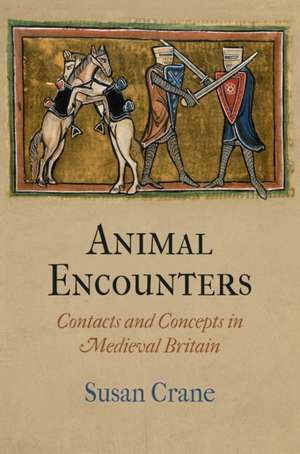
Animal Encounters
Autor Susan Craneen Limba Engleză Hardback – dec 2012
Prezentat într-un format Hardback robust, cu o legătură durabilă specifică edițiilor academice de la MT – University of Pennsylvania Press, acest volum din The Middle Ages Series este conceput să reziste deceniilor de studiu intens. Calitatea hârtiei și claritatea tipografică reflectă standardele înalte ale unei instituții care prețuiește atât rigoarea științifică, cât și experiența tactilă a lecturii. În Animal Encounters – Contacts and Concepts in Medieval Britain, descoperim o perspectivă fascinantă asupra modului în care granița dintre specii era negociată în Britania medievală. Suntem de părere că Susan Crane reușește o performanță rară: aceea de a recupera „animalul viu” din spatele metaforelor literare. Cartea nu se limitează la analiza bestiarelor, ci plonjează în realitatea cotidiană a coabitării, de la corbul Sfântului Cuthbert până la calul de război al unui cavaler deposedat. Structura narativă urmează o progresie logică, pornind de la conceptul general de coabitare și avansând spre studii de caz complexe despre taxonomie, ritualurile vânătorii nobiliare și legăturile profunde dintre șoimi și aristocrație. Complementar lucrării The Boundaries of the Human in Medieval English Literature de Dorothy Yamamoto, unde accentul cade pe construcția umanității prin opoziție cu „omul sălbatic”, volumul lui Crane explorează interpenetrarea minților și corpurilor dincolo de liniile speciilor. Dacă Yamamoto vede o instabilitate dinamică, Crane găsește o cultură comună creată prin interacțiune. Această abordare continuă preocupările autoarei pentru identitate și performanță, teme centrale și în The Performance Self sau Gender and Romance in Chaucer`s Canterbury Tales, mutând însă reflectorul de pe construcția genului și a ritualului social asupra relației ontologice cu non-umanul.
Preț: 551.20 lei
Preț vechi: 619.34 lei
-11%
Carte tipărită la comandă
Livrare economică 21 decembrie 26 - 04 ianuarie 27
Specificații
ISBN-10: 0812244583
Pagini: 282
Dimensiuni: 157 x 235 x 21 mm
Greutate: 0.56 kg
Ediția:New.
Editura: University of Pennsylvania Press
V-ar putea interesa
-
 Ovid (Routledge Revivals)J. Binns-18%Preț: 1412.81 lei1722.93 lei
-
 Gender and Romance in Chaucer's Canterbury TalesSusan CranePreț: 326.54 lei
-
 -35%Preț: 762.08 lei1169.14 lei
-
 -23%Preț: 527.95 lei685.65 lei
-
 Preț: 502.41 lei
-
 Stag of Love – The Chase in Medieval LiteratureMarcelle ThiébauxPreț: 288.39 lei
-
 Museums and MemorySusan CranePreț: 214.17 lei
-
 Broken ColumnsDavid R SlavittPreț: 198.18 lei
-
 Aristophanes, 3David R SlavittPreț: 322.41 lei
-
 The Performance SelfSusan CranePreț: 251.97 lei
-
 AusoniusDavid R SlavittPreț: 160.15 lei
-
 Covert OperationsKarma LochriePreț: 244.78 lei
-
 Beowulf and Other Old English PoemsCraig WilliamsonPreț: 252.70 lei
-
 The Song of TroilusThomas C Stillinger-11%Preț: 493.11 lei554.06 lei
-
 Written WorkSteven Justice-11%Preț: 500.79 lei562.68 lei
-
 The Penn Commentary on Piers Plowman, Volume 5Stephen A Barney-14%Preț: 750.37 lei872.53 lei
-
 The Penn Commentary on Piers Plowman, Volume 1Andrew Galloway-14%Preț: 742.61 lei863.50 lei
-
 In Light of Another's WordShirin A KhanmohamadiPreț: 450.86 lei
-
 Iambic Poetics in the Roman EmpireTom Hawkins-14%Preț: 749.56 lei871.58 lei
-
 Luke and Vergil: Imitations of Classical Greek LiteratureDennis R. MacDonald-32%Preț: 597.50 lei878.79 lei
-
 Dante's Journey to PolyphonyFrancesco Ciabattoni-23%Preț: 201.17 lei262.87 lei
-
 Diachrony and Synchrony in English Corpus LinguisticsSalvador Valera Hernández-27%Preț: 782.23 lei1071.55 lei
-
 Ancient EthicsProf. Dr. Jörg Hardy-9%Preț: 564.02 lei619.80 lei
De ce să citești această carte
Pentru pasionații de istorie medievală și etică animală, această carte oferă o înțelegere profundă a rădăcinilor umanismului european. Cititorul câștigă o perspectivă nouă asupra modului în care strămoșii noștri nu doar foloseau animalele, ci gândeau împreună cu ele. Este o lectură esențială pentru cei care doresc să depășească viziunea simplistă a animalului ca simbol, descoperind un partener activ în formarea culturii britanice.
Recenzii
Cuprins
Descriere scurtă
The grip of a certain humanism was strong in medieval Britain, as it is today: the humanism that conceives animals in diametrical opposition to humankind. Yet medieval writing was far from univocal in this regard. Latin and vernacular works abound in other ways of thinking about animals that invite the saint, the scholar, and the knight to explore how bodies and minds interpenetrate across species lines. Crane brings these other ways of thinking to light in her readings of the beast fable, the hunting treatise, the saint's life, the bestiary, and other genres. Her substantial contribution to the field of animal studies investigates how animals and people interact in culture making, how conceiving the animal is integral to conceiving the human, and how cross-species encounters transform both their animal and their human participants.