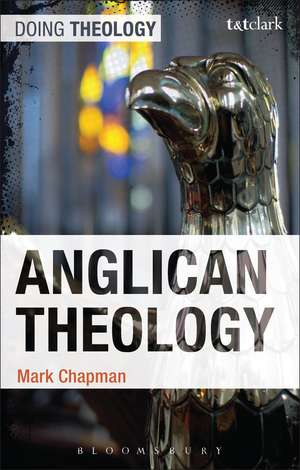
Anglican Theology: Doing Theology
Autor Mark Chapmanen Limba Engleză Paperback – 2 feb 2012


Preț: 180.12 lei
Preț vechi: 322.55 lei
-44%
Puncte Express: 270
Carte disponibilă
Livrare economică 09-23 noiembrie
Livrare prin curier în România Termenul estimat este afișat lângă disponibilitate.
Transport gratuit de la 400.00 lei Plată online sau ramburs, în funcție de opțiunile comenzii.
Retur gratuit în 14 zile Comandă securizată și suport în română.
Specificații
ISBN-13: 9780567008022
ISBN-10: 0567008029
Pagini: 288
Ilustrații: black & white illustrations
Dimensiuni: 136 x 212 x 22 mm
Greutate: 0.36 kg
Ediția:New.
Editura: Bloomsbury Publishing
Colecția T&T Clark
Seria Doing Theology
Locul publicării:London, United Kingdom
ISBN-10: 0567008029
Pagini: 288
Ilustrații: black & white illustrations
Dimensiuni: 136 x 212 x 22 mm
Greutate: 0.36 kg
Ediția:New.
Editura: Bloomsbury Publishing
Colecția T&T Clark
Seria Doing Theology
Locul publicării:London, United Kingdom
V-ar putea interesa
-
 The Weight of GloryC. S. LewisPreț: 77.29 lei
 -
 -31%Preț: 804.84 lei1169.53 lei
 -
 Open to Judgement (new edition)Rowan WilliamsPreț: 79.80 lei
 -
 Ready to Share One BreadSandra MillarPreț: 105.78 lei
 -
 Preț: 79.11 lei
 -
 Preț: 73.46 lei
 -
 My Journey So FarAndrew WhitePreț: 116.59 lei
 -
 Episcopal Questions, Episcopal AnswersC K RobertsonPreț: 94.73 lei
 -
 The Episcopal HandbookChurch Publishing IncorporatedPreț: 156.98 lei
 -
 Saints, Sacrilege and Sedition: Religion and Conflict in the Tudor ReformationsProfessor Eamon Duffy-37%Preț: 121.88 lei194.68 lei
 -
 Our ChurchRoger Scruton-26%Preț: 62.46 lei84.65 lei
Cuprins
Chapter One: The Identity of Anglicanism
Chapter Two: Norms and Methods in Anglican Theology I
Chapter Three: Norms and Methods in Anglican Theology II
Chapter Four: Liturgical and Sacramental Theology
Chapter Five: Moral Theology
Chapter Six: Ecclesiology
Conclusion: The future of Anglicanism
Chapter Two: Norms and Methods in Anglican Theology I
Chapter Three: Norms and Methods in Anglican Theology II
Chapter Four: Liturgical and Sacramental Theology
Chapter Five: Moral Theology
Chapter Six: Ecclesiology
Conclusion: The future of Anglicanism
Recenzii
Chapman declares that "conflict is the normal state of Anglican theology throughout history". He illustrates this from the time of the Henrican reformation to the present day. He provides a history of Anglican theology and employs the complementary skills of the historian and the theologian exceptionally well. It is a fascinating story, very well told. Chapman describes Anglicanism's complexity as both infuriating and exciting. So it is.
This book offers an unusual perspective on Anglican identity from the Reformation to the nineteenth century, with some reflections on the state of the Anglican communion today... Illuminates some key moments in the making of Anglican theology... A very useful study text.
The wider strength of the work is that it challenges readers (Anglicans, Ordinands, and none of the above) to a kind of 'resourcement' within Anglican thought.
A fascinating story, very well told. Chapman describes Anglicanism's complexity as both infuriating and exciting. So it is.
Is there such a thing as Anglican Theology? This is what Chapman explores in this rigorous but stimulating book. In a well presented but compact review, he shows how a plurality of theologies - especially of the church and authority - have always characterised Anglicanism.He begins with Henry VIII, but he could as well have begun with Bede and used the same rigorous method. He quotes primary as well as secondary sources and reveals step by step the lack of historical perspective in those who claim that their understanding is the right - or indeed the only - Anglican position. Since a theology of development is always potentially threatening, this timely study is important, not just for the Church of England but for the whole Anglican Communion.
Listed in the 'new titles just published' section of the Church Times.
Mentioned in an article in the Church of England Newspaper.
This book offers an unusual perspective on Anglican identity from the Reformation to the nineteenth century, with some reflections on the state of the Anglican communion today... Illuminates some key moments in the making of Anglican theology... A very useful study text.
The wider strength of the work is that it challenges readers (Anglicans, Ordinands, and none of the above) to a kind of 'resourcement' within Anglican thought.
A fascinating story, very well told. Chapman describes Anglicanism's complexity as both infuriating and exciting. So it is.
Is there such a thing as Anglican Theology? This is what Chapman explores in this rigorous but stimulating book. In a well presented but compact review, he shows how a plurality of theologies - especially of the church and authority - have always characterised Anglicanism.He begins with Henry VIII, but he could as well have begun with Bede and used the same rigorous method. He quotes primary as well as secondary sources and reveals step by step the lack of historical perspective in those who claim that their understanding is the right - or indeed the only - Anglican position. Since a theology of development is always potentially threatening, this timely study is important, not just for the Church of England but for the whole Anglican Communion.
Listed in the 'new titles just published' section of the Church Times.
Mentioned in an article in the Church of England Newspaper.