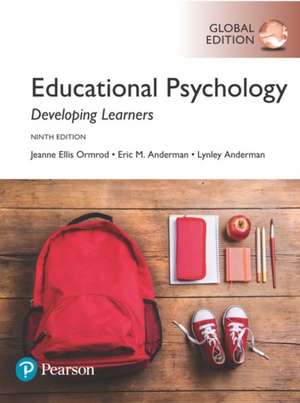
Anderman, E: Educational Psychology: Developing Learners, Gl
Autor Lynley Andermanen Limba Engleză Paperback – 10 noi 2016
Descoperim în această a noua ediție a Anderman, E: Educational Psychology: Developing Learners, Gl un instrument de lucru axat pe aplicabilitatea imediată, unde exercițiile „Experiencing Firsthand” joacă un rol central. Acestea permit studenților să își analizeze propriile procese cognitive înainte de a transpune teoria în tehnici de predare. Apreciem modul în care Lynley Anderman ancorează fiecare capitol într-un studiu de caz concret, facilitând tranziția de la conceptele abstracte de neuropsihologie la realitatea sălii de clasă.
Structura volumului este riguros organizată în trei părți: fundamentele dezvoltării și diversității, mecanismele învățării și motivației, și, în final, strategiile practice de evaluare și gestionare a mediului de învățare. Această progresie logică reflectă curriculumul modern de formare a profesorilor, punând un accent sporit pe diversitatea culturală și impactul tehnologiei. Ediția de față extinde cadrul propus de Psychology and the Teacher de Professor Dennis Child cu date noi din neuropsihologie și o analiză detaliată a sistemelor bioecologice ale lui Bronfenbrenner. De asemenea, spre deosebire de abordarea modulară din Educational Psychology, Global Edition de Anita Woolfolk, textul de față menține o focalizare constantă pe tendințele de dezvoltare specifice fiecărei grupe de vârstă, de la grădiniță la liceu.
Remarcăm introducerea unor teme actuale, precum „mindsets” și strategiile metacognitive necesare în era digitală, care completează revizuirea capitolului dedicat teoriilor social-cognitive. În plus, includerea secțiunilor de pregătire pentru licențiere la finalul fiecărui capitol transformă acest titlu publicat de Pearson Education într-o resursă completă pentru viitorii pedagogi.
Preț: 606.65 lei
Preț vechi: 697.30 lei
-13%
Carte disponibilă
Livrare economică 29 octombrie-12 noiembrie
Livrare express 14-20 octombrie pentru 72.31 lei
Specificații
ISBN-10: 1292170700
Pagini: 776
Dimensiuni: 280 x 221 x 30 mm
Greutate: 1.59 kg
Ediția:9 ed
Editura: Pearson Education
V-ar putea interesa
-
 -37%Preț: 383.95 lei608.32 lei
 -
 Statistical Analysis with R For DummiesJ SchmullerPreț: 225.46 lei
 -
 Tourism: Principles and PracticeAlan Fyall-9%Preț: 568.21 lei624.41 lei
 -
 Data Analytics For BeginnersVictor Finch-20%Preț: 97.17 lei121.47 lei
 -
 The Mammoth Book of Celtic Myths and LegendsPeter Ellis-25%Preț: 81.88 lei109.45 lei
 -
 Advanced Coatings for Corrosion ProtectionWolfram FürbethPreț: 368.56 lei
De ce să citești această carte
Recomandăm această carte studenților de la facultățile de psihologie și științele educației care doresc o punte solidă între teorie și practică. Prin tabelele de strategii diferențiate pe vârste și exercițiile de autoreflecție, cititorul câștigă nu doar cunoștințe academice, ci și competențe aplicate pentru gestionarea diversității în clasă și pregătirea eficientă pentru examenele de titularizare sau licențiere.
Cuprins
- Chapter 1 Teaching and Educational Psychology
- Part I Development and Diversity
- Chapter 2 Cognitive and Linguistic Development
- Chapter 3 Personal and Social Development
- Chapter 4 Group Differences
- Chapter 5 Individual Differences and Special Educational Needs
- Part II Learning and Motivation
- Chapter 6 Learning, Cognition, and Memory
- Chapter 7 Complex Cognitive Processes
- Chapter 8 Learning and Cognition in Context
- Chapter 9 Behaviorist Views of Learning
- Chapter 10 Social Cognitive Views of Learning
- Chapter 11 Motivation and Affect
- Part III Classroom Strategies
- Chapter 12 Instructional Strategies
- Chapter 13 Creating a Productive Learning Environment
- Chapter 14 Classroom Assessment Strategies
- Chapter 15 Summarizing Students' Achievements and Abilities
- Appendices
- Appendix A: Describing Associations with Correlation Coefficients A-1
- Appendix B: Determining Reliability and Predictive Validity B-1
- Appendix C: Matching Book and MyEducationLab Content to the Praxis® Principles of Learning and Teaching Tests C-1