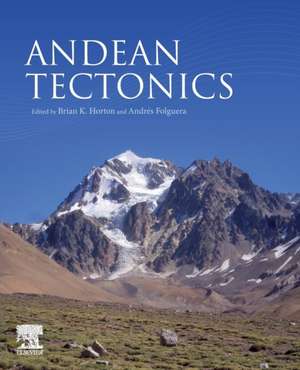
Andean Tectonics
Editat de Brian K. Horton, Andrés Folgueraen Limba Engleză Paperback – 18 iun 2019
Găsim în această carte o abordare tehnică riguroasă a celui mai important exemplu global de orogeneză prin subducție, structurată pentru a servi drept resursă fundamentală în mediul academic și industrial. Andean Tectonics se deschide cu analize aplicate asupra structurii seismice utilizând date de gravitație prin satelit și studii de caz privind eroziunea prin subducție în marginea centrală chiliană. Această componentă practică este susținută de utilizarea unor tehnici avansate, precum dubla datare a zirconului detritic pentru a descifra mecanismele de progradare în bazinele din Columbia sau utilizarea geodeziei prin satelit pentru a constrânge evoluția tectonică cenozoică.
Volumul, publicat sub egida ELSEVIER SCIENCE, este organizat meticulos pentru a oferi o viziune integrată asupra Anzilor de Nord, Centrali și de Sud, zone care istoric au fost studiate separat. Progresia capitolelor ghidează cititorul de la procesele geofizice de scară largă către specificul regional al cordilierelor și bazinelor foreland. Merită menționat că lucrarea evaluează interacțiunile complexe dintre deformare și magmatism pe parcursul ultimelor 300 de milioane de ani.
Andean Tectonics completează perspectiva oferită de The Evolution of the Chilean-Argentinean Andes, adăugând o acoperire geografică mult mai vastă, care include segmentele nordice din Ecuador și Columbia, și o integrare mai profundă a datelor de geocronologie și izotopi. În timp ce titluri precum Andean Structural Styles se concentrează pe explorarea resurselor de hidrocarburi prin seismografie, lucrarea editată de Brian K. Horton și Andrés Folguera oferă fundamentul teoretic și empiric al evoluției litosferice necesar pentru orice cercetare geologică avansată în regiune.
Preț: 999.23 lei
Preț vechi: 1420.47 lei
-30%
Carte tipărită la comandă
Livrare economică 21 noiembrie-05 decembrie
Specificații
ISBN-10: 0128160098
Pagini: 743
Dimensiuni: 191 x 235 x 44 mm
Greutate: 1.26 kg
Editura: ELSEVIER SCIENCE
V-ar putea interesa
-
 Plate Tectonics: A Very Short IntroductionPeter Molnar-20%Preț: 56.19 lei70.53 lei
 -
 -13%Preț: 133.12 lei153.46 lei
 -
 Tectonic GeodynamicsClaudio Faccenna-16%Preț: 770.92 lei917.76 lei
 -
 Roadside Geology of OregonMarli B MillerPreț: 167.33 lei
 -
 Tectonics of Sedimentary BasinsCathy Busby-23%Preț: 844.54 lei1096.81 lei
 -
 Sedimentary GeologyDonald Prothero-39%Preț: 551.43 lei908.07 lei
 -
 Hot Springs of the AndesYanira K. WisePreț: 134.33 lei
 -
 -21%Preț: 73.67 lei93.48 lei
 -
 Preț: 273.77 lei
 -
 MountainsGraham Park-23%Preț: 476.65 lei619.02 lei
 -
 Preț: 200.37 lei
 -
 Plate TectonicsWolfgang FrischPreț: 498.57 lei
 -
 Neogenic Evolution of the Mediterranean RegionEnzo Mantovani-18%Preț: 1004.18 lei1224.62 lei
 -
 Geology of the Nepal HimalayaMegh Raj Dhital-18%Preț: 652.90 lei796.23 lei
 -
 Ancient Landscapes of Western North AmericaRonald C. BlakeyPreț: 241.97 lei
 -
 The Evolution of the Chilean-Argentinean AndesAndrés Folguera-18%Preț: 983.95 lei1199.94 lei
 -
 Arc-Continent CollisionDennis Brown-18%Preț: 1202.19 lei1466.08 lei
 -
 -18%Preț: 976.51 lei1190.86 lei
Public țintă
Primary: geologists, geochemists, geophysicists, exploration geologistsSecondary: hydrocarbon and mining industries
De ce să citești această carte
Recomandăm acest volum geologilor și geofizicienilor care necesită o înțelegere sistemică a orogenezei de tip andin. Cititorul câștigă acces la studii recente ce integrează magmatismul, sedimentologia și tectonica pe o scară temporală de 300 de milioane de ani. Este o resursă esențială pentru specialiștii din industriile extractive și cercetătorii care studiază marginile continentale active și evoluția bazinelor sedimentare complexe.
Descriere scurtă
Andean Tectonics is a critical resource for researchers interested in the causes and consequences of Andean-type orogenesis and the long-term evolution of fold-thrust belts, magmatic arcs, and forearc and foreland basins.
- Evaluates the history of Andean mountain building over the past 300 million years
- Integrates recent studies and new perspectives on the complementary records of deformation, magmatism, and sedimentary basin evolution and their interactions in time and space
- Provides insight into the development of the northern, central, and southern Andes, which have typically been considered in isolation
Cuprins
1. Seismic structure along the South American subduction zone using satellite gravity data
2. Control of subduction erosion and sediment accretion processes on the trench curvature of the central Chilean margin
3. Measuring dynamic topography in South America
Northern Andes
4. Cenozoic tectonic evolution of the North Andes with constraints from volcanic ages, seismic reflection, and satellite geodesy
5. Thermochronological constraints on Cenozoic exhumation along the southern Caribbean: The Santa Marta range, northern Colombia
6. Discriminating mechanisms for coarse clastic progradation in the Colombian foreland basin using detrital zircon double-dating
7. Latest Triassic to Early Cretaceous tectonics of the Northern Andes: Geochronology, geochemistry, isotopic tracing and thermochronology
8. Late Cretaceous to Miocene stratigraphy and provenance of the coastal forearc and Western Cordillera of Ecuador: Evidence for accretion of a single oceanic plateau fragment
9. Provenance and geochronological insights into Late Cretaceous-Cenozoic foreland basin development in the Subandean Zone and Oriente Basin of Ecuador
10. Sediment provenance variations during contrasting Mesozoic-early Cenozoic tectonic regimes of the northern Peruvian Andes and Santiago-Marañón foreland basin
Central Andes
11. Western thrusting and uplift in northern Central Andes (western Peruvian margin)
12. Structural controls along the Peruvian Subandes
13. Provenance and recycling of detrital zircons from Cenozoic Altiplano strata and the crustal evolution of western South America from combined U-Pb and Lu-Hf isotopic analysis
14. Structure and tectonic evolution of the Interandean and Subandean fold and thrust belts of Bolivia
15. Structural and thermochronologic constraints on kinematics and timing of inversion of the Salta Rift in the Tonco-Amblayo sector of the Andean retroarc fold-thrust belt, northwestern Argentina
16. Tectonic evolution of the western "Pampean" flat segment (28º-30ºS)
17. Thermal and lithospheric structure of the Chilean-Pampean flat-slab from gravity and magnetic data
18. Fragments of the late Paleozoic accretionary complex in central and northern Chile: Similarities and differences as a key to decipher the complexity of the late Paleozoic to Triassic early Andean events
19. 40Ar/39Ar constraints on the tectonic evolution of the Late Paleozoic and Early Mesozoic accretionary complex of coastal Central Chile
Southern Andes
20. Crustal structure in the southern Andes, adjacent foreland and Atlantic passive margin delineated by satellite gravimetric models
21. Cenozoic arc-related magmatism in the Southern Central and North Patagonian Andes
22. Tectonic controls on the building of the North Patagonian fold-thrust belt (~ 43°S)
23. Along-strike segmentation of the Farallon-Phoenix mid-ocean ridge: Insights from the Paleogene tectonic evolution of the Patagonian Andes between 45° and 46°30’S
24. Structure and tectonic evolution of the South Patagonian fold and thrust belt: coupling between subduction dynamics, climate and tectonic deformation