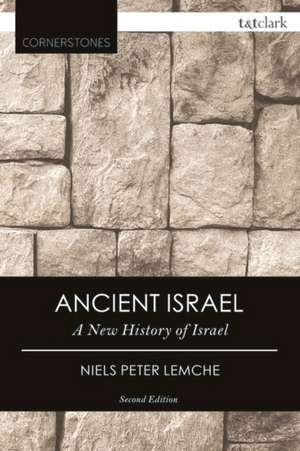
Ancient Israel: A New History of Israel: T&T Clark Cornerstones
Autor Niels Peter Lemcheen Limba Engleză Paperback – 19 noi 2015
When this provocative text was first published, Lemche presented a new model of how we should understand Israelite society, its history and its religion. Lemche argues first that 'Israel' was the result of a social development among the Canaanite population of Palestine in the second half of the second millennium BCE. This implies that Israelite religion was originally 'Canaanite' and that what we think of as typically 'Jewish' religion did not arise until c. 500 BCE.
Lemche's radical reassessment of Israelite history is based on the conviction that the Old Testament contains hardly any historical sources older than the seventh century BCE. The early history of Israel must therefore be reconstructed from archaeological results and non-biblical evidence, not from the Old Testament. In this new edition Lemche provides an extensive new introduction and bibliography, considering how the field has developed since the work first appeared.
Din seria T&T Clark Cornerstones
- 21%
 Preț: 183.93 lei
 - 17%
 Preț: 188.02 lei
 - 20%
 Preț: 186.82 lei
 - 15%
 Preț: 270.00 lei
 - 25%
 Preț: 187.22 lei
 - 28%
 Preț: 186.32 lei
 - 23%
 Preț: 253.92 lei
 - 18%
 Preț: 252.15 lei
 - 26%
 Preț: 184.39 lei
 - 18%
 Preț: 183.04 lei
 - 19%
 Preț: 191.29 lei
 - 18%
 Preț: 184.64 lei
 - 17%
 Preț: 187.22 lei
 - 20%
 Preț: 190.08 lei
 - 11%
 Preț: 378.45 lei
 -
 Preț: 176.50 lei
 - 27%
 Preț: 176.88 lei
 - 17%
 Preț: 245.96 lei
Preț: 267.62 lei
Carte tipărită la comandă
Livrare economică 06-20 iunie
Specificații
ISBN-10: 0567662780
Pagini: 296
Dimensiuni: 156 x 234 x 18 mm
Greutate: 0.44 kg
Ediția:Revised
Editura: Bloomsbury Publishing
Colecția T&T Clark
Seria T&T Clark Cornerstones
Locul publicării:London, United Kingdom
V-ar putea interesa
-
 -33%Preț: 521.12 lei782.97 lei
 -
 Preț: 192.27 lei
 -
 The Case Against Israel's EnemiesAlan DershowitzPreț: 90.39 lei
 -
 Love In A Torn LandJean Sasson-19%Preț: 50.17 lei62.24 lei
 -
 The Assassins' GateGeorge PackerPreț: 103.95 lei
 -
 Journey from the Land of NoRoya HakakianPreț: 115.93 lei
 -
 Righteous VictimsBenny MorrisPreț: 149.41 lei
 -
 CairoMax RodenbeckPreț: 104.77 lei
 -
 -16%Preț: 249.21 lei297.94 lei
 -
 Persian MirrorsElaine SciolinoPreț: 154.38 lei
 -
 -34%Preț: 87.15 lei131.55 lei
 -
 Barefoot SoldierJohnson Beharry, VC-27%Preț: 70.20 lei96.38 lei
 -
 Preț: 191.03 lei
 -
 The Cypress TreeKamin Mohammadi-28%Preț: 64.17 lei88.87 lei
 -
 Preț: 130.55 lei
 -
 Cyprus: The Search for a SolutionDavid Hannay-27%Preț: 360.28 lei494.09 lei
 -
 The Ethnic Cleansing of PalestineIlan PappéPreț: 89.88 lei
Cuprins
Preface
Table of Chronology
Reflective Introduction
1. Geography, Demography, Economy
2. Text and History
3. The Pre-Monarchical Period
4. The Period of Monarchy
5. The Exile and the Post-Exilic Period
6. Israelite Religion
A Guide to Relevant Literature
Index of Biblical References
Index of Authors
Recenzii
[A]n indispensable tool for anyone teaching and learning biblical history . provides a great starting point to navigate through the way the field has evolved . In all, Grabbe provides exactly what he promised to offer and does so better than anyone before him. Ancient Israel shall remain and continue to serve as an essential resource for students, teachers, and researchers of biblical history and archaeology.
Should serve as a great example of scholarly discussion, a stimulus to further methodological reflection, and a model to follow in clarity of expression.
When it first appeared, Lemche's Ancient Israel was the first of a new generation of Iron age histories, with its insistence on a sociological rather than theological approach, its rejection of the 'rationalistic biblical paraphrases', (as Lemche felicitously termed what had gone before). If some features of this new approach were already being anticipated, Lemche provided the first synthesis, laying the foundation for the current agenda. In this new edition, some of his own modifications and developments of that agenda are also reviewed. It remains an excellent foundation for historical research into the Hebrew Bible.
When it was first published, this best-selling introductory textbook on the history of ancient Israel stood at the cusp of the departure from a history based on a rational paraphrase of the Bible and the construction of the critical, archaeologically based history of Palestine which is dominant today. Rooted in a social science-based perspective of Palestine's ancient past, Lemche based himself in the rapidly changing perspectives of Israel and Judah's histories of the decade preceding his textbook and set a firm foundation for the critical histories of the present.