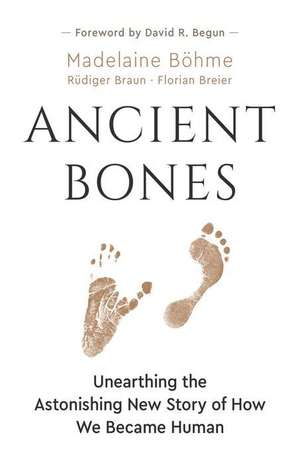
Ancient Bones
Autor Madelaine Böhme, Rüdiger Braun, Florian Breier Traducere de Jane Billinghursten Limba Engleză Paperback – 30 aug 2022
Relevanța lucrării Ancient Bones pentru studiile de antropologie fizică și paleoantropologie este fundamentală, oferind o perspectivă critică asupra momentului zero al bipedalismului. Suntem de părere că această lucrare reprezintă mai mult decât o cronică a unei săpături arheologice; este o recalibrare științifică necesară pentru orice curriculum modern de evoluție umană. Autorii, conduși de Madelaine Böhme, documentează descoperirea speciei Danuvius guggenmosi, ale cărei adaptări scheletice sugerează că un strămoș comun al omului și al maimuțelor mari a trăit în Europa, nu în Africa, acum 12 milioane de ani. Descoperim aici o metodologie riguroasă care îmbină munca de teren din Bavaria cu analiza climatică, explicând cum schimbările de mediu au forțat adaptări evolutive radicale. Cartea este structurată pentru a ghida cititorul prin depozitele prăfuite ale muzeelor și până la siturile de excavare, fiind susținută vizual de hărți, diagrame și un insert color de opt pagini. Comparabil cu What the Bones Tell Us de Jeffrey H. Schwartz în rigurozitatea analizei fragmentelor osoase, titlul de față aduce un plus de actualitate prin datele recente care contestă ipoteza „Out of Africa” pentru primii hominizi. Dacă Written in Bones de Paul Bahn se concentrează pe interpretarea rămășițelor umane în context arheologic larg, Ancient Bones se specializează pe mecanismele paleobiologice și climatice care au modelat preistoria timpurie, oferind o claritate rar întâlnită în literatura academică tradusă din limba germană.
Preț: 108.31 lei
Carte disponibilă
Livrare economică 09-23 noiembrie
Livrare express 23-29 octombrie pentru 29.67 lei
Specificații
ISBN-10: 1778400310
Pagini: 376
Ilustrații: 8-page color insert, maps and diagrams throughout
Dimensiuni: 138 x 214 x 22 mm
Greutate: 0.43 kg
Editura: Grey Stone Books
V-ar putea interesa
-
 The Secret Lives of DinosaursDean R. LomaxPreț: 250.02 lei
 -
 -16%Preț: 81.07 lei96.61 lei
 -
 King TyrantMark P. WittonPreț: 276.95 lei
 -
 Dig!Ruth Hatfield-16%Preț: 92.35 lei109.98 lei
 -
 Ends of the EarthNeil ShubinPreț: 158.97 lei
 -
 When the Earth Was GreenRiley BlackPreț: 159.94 lei
 -
 Vertebrate PalaeontologyMichael J. Benton-19%Preț: 463.49 lei572.21 lei
 -
 The Last NeanderthalLudovic SlimakPreț: 169.14 lei
 -
 A Short History of Nearly Everything 2.0Bill BrysonPreț: 142.00 lei
 -
 FlintJoanne BournePreț: 78.51 lei
 -
 Walking the Bones of BritainChristopher Somerville-17%Preț: 66.61 lei80.46 lei
 -
 Earth's Detectives: All About MineralsRebecca StormPreț: 70.13 lei
 -
 BonesJules HowardPreț: 82.03 lei
 -
 In Search of GemsKenneth StevenPreț: 62.26 lei
 -
 The Fossil Keeper's TreasureAmy AtwaterPreț: 126.13 lei
 -
 My Grandparents Were DinosaursAnne BrusattePreț: 57.51 lei
 -
 The OceanSturla HenriksenPreț: 194.28 lei
 -
 DinosaurusRhys CharlesPreț: 110.97 lei
 -
 Crystals, Rocks, and GemstonesKelsey OseidPreț: 110.53 lei
 -
 Extreme Human AntiquityMichael CremoPreț: 228.84 lei
De ce să citești această carte
Subliniem utilitatea acestei cărți pentru studenții la sociologie și antropologie, dar și pentru pasionații de paleontologie care doresc să înțeleagă noile paradigme evolutive. Cititorul câștigă o perspectivă actualizată asupra originilor umanității, susținută de dovezi materiale incontestabile. Este o resursă esențială pentru a înțelege cum descoperirile recente din Europa rescriu manualele de istorie naturală, oferind argumente solide împotriva teoriilor liniare ale evoluției.
Despre autor
Madelaine Böhme este un renumit paleontolog și paleoclimatolog german, profesor la Universitatea din Tübingen. Cercetările sale se concentrează pe interacțiunea dintre schimbările climatice și evoluția vertebratelor, fiind recunoscută la nivel mondial pentru conducerea echipei care a descoperit hominidul Danuvius guggenmosi. Alături de jurnaliștii științifici Rüdiger Braun și Florian Breier, ea reușește să transforme datele tehnice în narațiuni accesibile, menținând totodată standardele academice impuse de publicațiile de prestigiu precum Nature.
Notă biografică
RÜDIGER BRAUN is a journalist who translates cutting-edge science into gripping stories to affect societal change.
FLORIAN BREIER is a journalist, filmmaker, and writer for various television networks.
DAVID R. BEGUN is a professor of anthropology at the University of Toronto and co-author of the 2019 study that broke the story of the newly discovered bones to the world.