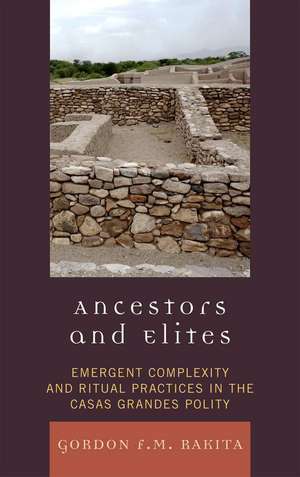
Ancestors and Elites: Emergent Complexity and Ritual Practices in the Casas Grandes Polity: Archaeology of Religion
Autor Gordon F. M. Rakitaen Limba Engleză Hardback – 16 apr 2009
Preț: 462.22 lei
Preț vechi: 699.20 lei
-34%
Puncte Express: 693
Carte tipărită la comandă
Livrare economică 08-22 iunie
Specificații
ISBN-13: 9780759111288
ISBN-10: 0759111286
Pagini: 207
Dimensiuni: 160 x 241 x 19 mm
Greutate: 0.47 kg
Editura: Bloomsbury Publishing
Colecția AltaMira Press
Seria Archaeology of Religion
Locul publicării:New York, United States
ISBN-10: 0759111286
Pagini: 207
Dimensiuni: 160 x 241 x 19 mm
Greutate: 0.47 kg
Editura: Bloomsbury Publishing
Colecția AltaMira Press
Seria Archaeology of Religion
Locul publicării:New York, United States
V-ar putea interesa
-
 Archaeology: A Very Short IntroductionPaul Bahn-21%Preț: 53.28 lei67.68 lei
 -
 The Art and Archaeology of PashashTerence GriederPreț: 289.94 lei
 -
 Heritage and GlobalisationSophia Labadi-15%Preț: 419.81 lei493.89 lei
 -
 Museum Objects: Experiencing the Properties of ThingsSandra H. Dudley-15%Preț: 470.65 lei553.71 lei
 -
 Preț: 445.09 lei
 -
 -15%Preț: 448.74 lei527.93 lei
 -
 Heritage: Critical ApproachesRodney HarrisonPreț: 353.19 lei
 -
 The Heritage of WarMartin Gegner-15%Preț: 422.47 lei497.02 lei
 -
 Preț: 451.31 lei
 -
 Preț: 257.18 lei
 -
 Preț: 385.99 lei
 -
 Archaeological Theory TodayIan HodderPreț: 271.64 lei
 -
 Handbook of Landscape ArchaeologyBruno David-8%Preț: 438.17 lei476.28 lei
Cuprins
Chapter 1. Introduction
Chapter 2. Emergent Complexity
Chapter 3. Ritual and Emergent Complexity
Chapter 4. Ritual Practices at Paquimé
Chapter 5. Interpretations and Conclusions
Chapter 2. Emergent Complexity
Chapter 3. Ritual and Emergent Complexity
Chapter 4. Ritual Practices at Paquimé
Chapter 5. Interpretations and Conclusions
Recenzii
Gordon Rakita gives us an important addition to the literature dealing with Chihuahuan prehistory. Starting from a cultural evolutionary position, he uses anthropological theory and specific case studies to examine the role of ritual behavior in the development of the Casas Grandes region, focusing on the site of Paquimé and using the eight volumes of the Joint Casas Grandes Expedition as his primary data base. Rakita argues that ceremonialism and ritual behavior are separable strands that contributed both to communal solidarity and to the emergence of the authority and power needed by decision-making structures in aggregated communities. He thus firmly places ritual behavior on a par with economic and other factors in the cauldron of emerging complexity.
The development of social complexity at the site of Paquimé, or Casas Grandes, has long intrigued archaeologists working in northwestern Chihuahua, Mexico and the American Southwest. Dr. Rakita's analysis of the role of ritual and religious organization in the emergence and sustainability of social inequality at Casas Grandes represents an innovative approach to this topic. Students and scholars alike, interested in the evolution of ritual behavior and its relationship to institutional inequality in aggregating communities, will find this book to be a valuable resource.
One of the most important, and interesting, topics in anthropology is how religion and its associated ritual practices facilitate but also constrain emerging social hierarchies and newly empowered leaders. Rakita expertly studies these topics, thereby expanding our understanding of the relationship between religion and social hierarchies in general, while also contributing to our understanding of Southwestern prehistory.
The development of social complexity at the site of Paquimé, or Casas Grandes, has long intrigued archaeologists working in northwestern Chihuahua, Mexico and the American Southwest. Dr. Rakita's analysis of the role of ritual and religious organization in the emergence and sustainability of social inequality at Casas Grandes represents an innovative approach to this topic. Students and scholars alike, interested in the evolution of ritual behavior and its relationship to institutional inequality in aggregating communities, will find this book to be a valuable resource.
One of the most important, and interesting, topics in anthropology is how religion and its associated ritual practices facilitate but also constrain emerging social hierarchies and newly empowered leaders. Rakita expertly studies these topics, thereby expanding our understanding of the relationship between religion and social hierarchies in general, while also contributing to our understanding of Southwestern prehistory.