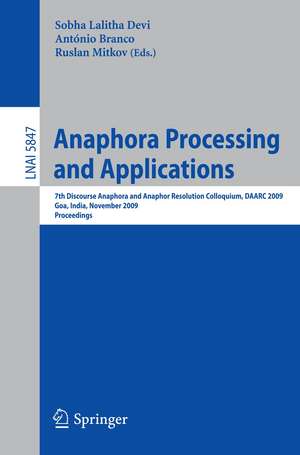
Anaphora Processing and Applications
Editat de Lalitha Devi Sobha, António Branco, Ruslan Mitkoven Limba Engleză Paperback – 26 oct 2009
Preț: 326.72 lei
Preț vechi: 408.39 lei
-20%
Puncte Express: 490
Carte tipărită la comandă
Livrare economică 21 noiembrie-05 decembrie
Livrare prin curier în România Termenul estimat este afișat lângă disponibilitate.
Transport gratuit de la 400.00 lei Plată online sau ramburs, în funcție de opțiunile comenzii.
Retur gratuit în 14 zile Comandă securizată și suport în română.
Specificații
ISBN-13: 9783642049743
ISBN-10: 3642049745
Pagini: 144
Ilustrații: X, 131 p.
Dimensiuni: 155 x 235 x 9 mm
Greutate: 0.23 kg
Ediția:2009
Editura: Springer
Locul publicării:Berlin, Heidelberg, Germany
ISBN-10: 3642049745
Pagini: 144
Ilustrații: X, 131 p.
Dimensiuni: 155 x 235 x 9 mm
Greutate: 0.23 kg
Ediția:2009
Editura: Springer
Locul publicării:Berlin, Heidelberg, Germany
V-ar putea interesa
-
 Anaphora ResolutionRuslan Mitkov-18%Preț: 1358.20 lei1656.34 lei
 -
 Linguistic Issues in Machine TranslationFrank Van Eydne-33%Preț: 899.33 lei1337.75 lei
 -
 Logics and FalsificationsAndreas KapsnerPreț: 404.57 lei
 -
 Advances in Artificial IntelligenceMarina Sokolova-20%Preț: 341.23 lei426.53 lei
 -
 Natural Language Processing and Information SystemsElisabeth Métais-20%Preț: 321.56 lei401.94 lei
 -
 -20%Preț: 349.32 lei436.65 lei
 -
 Controlled Natural LanguageBrian Davis-20%Preț: 330.36 lei412.94 lei
 -
 Hybrid Approaches to Machine TranslationMarta R. Costa-Jussà-20%Preț: 821.51 lei1026.88 lei
 -
 Natural Language Understanding in a Semantic Web ContextCaroline Barrière-20%Preț: 467.10 lei583.87 lei
 -
 Controlled Natural LanguageBrian Davis-20%Preț: 269.62 lei337.03 lei
 -
 -20%Preț: 341.01 lei426.26 lei
 -
 -20%Preț: 321.36 lei401.70 lei
 -
 -20%Preț: 329.35 lei411.69 lei
 -
 Sanskrit Computational LinguisticsAmba Kulkarni-20%Preț: 327.99 lei409.99 lei
 -
 -20%Preț: 314.86 lei393.57 lei
 -
 -20%Preț: 316.28 lei395.35 lei
 -
 Statistical Language and Speech ProcessingAdrian-Horia Dediu-20%Preț: 336.31 lei420.38 lei
 -
 Multilingual Information RetrievalCarol Peters-20%Preț: 331.63 lei414.54 lei
 -
 -20%Preț: 359.97 lei449.97 lei
 -
 Logical Aspects of Computational LinguisticsNicholas Asher-20%Preț: 330.14 lei412.68 lei
 -
 Building and Using Comparable CorporaSerge Sharoff-20%Preț: 645.86 lei807.34 lei
 -
 Developments in Language TheorySre¿ko Brlek-20%Preț: 328.72 lei410.89 lei
 -
 The WordNet in Indian LanguagesNiladri Sekhar Dash-20%Preț: 684.10 lei855.13 lei
 -
 -20%Preț: 1267.39 lei1584.24 lei
Public țintă
ResearchCuprins
Resolution Methodology.- Why Would a Robot Make Use of Pronouns? An Evolutionary Investigation of the Emergence of Pronominal Anaphora.- Automatic Recognition of the Function of Singular Neuter Pronouns in Texts and Spoken Data.- A Deeper Look into Features for Coreference Resolution.- Computational Applications.- Coreference Resolution on Blogs and Commented News.- Identification of Similar Documents Using Coherent Chunks.- Language Analysis.- Binding without Identity: Towards a Unified Semantics for Bound and Exempt Anaphors.- The Doubly Marked Reflexive in Chinese.- Human Processing.- Definiteness Marking Shows Late Effects during Discourse Processing: Evidence from ERPs.- Pronoun Resolution to Commanders and Recessors: A View from Event-Related Brain Potentials.- Effects of Anaphoric Dependencies and Semantic Representations on Pronoun Interpretation.
Textul de pe ultima copertă
This book constitutes the refereed proceedings of the 7th Discourse Anaphora and Anaphor Resolution Colloquium, DAARC 2009, held in Goa, India, in November 2009.
The 10 revised full papers presented were carefully reviewed and selected from 37 initial submissions. The papers are organized in topical sections on resolution methodology, computational applications, language analysis, and human processing.
The 10 revised full papers presented were carefully reviewed and selected from 37 initial submissions. The papers are organized in topical sections on resolution methodology, computational applications, language analysis, and human processing.