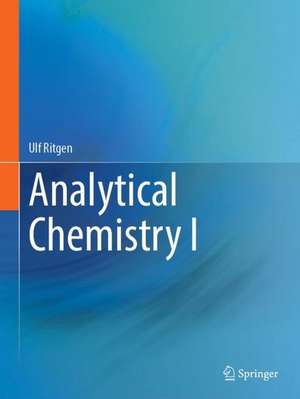
Analytical Chemistry I
Autor Ulf Ritgenen Limba Engleză Paperback – 22 apr 2023
Considerăm că apariția Analytical Chemistry I de Ulf Ritgen umple un gol metodologic important, oferind un format de „workbook” (caiet de lucru) care lipsește adesea în literatura academică rigidă. Această primă ediție în limba engleză din 2023 este concepută special pentru a însoți studiul individual, servind drept ghid practic pentru celebrul manual al lui Harris, Textbook of Quantitative Analysis. Spre deosebire de manualele clasice care se concentrează pe teorie, lucrarea de față prioritizează aplicabilitatea, fiind testată riguros în cadrul cursurilor de învățământ la distanță pentru a asigura succesul la examenele de modul. Structura cărții urmărește o progresie logică, de la conceptele de bază ale eșantionării și asigurării calității, la analiza dimensională (titrări acido-bazice, complexometrie, gravimetrie) și metodele instrumentale moderne. Secțiunile dedicate cromatografiei (LC, GC) și spectroscopiei (UV/VIS, Raman, IR, precum și spectroscopie atomică) sunt punctate de exemple selectate care fac legătura între cunoștințele de chimie generală și tehnicile analitice avansate. Reținem că autorul menține un stil accesibil, caracteristic și altor lucrări ale sale, precum Allgemeine Chemie für Dummies sau Chemisches Rechnen und Stöchiometrie für Dummies, unde complexitatea este descompusă în pași logici. În comparație cu Chemical Analysis de Francis Rouessac, care oferă o privire de ansamblu asupra instrumentației moderne, volumul lui Ulf Ritgen are o abordare mult mai aplicată și orientată către exercițiu, fiind un instrument de lucru activ, nu doar o sursă de informare. De asemenea, dacă Analytical Chemistry for Technicians de John Kenkel se concentrează pe aspectele practice de laborator pentru tehnicieni, Analytical Chemistry I echilibrează rigoarea teoretică universitară cu exercițiul practic, pregătind terenul pentru volumul următor, Analytical Chemistry II, dedicat analizei instrumentale avansate.
Preț: 397.72 lei
Preț vechi: 414.30 lei
-4%
Carte disponibilă
Livrare economică 12-26 noiembrie
Livrare express 28 octombrie-03 noiembrie pentru 57.17 lei
Specificații
ISBN-10: 366266335X
Pagini: 324
Ilustrații: XI, 312 p. 46 illus., 6 illus. in color.
Dimensiuni: 210 x 279 x 17 mm
Greutate: 0.89 kg
Ediția:1st edition 2023
Editura: Springer
Locul publicării:Berlin, Heidelberg, Germany
De ce să citești această carte
Recomandăm această carte studenților la chimie care doresc o structură clară pentru studiul individual. Este mai mult decât un manual; este un instrument de învățare care transformă teoria densă a analizei cantitative în pași ușor de asimilat. Cititorul câștigă claritate în execuția calculelor de titrare și în înțelegerea mecanismelor cromatografice, fiind ideal pentru pregătirea examenelor datorită exemplelor selectate și a corelării constante cu fundamentele chimiei generale.
Despre autor
Ulf Ritgen este un autor și educator specializat în simplificarea conceptelor chimice complexe pentru studenți. Portofoliul său include lucrări de succes din seria „For Dummies”, precum Allgemeine Chemie für Dummies și Chemie für Dummies. Das Lehrbuch, care demonstrează capacitatea sa de a explica principii fundamentale într-un limbaj accesibil. Expertiza sa în pedagogia chimiei este reflectată în dezvoltarea materialelor de curs pentru învățământul la distanță, Analytical Chemistry I fiind rezultatul direct al nevoii de instrumente de studiu autodidact care să pună accent pe calculul chimic și pe înțelegerea metodologiilor analitice.
Cuprins
Textul de pe ultima copertă
This book is a translation of the original German 1st edition Analytische Chemie I by Ulf Ritgen, published by Springer-Verlag GmbH Germany, part of Springer Nature in 2019. The translation was done with the help of artificial intelligence (machine translation by the service DeepL.com). A subsequent human revision was done primarily in terms of content, so that the book will read stylistically differently from a conventional translation. Springer Nature works continuously to further the development of tools for the production of books and on the related technologies to support the authors.
The Author