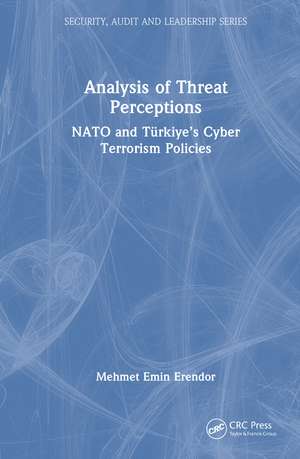
Analysis of Threat Perceptions: NATO and Türkiye’s Cyber Terrorism Policies: Security, Audit and Leadership Series
Autor Mehmet Emin Erendoren Limba Engleză Hardback – 10 aug 2025
When updating its own technology, the organization needs to be ready to defend itself against all kinds of asymmetrical warfare, whether from within or beyond its operational range. However, the terms of Article 5 of the North Atlantic Treaty were imprecise as to whether cyberattacks can be regarded as a form of threat; for this reason, NATO accepted the case‑by‑case concept on cyber threats/attacks in terms of the application of Article 5 by the Wales Summit in 2014. Despite the fact that the Charter of the United Nations has not been revised, if its articles are broadly evaluated, cyberattacks would be accepted as a threat or use of force against the territorial integrity of a state.
The main purpose of this book is to analyze and evaluate what has been carried out regarding NATO’s operational arrangements and its cyber defense approach and, secondly, to explain this through the lens of Game Theory. Furthermore, it will demonstrate why the web is paramount to NATO’s system‑driven operations, and why it requires a cyber defense arrangement. In particular, the research presented here will analyze Türkiye in this regard. The cyberattack on Estonia in 2007 will be used by way of a case study to explain the development of threat perceptions, risks, international law, cybersecurity policies and application of Game Theory.
| Toate formatele și edițiile | Preț | Express |
|---|---|---|
| Paperback (1) | 358.73 lei 3-5 săpt. | +0.00 lei 7-13 zile |
| CRC Press – 10 aug 2025 | 358.73 lei 3-5 săpt. | +0.00 lei 7-13 zile |
| Hardback (1) | 757.03 lei 3-5 săpt. | |
| CRC Press – 10 aug 2025 | 757.03 lei 3-5 săpt. |
Din seria Security, Audit and Leadership Series
- 21%
 Preț: 237.78 lei
 - 37%
 Preț: 228.34 lei
 - 37%
 Preț: 228.28 lei
 - 34%
 Preț: 384.06 lei
 - 37%
 Preț: 224.90 lei
 - 35%
 Preț: 1004.98 lei
 - 20%
 Preț: 272.29 lei
 - 21%
 Preț: 238.64 lei
 - 34%
 Preț: 370.80 lei
 - 34%
 Preț: 288.09 lei
 - 34%
 Preț: 299.05 lei
 - 26%
 Preț: 338.61 lei
 - 34%
 Preț: 391.43 lei
 - 35%
 Preț: 692.70 lei
 - 34%
 Preț: 364.22 lei
 - 34%
 Preț: 706.48 lei
 - 34%
 Preț: 369.13 lei
 - 35%
 Preț: 693.16 lei
 - 37%
 Preț: 191.92 lei
 - 21%
 Preț: 263.60 lei
 - 37%
 Preț: 229.75 lei
 - 35%
 Preț: 752.87 lei
 - 37%
 Preț: 227.62 lei
 - 38%
 Preț: 212.39 lei
 - 34%
 Preț: 362.22 lei
 - 33%
 Preț: 288.63 lei
 - 33%
 Preț: 721.43 lei
 - 34%
 Preț: 361.89 lei
 - 20%
 Preț: 270.40 lei
 - 15%
 Preț: 214.11 lei
 - 35%
 Preț: 504.94 lei
 - 35%
 Preț: 861.16 lei
 - 34%
 Preț: 339.67 lei
 - 35%
 Preț: 359.50 lei
 - 21%
 Preț: 266.71 lei
 - 37%
 Preț: 193.83 lei
 - 34%
 Preț: 383.99 lei
 - 35%
 Preț: 690.51 lei
 - 33%
 Preț: 282.99 lei
Preț: 757.03 lei
Preț vechi: 989.76 lei
-24%
Puncte Express: 1136
Preț estimativ în valută:
133.98€ • 156.58$ • 116.32£
133.98€ • 156.58$ • 116.32£
Carte disponibilă
Livrare economică 30 ianuarie-13 februarie
Preluare comenzi: 021 569.72.76
Specificații
ISBN-13: 9781032802282
ISBN-10: 1032802286
Pagini: 202
Dimensiuni: 156 x 234 mm
Greutate: 0.53 kg
Ediția:1
Editura: CRC Press
Colecția CRC Press
Seria Security, Audit and Leadership Series
ISBN-10: 1032802286
Pagini: 202
Dimensiuni: 156 x 234 mm
Greutate: 0.53 kg
Ediția:1
Editura: CRC Press
Colecția CRC Press
Seria Security, Audit and Leadership Series
Public țintă
Professional Practice & Development, Professional Reference, and Professional TrainingCuprins
Preface Author Biography List of abbreviations Introduction Chapter 1 CASE STUDY OF CYBER TERRORISM: ESTONIA Chapter 2 THE HISTORICAL BACKGROUND OF THE CONCEPT OF THREAT AND THE ASSESSMENT OF THE RISK Chapter 3 GAME THEORY Chapter 4 THE CYBER SECURITY POLICY OF NATO Chapter 5 THE CYBER SECURITY POLICY OF TÜRKİYE CONCLUSION References
Notă biografică
Mehmet Emin Erendor was born in Kilis, Türkiye in 1985. He received his bachelor’s degree in International Relations from the University of Kırıkkale, Türkiye in 2008. He received the master’s degree in International Law: Rights and Responsibilities from the University of Sussex, Brighton in 2011 and the Ph.D. degree in International Relations from the University of Southampton in 2017. From 2017 to 2018, he worked as a Dr. Research Assistant at the University of Çukurova. Since 2018, he has been an Associate Professor with the International Relations Department, Adana Alparslan Türkeş Science and Technology University. His research interests include cyber security, terrorism, human rights, humanitarian intervention, and international organizations.
Descriere
The main purpose of this book is to analyze and evaluate what has been carried out regarding NATO’s operational arrangements and its Cyber Defense approach, and, secondly, to explain this in the lens of Game Theory.