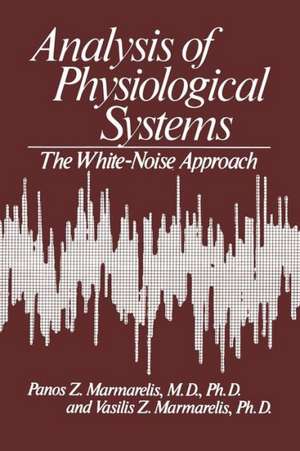
Analysis of Physiological Systems: The White-Noise Approach: Computers in Biology and Medicine
Autor Vasilis Marmarelisen Limba Engleză Paperback – 29 dec 2011

Preț: 625.57 lei
Preț vechi: 735.96 lei
-15%
Puncte Express: 938
Carte tipărită la comandă
Livrare economică 04-18 decembrie
Livrare prin curier în România Termenul estimat este afișat lângă disponibilitate.
Transport gratuit pentru acest produs Plată online sau ramburs, în funcție de opțiunile comenzii.
Retur gratuit în 14 zile Comandă securizată și suport în română.
Specificații
ISBN-13: 9781461339724
ISBN-10: 1461339723
Pagini: 508
Ilustrații: XVI, 488 p. 75 illus.
Dimensiuni: 155 x 235 x 27 mm
Greutate: 0.7 kg
Ediția:1978
Editura: Springer Us
Colecția Springer
Seria Computers in Biology and Medicine
Locul publicării:New York, NY, United States
ISBN-10: 1461339723
Pagini: 508
Ilustrații: XVI, 488 p. 75 illus.
Dimensiuni: 155 x 235 x 27 mm
Greutate: 0.7 kg
Ediția:1978
Editura: Springer Us
Colecția Springer
Seria Computers in Biology and Medicine
Locul publicării:New York, NY, United States
V-ar putea interesa
-
 Permanent Present TenseSuzanne Corkin-19%Preț: 76.46 lei93.95 lei
 -
 Brain On Fire: My Month of MadnessSusannah Cahalan-31%Preț: 63.76 lei92.81 lei
 -
 Brain Function and Psychotropic DrugsHeather Ashton-28%Preț: 423.78 lei587.68 lei
 -
 Corticospinal Function and Voluntary MovementRobert Porter-26%Preț: 831.05 lei1129.67 lei
 -
 Calcium Ions in Nerve Cell FunctionPlaton G. Kostyuk-33%Preț: 614.91 lei911.44 lei
 -
 -24%Preț: 547.45 lei718.80 lei
 -
 The Autisms: Molecules to Model SystemsCraig M. Powell-33%Preț: 1354.41 lei2016.05 lei
 -
 Brain, Mind, and the Structure of RealityPaul L. Nunez-21%Preț: 375.00 lei476.33 lei
 -
 Explorations in Learning and the BrainTon De De JongPreț: 364.08 lei
 -
 Incomplete NatureTerrence W. DeaconPreț: 292.75 lei
 -
 Neurobehavioral Disorders of ChildhoodRobert Melillo-5%Preț: 1675.02 lei1763.18 lei
 -
 Language and Action in Cognitive NeuroscienceYann Coello-18%Preț: 1126.68 lei1374.00 lei
Public țintă
ResearchCuprins
1. The Problem of System Identification in Physiology.- 1.1. The Problem of Systems Analysis in Physiology.- 1.2. Functional and Structural Identification of Physiological Systems.- 1.3. “Black Box” vs. Parameter Identification in Physiological Systems.- 2. Analysis of Physiological Signals.- 2.1. Physiological Systems Data: Deterministic and Stochastic Descriptions.- 2.2. Some Statistical Tools and Concepts.- 2.3. Autocorrelation and Crosscorrelation Functions.- 2.4. Frequency Domain Description of Signals.- 2.5. Certain Properties of Gaussian Signals.- 2.6. Sampling Considerations.- 2.7. Statistical Estimation from Physiological Signals.- 2.8. Filtering of Physiological Signals.- 2.9. Considerations in Computing Power Spectra.- 3. Traditional Approaches to Physiological System Identification.- 3.1. Stimulus-Response Relations in Linear Systems.- 3.2. Transfer Functions and Bode Plots.- 3.3. Transfer Functions from Stimulus-Response Spectra.- 3.4. Coherence Function.- 3.5. Mufti-Input Linear Systems.- 3.6. Nonlinear Systems: Identification Using “Describing Functions”..- 3.7. Effects of Feedback in Physiological Systems.- 3.8. Feedback Analysis in a Neurosensory System.- 4. The White-Noise Method in System Identification.- 4.1. Linear and Nonlinear Systems-The Volterra Series.- 4.2. The Wiener Theory.- 4.3. Schemes for the Estimation of the System Kernels.- 4.4. Multi-Input, Multi-Output Systems.- 4.5. Other Formulations of the White-Noise Approach.- 5. Applicability of the White-Noise Method and the Use of Quasiwhite Test Signals.- 5.1. The Band-Limited Gaussian White Noise.- 5.2. The Pseudorandom Signals Based on m Sequences.- 5.3. The Constant-Switching-Pace Symmetric Random Signals.- 5.4. Comparative Study of the Use of GWN, PRS, and CSRS in SystemIdentification.- 5.5. Validation of Generated Quasiwhite Test Signals.- 6. Methods of Computation of System Kernels.- 6.1. Computational Considerations for Kernel Measurement.- 6.2. Time-Domain Approaches to Kernel Computation.- 6.3. Frequency-Domain Approach: Use of the Fast Fourier Transform Algorithm.- 6.4. Special Cases of Kernel Computation.- 6.5. Analog (Hybrid) Methods for the Computation of Kernels.- 6.6. Evaluation of the System Kernels.- 6.7. Evaluation of Results of Experiment.- 7. Errors in the Estimation of System Kernels.- 7.1. Estimation Errors Using GWN Stimulus.- 7.2. Estimation Errors Using PRS Stimuli.- 7.3. Estimation Errors Using CSRS Stimuli.- 7.4. Errors Due to the Presence of Contaminating Noise.- 8. Tests and Analyses Preliminary to Identification Experiment.- 8.1. Determination of the System Input and Output and Region of Operation.- 8.2. Examination of System Stationarity and Noise Conditions.- 8.3. Removal of Drifts in the Response Data.- 8.4. The Measurement of System Memory and Bandwidth.- 8.5. Measurement of Extent of System Nonlinearity.- 8.6. Recording and Digitalization of Stimulus-Response Data.- 8.7. Choice of GWN Bandwidth and Record Length.- 8.8. Optimal Choice of CSRS Step and Record Length.- 9. Peeking into the Black Box.- 9.1. Analysis of Cascades in Physiological Systems.- 9.2. Zero-Memory Systems.- 9.3. Combinations of Systems.- 10. Applications of the White-Noise Method to Neural Systems.- 10.1. Practical Considerations in Application of the White-Noise Method to Neural Systems.- 10.2. Identification of One-Input Neural Systems Using GWN Stimulus.- 10.3. Identification of Two-Input Neural Systems Using GWN Stimulus.- 10.4. Identification of One-Input Neural System Using Pseudorandom Binary Stimulus.- 10.5. Identification of One-Input Neural System Using CSRS Stimulus.- 10.6. Applications of Alternate Identification Techniques to Neural Systems with Discrete Input or Output.- 11. Physiological Systems Requiring Special Treatment.- 11.1. Physiological Systems with Point Process Inputs and Outputs.- 11.2. Systems with Spatiotemporal Inputs.- 11.3. Nonstationary Systems.- 11.4. Systems with Nonwhite Random Inputs.- 12. Dialogue for Epilogue.- References.- Related Literature.