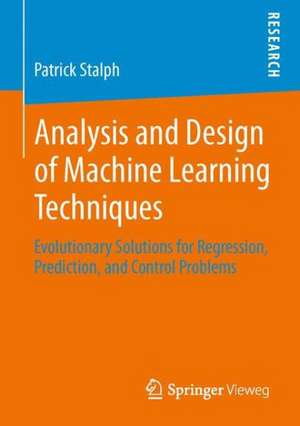
Analysis and Design of Machine Learning Techniques
Autor Patrick Stalphen Limba Engleză Paperback – 17 feb 2014
Preț: 381.78 lei
Puncte Express: 573
Carte tipărită la comandă
Livrare economică 03-17 decembrie
Livrare prin curier în România Termenul estimat este afișat lângă disponibilitate.
Transport gratuit de la 400.00 lei Plată online sau ramburs, în funcție de opțiunile comenzii.
Retur gratuit în 14 zile Comandă securizată și suport în română.
Specificații
ISBN-13: 9783658049362
ISBN-10: 3658049367
Pagini: 176
Ilustrații: XIX, 155 p. 62 illus.
Dimensiuni: 148 x 210 x 10 mm
Greutate: 0.24 kg
Ediția:2014
Editura: SPRINGER VS
Locul publicării:Wiesbaden, Germany
ISBN-10: 3658049367
Pagini: 176
Ilustrații: XIX, 155 p. 62 illus.
Dimensiuni: 148 x 210 x 10 mm
Greutate: 0.24 kg
Ediția:2014
Editura: SPRINGER VS
Locul publicării:Wiesbaden, Germany
V-ar putea interesa
-
 -39%Preț: 189.09 lei312.25 lei
 -
 Preț: 198.45 lei
 -
 Kalman Filtering: Theory and Practice with MATLABMohinder S. Grewal-5%Preț: 662.84 lei697.72 lei
 -
 Drones for DummiesMark LafayPreț: 158.96 lei
 -
 The LEGO Power Functions Idea Book, Volume 2Yoshihito IsogawaPreț: 170.52 lei
 -
 Make: FireTim DeaganPreț: 174.31 lei
 -
 DIY Drone and Quadcopter ProjectsMake the Editors ofPreț: 83.78 lei
 -
 Make: DronesDavid McgriffyPreț: 168.11 lei
 -
 Automation for RoboticsLuc Jaulin-9%Preț: 1018.80 lei1119.57 lei
 -
 New Autonomous SystemsAlain Cardon-9%Preț: 1017.54 lei1118.17 lei
 -
 -9%Preț: 1014.33 lei1114.65 lei
Public țintă
ResearchCuprins
Introduction and Motivation.- Introduction to Function Approximation and Regression.- Elementary Features of Local Learning Algorithms.- Algorithmic Description of XCSF.- How and Why XCSF works.- Evolutionary Challenges for XCSF.- Basics of Kinematic Robot Control.- Learning Directional Control of an Anthropomorphic Arm.- Visual Servoing for the iCub.- Summary and Conclusion.
Textul de pe ultima copertă
Manipulating or grasping objects seems like a trivial task for humans, as these are motor skills of everyday life. Nevertheless, motor skills are not easy to learn for humans and this is also an active research topic in robotics. However, most solutions are optimized for industrial applications and, thus, few are plausible explanations for human learning. The fundamental challenge, that motivates Patrick Stalph, originates from the cognitive science: How do humans learn their motor skills? The author makes a connection between robotics and cognitive sciences by analyzing motor skill learning using implementations that could be found in the human brain – at least to some extent. Therefore three suitable machine learning algorithms are selected – algorithms that are plausible from a cognitive viewpoint and feasible for the roboticist. The power and scalability of those algorithms is evaluated in theoretical simulations and more realistic scenarios with the iCub humanoid robot. Convincing results confirm the applicability of the approach, while the biological plausibility is discussed in retrospect.
Contents
Target Groups
About the Author
Patrick Stalph was a Ph.D. student at the chair ofCognitive Modeling, which is led by Prof. Butz at the University of Tübingen.
Contents
- How do humans learn their motor skills
- Evolutionarymachinelearningalgorithms
- Applicationtosimulatedrobots
Target Groups
- Researchers interested in artificial intelligence, cognitive sciences or robotics
- Roboticists interested in integrating machine learning
About the Author
Patrick Stalph was a Ph.D. student at the chair ofCognitive Modeling, which is led by Prof. Butz at the University of Tübingen.
Caracteristici
Publication in the field of technical sciences Includes supplementary material: sn.pub/extras