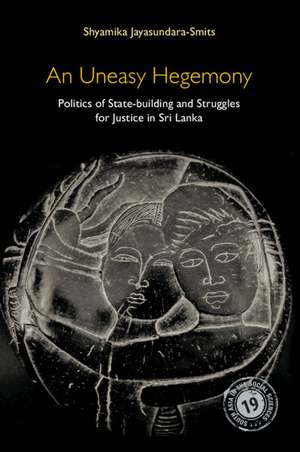
An Uneasy Hegemony
Autor Shyamika Jayasundara-Smitsen Limba Engleză Hardback – 10 noi 2022
Găsim în An Uneasy Hegemony o analiză riguroasă a procesului de construcție statală în Sri Lanka, organizată metodologic pentru a evidenția tensiunile dintre idealurile democratice moștenite și realitatea hegemoniei etnice. Autorul, Shyamika Jayasundara-Smits, structurează materialul progresiv, pornind de la fundamentele naționalismului și evoluând spre mecanismele subtile ale patronajului politic și impactul instituțional al acestuia. Suntem de părere că această structură, care dedică spații extinse modului în care politica de zi cu zi și instituțiile de stat sunt subordonate intereselor de grup, oferă o perspectivă necesară asupra crizei continue a statului srilankez. Notăm cu interes modul în care această ediție nouă integrează exemple practice și exerciții, transformând o monografie teoretică într-un instrument de studiu aplicat. Din punct de vedere metodologic, lucrarea extinde cadrul propus de State Formation and Conflicts in Sri Lanka de Sunil Bastian prin adăugarea unei dimensiuni esențiale: dinamica relațiilor de clasă din interiorul majorității sinhaleze. Dacă Sunil Bastian se concentra pe influența politicilor neoliberale și a instituțiilor internaționale, Shyamika Jayasundara-Smits privește spre interior, spre modul în care supremația etnică și excluderea socială devin instrumente de legitimare a puterii. Cuprinsul reflectă o progresie logică, de la „Politica judecății” la analiza perioadei de după războiul civil, oferind cititorului o imagine clară a modului în care conflictele etnice nu sunt doar explozii izolate, ci rezultatul unei politici deliberate de respingere a egalității. Este o resursă academică ce completează literatura de specialitate prin claritatea cu care demontează mitul „modelului de democrație” srilankez în contextul post-colonial.
Preț: 713.27 lei
Preț vechi: 829.39 lei
-14%
Carte disponibilă
Livrare economică 05-19 noiembrie
Specificații
ISBN-10: 1009199242
Pagini: 280
Ilustrații: Worked examples or Exercises
Dimensiuni: 166 x 234 x 30 mm
Greutate: 0.59 kg
Ediția:Nouă
Editura: Cambridge University Press
Locul publicării:Cambridge, United Kingdom
De ce să citești această carte
Recomandăm această carte cercetătorilor în științe politice și studenților interesați de procesele de state-building în Asia de Sud. Cititorul câștigă o înțelegere profundă a modului în care tensiunile interne de clasă și patronajul politic pot submina stabilitatea unei democrații. Este o lectură esențială pentru a descifra mecanismele prin care naționalismul se transformă în hegemonie etnică, oferind instrumente analitice aplicabile și altor state aflate în tranziție.
Descriere scurtă
Cuprins
Recenzii
'A very fine analysis laced with irony that moves away from the prism of ethno-religious conflict to give centrality to class in the process of state building in late colonial and postcolonial Sri Lanka. Shyamika Jayasundara-Smits convincingly challenges the constructed ontology of ethnicization. This deeply rooted investigation guides us with deft precision through the various incarnations of Sinhala Buddhist ideology and patronage politics towards a devastating conclusion. An original and eloquent book.' Nira Wickramasinghe, Chair and Professor of Modern South Asian Studies, Leiden University Institute for Area Studies, The Netherlands
'This book offers readers a fresh intersectional lens for understanding politics in Sri Lanka. Drawing on studies of nationalism, decoloniality, and class, the book analyzes 'hegemony-building processes.' Drawing up her personal experiences growing up in Sri Lanka and her expertise in conflict transformation and peacebuilding, the author offers a significant contribution to the analysis of war and peace, polarization and repression in Sri Lanka.' Lisa Schirch, Richard G. Starmann Sr. Professor of the Practice in Peace Studies, Keough School of Global Affairs, Kroc Institute for International Peace Studies, University of Notre Dame, USA
'This book engages in, and makes an important contribution to, longstanding debates on the trajectory and character of Sri Lanka's postcolonial state. Though ostensibly now a post war state, it remains a state in crisis. This lends urgency to the task of better understanding the historical and contemporary politics of statebuilding in Sri Lanka. The author eschews a narrow focus on ethnicity and armed conflict, instead providing a more intricate and integrated analysis of the discursive, political and economic factors that have shaped Sri Lanka's contested trajectory. At a time of a global resurgence of populist and authoritarian politics, it is important to look carefully at the particular conditions that give rise to such projects, as this book does so admirably.' Jonathan Goodhand, Professor of Conflict and Development Studies, SOAS, University of London