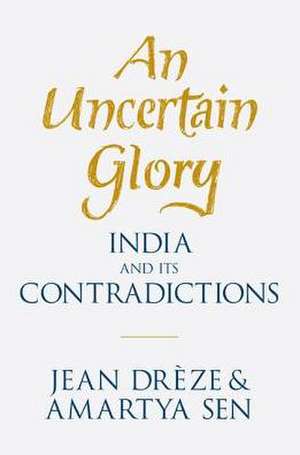
An Uncertain Glory
Autor Jean Drèze, Amartya Senen Limba Engleză Paperback – 22 mar 2015
Maintaining rapid as well as environmentally sustainable growth remains an important and achievable goal for India. In "An Uncertain Glory," two of India's leading economists argue that the country's main problems lie in the lack of attention paid to the essential needs of the people, especially of the poor, and often of women. There have been major failures both to foster participatory growth and to make good use of the public resources generated by economic growth to enhance people's living conditions. There is also a continued inadequacy of social services such as schooling and medical care as well as of physical services such as safe water, electricity, drainage, transportation, and sanitation. In the long run, even the feasibility of high economic growth is threatened by the underdevelopment of social and physical infrastructure and the neglect of human capabilities, in contrast with the Asian approach of simultaneous pursuit of economic growth and human development, as pioneered by Japan, South Korea, and China.
In a democratic system, which India has great reason to value, addressing these failures requires not only significant policy rethinking by the government, but also a clearer public understanding of the abysmal extent of social and economic deprivations in the country. The deep inequalities in Indian society tend to constrict public discussion, confining it largely to the lives and concerns of the relatively affluent. Dreze and Sen present a powerful analysis of these deprivations and inequalities as well as the possibility of change through democratic practice."
Preț: 147.15 lei
Preț vechi: 147.15 lei
-NaN%
Puncte Express: 221
Carte disponibilă
Livrare economică 17 noiembrie-01 decembrie
Livrare prin curier în România Termenul estimat este afișat lângă disponibilitate.
Transport gratuit de la 400.00 lei Plată online sau ramburs, în funcție de opțiunile comenzii.
Retur gratuit în 14 zile Comandă securizată și suport în română.
Specificații
ISBN-13: 9780691165523
ISBN-10: 0691165521
Pagini: 448
Dimensiuni: 146 x 226 x 30 mm
Greutate: 0.59 kg
Editura: Princeton University Press
ISBN-10: 0691165521
Pagini: 448
Dimensiuni: 146 x 226 x 30 mm
Greutate: 0.59 kg
Editura: Princeton University Press
V-ar putea interesa
-
 The Third PillarRaghuram RajanPreț: 108.24 lei
 -
 The Argumentative IndianAmartya Sen-29%Preț: 67.01 lei94.17 lei
 -
 India: A PortraitPatrick French-18%Preț: 75.69 lei92.73 lei
 -
 Left BehindPaul CollierPreț: 93.10 lei
 -
 GrowthDaniel SusskindPreț: 93.52 lei
 -
 Economics: A Very Short IntroductionPartha Dasgupta-18%Preț: 58.34 lei71.48 lei
 -
 Development as FreedomAmartya Sen-17%Preț: 96.64 lei116.29 lei
 -
 India's Political Economy: The Gradual Revolution (1947-2004)Francine R. FrankelPreț: 268.66 lei
 -
 Indian Cities: Oxford India Short IntroductionsAnnapurna ShawPreț: 97.47 lei
 -
 -14%Preț: 82.77 lei96.61 lei
 -
 -23%Preț: 886.99 lei1151.94 lei
 -
 The Country of First Boys: And Other EssaysAmartya Sen-17%Preț: 91.00 lei109.83 lei
 -
 -18%Preț: 301.78 lei370.21 lei
 -
 -25%Preț: 76.01 lei101.25 lei
 -
 The Poverty of GrowthOlivier De SchutterPreț: 105.31 lei
 -
 Preț: 391.82 lei
 -
 Preț: 391.11 lei
 -
 Slow Down or Die: The Economics of DegrowthTimothée Parrique-19%Preț: 98.77 lei122.14 lei
Textul de pe ultima copertă
"India is a great success story of economic growth and poverty decline, but it remains the home of global poverty, and half of its children are profoundly malnourished. This paradox of poverty and plenty poses one of the great intellectual and moral challenges of the day. We can ask for no better guides to it than a philosopher and an activist, both distinguished economists, and both with unparalleled knowledge of India's glories and its shames."--Angus Deaton, author of The Great Escape: Health, Wealth, and the Origins of Inequality
"This important book provides a comprehensive and probing analysis of the Indian economy and its enormous potential. What makes this such an engaging book is that it is a deeply sympathetic and, for that very reason, a deeply critical evaluation of contemporary India. The book's combination of economics, politics, history, and law makes it a fascinating read."--Kaushik Basu, chief economist of the World Bank
"This important book provides a comprehensive and probing analysis of the Indian economy and its enormous potential. What makes this such an engaging book is that it is a deeply sympathetic and, for that very reason, a deeply critical evaluation of contemporary India. The book's combination of economics, politics, history, and law makes it a fascinating read."--Kaushik Basu, chief economist of the World Bank
Notă biografică
Jean Drèze has lived in India since 1979 and became an Indian citizen in 2002. He has taught at the London School of Economics and the Delhi School of Economics, and he is now a visiting professor at Allahabad University. He is the coauthor (with Amartya Sen) of Hunger and Public Action and India: Development and Participation. Amartya Sen is the Thomas W. Lamont University Professor and professor of economics and philosophy at Harvard University. He won the Nobel Prize in Economics in 1998. His many books include Development as Freedom, Rationality and Freedom, The Argumentative Indian, Identity and Violence, and The Idea of Justice.