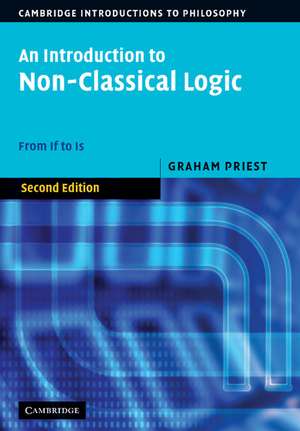
An Introduction to Non-Classical Logic
Autor Graham Priesten Limba Engleză Hardback – 13 ian 2012
Apreciem An Introduction to Non-Classical Logic ca fiind un text fundamental care a definit modul în care logica non-clasică este predată la nivel universitar. Această a doua ediție reprezintă o revizuire masivă: dacă prima ediție se concentra exclusiv pe logica propozițională, volumul de față este de peste două ori mai lung, introducând o a doua parte integral nouă dedicată cuantificării și identității pentru toate sistemele analizate anterior. Subliniem efortul autorului de a unifica un peisaj teoretic fragmentat — care include logici modale, temporale, intuiționiste, multivalente, paraconsistente și fuzzy — sub tema comună a semanticii lumilor posibile. Structura lucrării urmărește o progresie pedagogică riguroasă. Partea I reia bazele logicii propoziționale, adăugând material nou despre condiționali, în timp ce Partea II extinde aceste concepte către logica predicatelor. Utilizarea constantă a demonstrațiilor de tip tableau (arbori de consistență) face ca materialul tehnic să fie accesibil fără a sacrifica rigoarea matematică. Cartea servește ca o alternativă cuprinzătoare la Philosophical Logic de John P Burgess pentru cursurile de filozofie analitică, oferind avantajul unei acoperiri mult mai vaste a sistemelor non-standard și a implicațiilor lor filozofice. În contextul operei lui Graham Priest, acest manual reprezintă fundamentul tehnic pentru explorările sale mai speculative. Dacă în What Can't be Said sau Everything and Nothing autorul analizează limitele gândirii și paradoxurile realității, aici el oferă cititorului instrumentarul logic necesar pentru a înțelege cum pot funcționa sistemele care acceptă contradicția sau lacunele de adevăr. Este o lucrare esențială pentru oricine dorește să depășească limitele logicii clasice fregeene.
Preț: 898.83 lei
Preț vechi: 1167.31 lei
-23%
Carte tipărită la comandă
Livrare economică 18 iulie-01 august
Specificații
ISBN-10: 0521854334
Pagini: 646
Dimensiuni: 175 x 250 x 39 mm
Greutate: 1.28 kg
Ediția:Revizuită
Editura: Cambridge University Press
Locul publicării:Cambridge, United Kingdom
V-ar putea interesa
-
 Being and TimeMartin HeideggerPreț: 137.07 lei
 -
 -13%Preț: 514.63 lei590.56 lei
 -
 Philosophy without IntuitionsHerman CappelenPreț: 260.49 lei
 -
 Frege's TheoremRichard G. HeckPreț: 256.41 lei
 -
 The Oxford Handbook of WittgensteinOskari Kuusela-20%Preț: 299.93 lei373.35 lei
 -
 -19%Preț: 277.53 lei342.00 lei
 -
 Towards Non-BeingGraham PriestPreț: 325.34 lei
 -
 Doubt Truth to be a LiarGraham Priest-15%Preț: 372.82 lei436.09 lei
 -
 Beyond the Limits of Thought: New editionGraham Priest-14%Preț: 379.44 lei442.19 lei
 -
 In ContradictionGraham Priest-11%Preț: 402.62 lei452.38 lei
 -
 Visual Thinking in MathematicsMarcus GiaquintoPreț: 343.33 lei
 -
 Empty Representations: Reference and Non-ExistenceManuel García-Carpintero-33%Preț: 597.85 lei896.10 lei
 -
 Preț: 242.40 lei
 -
 The Cambridge Companion to GadamerRobert J. Dostal-23%Preț: 192.67 lei250.45 lei
 -
 Carnap's Construction of the WorldAlan W. RichardsonPreț: 343.46 lei
 -
 The Metaphysics of MindMichael TyePreț: 296.20 lei
 -
 Meaning and MethodGeorge BoolosPreț: 340.05 lei
 -
 The Cambridge Companion to HeideggerCharles B. GuignonPreț: 279.11 lei
 -
 An Introduction to MetaphysicsJohn CarrollPreț: 335.61 lei
 -
 What Is Analytic Philosophy?Hans-Johann GlockPreț: 205.13 lei
 -
 Origins of Analytical PhilosophyMichael Dummett-22%Preț: 137.58 lei176.76 lei
 -
 Truth and MethodHans-Georg Gadamer-25%Preț: 189.16 lei251.99 lei
De ce să citești această carte
Recomandăm această carte studenților și cercetătorilor din filozofie, matematică sau informatică ce dețin deja o bază în logica clasică. Cititorul câștigă o înțelegere profundă a alternativelor moderne la sistemul standard, învățând să opereze cu instrumente precum logica paraconsistentă sau fuzzy. Este probabil cel mai complet manual disponibil care tratează unitar atât aspectele propoziționale, cât și pe cele de cuantificare în logica non-clasică.
Despre autor
Graham Priest este unul dintre cei mai influenți logicieni contemporani, cunoscut în special pentru contribuțiile sale la dezvoltarea dialeteismului și a logicilor paraconsistente. Deși are o carieră academică distinsă în filozofie, fiind un expert recunoscut în logică analitică, Priest este și un cercetător pasionat de istorie militară, publicând numeroase lucrări de specialitate despre baionete și pici. Această dualitate între rigoarea formală a logicii și analiza istorică factuală se reflectă în stilul său de scriere: precis, structurat și ancorat în dezbateri filozofice reale.
Descriere scurtă
Cuprins
Recenzii
'I've used your book (first edition, that is) for years now in my upper level philosophy of logic courses. It is easily the best introduction to non-classical logics. I especially like its coverage of conditionals, and the introduction to relevant logic. Over the years, your book has made my students come to appreciate the variety and scope that exists within in formal logic, I intend to use the new edition so as to carry similar investigations into first order theory.' Jeffry Pelletier, Simon Fraser University
'Graham Priest's Introduction to Non-Classical Logic made this fascinating material on alternative logics accessible to my students for the very first time. The very welcome new edition extends the range of what is addressed to include important questions about quantification for modal logic, and the other systems as well.' Tony Roy, California State University, San Bernardino
'The first edition of Graham Priest's Introduction to Non-Classical Logic turned out to be an extremely useful and well-written introductory guide to the vast and difficult to survey area of non-classical and philosophical logic. The substantially expanded second edition in two volumes is bound to become a standard reference.' Heinrich Wansing, Dresden University of Technology
'Clear, self-contained, generously complete: this is bound to be the classic on non-classical logics for many years to come.' Achille Varzi, Columbia University
'This is an excellent introductory book to modern non-classical logics, fully accessible to non-professionals, and useful to professionals too. I have used part of its content in teaching Non-Classical Logic in the past years, and the response from my students shows the great success of the author's intention. The proof system it employs and the meta-proofs it provides are extremely easy to follow, while those followed-up philosophical discussions it summarizes for each logic system are both concise and lucid. It is not only a work introducing modern non-classical logic systems, but also a work full of interesting philosophical discussions on the motivations, advantages and disadvantages of these systems. With one penetrating theme - what a logic of conditionals should be like - in mind, the author has effectively organized a variety of topics into one integrated work. I would recommend it both to logicians and to philosophers, to professionals and to non-professionals.' Wen-fang Wang, National Chung Chen University
'The second edition of Graham Priest's book is, like the first, clearly expressed, well thought out for the student and an essential work for all those studying philosophy who want an adequate grounding in non-classical logic. I have used the first edition successfully in my intermediate class for the last five years, and will certainly be adding the second edition to the reading list when it is available.' Steve Read, University of St Andrews
'Priest succeeds in offering a marvellously unified treatment of 11 varieties of logic: classical, basic modal, normal modal, non-normal, conditional, intuitionist, many-valued, first-degree entailment, basic relevant, mainstream relevant, and fussy … Excellent references support this concise but clear treatment.' Choice
'This book is just what the title says it is … And it is a very good one …' Stewart Shapiro, University of Ohio
' … for anyone who wants to explore the non-classical systems, it is the only book of its kind and could not be more highly recommended.' The Times Higher Education Supplement
'I've just picked up a copy of the second edition of Graham Preist's An Introduction to Non-Classical Logic from the CUP bookshop. It looks terrific. More than twice the length of the first edition which just covered propositional logics, this covers their extensions with quantifiers and identity too. I thought the fist edition was terrific: so this is a hugely welcome expansion and I'm delighted to report that CUP has published this as a paperback in their Cambridge Introductions to Philosophy Series at just £18.99, which is surely an amazing bargain for a well produced 613 page book. So a must-buy and a must-read!' Logic Matters