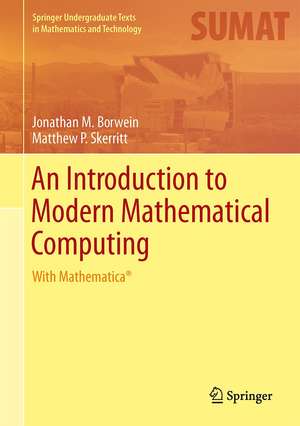
An Introduction to Modern Mathematical Computing
Autor Jonathan Borwein, Matthew P Skerritten Limba Engleză Hardback – 4 aug 2012
În cadrul capitolului dedicat Teoriei Numerelor, An Introduction to Modern Mathematical Computing stabilește o premisă clară: computerele nu mai sunt doar instrumente de aproximare numerică, ci parteneri în explorarea matematicii pure. Ne-a atras atenția modul în care autorii, Jonathan M Borwein și Matthew P Skerritt, reușesc să transforme procesul de învățare într-o experiență interactivă, axată pe utilizarea sistemelor de calcul algebric (CAS) pentru a genera conjecturi și a valida demonstrații. Structura volumului este riguros organizată, pornind de la fundamentele aritmetice și avansând spre analiză matematică și algebră liniară, culminând cu un post-scriptum esențial despre vizualizarea geometrică. Putem afirma că acest manual de nivel universitar umple un gol pedagogic, oferind studenților instrumentele necesare pentru a deveni „matematicieni experimentaliști”. Cititorii familiarizați cu The Computer as Crucible vor aprecia continuitatea stilului analitic, însă acest volum aduce un plus de rigoare aplicată, fiind conceput special pentru curriculumul universitar. Comparativ cu Introduction to Experimental Mathematics de Søren Eilers, care se bazează exclusiv pe Maple, lucrarea de față oferă o perspectivă mai largă asupra ecosistemului format de cele trei „M-uri”: Maple, Mathematica și Matlab. Abordarea este una pragmatică, menită să îmbunătățească modul în care viitorii ingineri și cercetători utilizează limbajul matematic. Recomandăm acest titlu editat de Springer pentru claritatea cu care demonstrează că o demonstrație solidă poate fi precedată și susținută de o explorare computațională bine structurată.
Preț: 445.63 lei
Carte tipărită la comandă
Livrare economică 28 noiembrie-12 decembrie
Specificații
ISBN-10: 1461442524
Pagini: 224
Ilustrații: XVI, 224 p.
Dimensiuni: 185 x 261 x 20 mm
Greutate: 0.61 kg
Ediția:2012 edition
Editura: Springer
Locul publicării:New York, NY, United States
V-ar putea interesa
-
 -24%Preț: 208.03 lei273.64 lei
 -
 Guide to AnalysisMary Hart-31%Preț: 473.18 lei689.17 lei
 -
 Pi: A Source BookJ. L. Berggren-18%Preț: 1922.15 lei2344.09 lei
 -
 An Introduction to Numerical AnalysisEndre Süli-19%Preț: 535.85 lei661.55 lei
 -
 Regularization of Inverse ProblemsHeinz Werner Engl-18%Preț: 1150.67 lei1403.26 lei
 -
 The Mathematics of Signal ProcessingSteven B. Damelin-11%Preț: 580.82 lei652.60 lei
 -
 Convex Analysis and Nonlinear OptimizationJonathan Borwein-15%Preț: 446.81 lei525.65 lei
 -
 Theory of Fuzzy ComputationApostolos SyropoulosPreț: 401.21 lei
 -
 Geometric Numerical IntegrationErnst Hairer-18%Preț: 1448.72 lei1766.73 lei
Public țintă
Upper undergraduateDe ce să citești această carte
Recomandăm această carte oricărui student la matematică sau informatică dornic să treacă de la calculul manual la cel asistat. Cititorul câștigă o metodologie modernă de lucru, învățând cum să folosească Mathematica pentru a vizualiza concepte abstracte și pentru a verifica ipoteze complexe. Este o resursă esențială pentru a înțelege cum tehnologia modernă transformă rigoarea matematică în explorare creativă.
Despre autor
Jonathan M Borwein a fost un matematician de renume, cunoscut pentru contribuțiile sale fundamentale în analiza funcțională și teoria optimizării. Lucrarea sa anterioară, Pi and the Agm, a primit aprecieri critice pentru modul în care explorează conexiunile matematice profunde, o temă pe care o continuă în acest volum prin prisma informaticii moderne. Împreună cu Matthew P Skerritt, Borwein a promovat activ matematica experimentală, demonstrând cum instrumentele digitale pot facilita descoperiri teoretice noi, poziționându-se ca un lider în pedagogia matematică contemporană la interfața cu tehnologia.
Descriere scurtă
We intend to persuade that Mathematica and other similar tools are worth knowing, assuming only that one wishes to be a mathematician, a mathematics educator, a computer scientist, an engineer or scientist, or anyone else who wishes/needs to use mathematics better. We also hope to explain how to become an "experimental mathematician" while learning to be better at proving things. To accomplish this our material is divided into three main chapters followed by a postscript. These cover elementary number theory, calculus of one and several variables, introductory linear algebra, and visualization and interactive geometric computation.
Cuprins
Recenzii
“There are two general approaches to computation: using computation as a numerical tool to approximate answers or using a computer algebra system to provide exact mathematical answers by symbolic manipulation. This book explores the second of these approaches, using the computer algebra system Mathematica. … Though this work does teach students how to use Mathematica, it does so with the goal of providing new insights into basic mathematics, which can then be applied to more advanced mathematics. … Summing Up: Recommended. Lower- and upper-division undergraduates.” (D. Z. Spicer, Choice, Vol. 50 (7), March, 2013)
“Three main chapters form the core of the book. In the first chapter, the authors talk about using a computer algebra system like Mathematica for problems in number theory … . Chapters 2 and 3 are devoted to calculus and linear algebra, respectively. … The mathematical content of the chapters is … elementary and written in a style easily understandable by nonspecialists. … a very good introduction for beginners to this interesting and important topic.” (Kai Diethelm, ACM Computing Reviews, March, 2013)
Notă biografică
Textul de pe ultima copertă
An Introduction to Modern Mathematical Computing: With Mathematica® looks beyond teaching the syntax and semantics of Mathematica and similar programs, and focuses on why they are necessary tools for anyone who engages in mathematics. It is an essential read for mathematicians, mathematics educators, computer scientists, engineers, scientists, and anyone who wishes to expand their knowledge of mathematics. This volume will also explain how to become an “experimental mathematician,” and will supply useful information about how to create better proofs.
The text covers material in elementary number theory, calculus, multivariable calculus, introductory linear algebra, and visualization and interactive geometric computation. It is intended for upper-undergraduate students, and as a reference guide for anyone who wishes to learn to use the Mathematica program.
Also by J.M. Borwein and M.B. Skerritt: An Introduction to Modern Mathematical Computing: With Maple™, © 2011, ISBN: 978-1-4614-0121-6, 216 p. and 81 color illustrations.