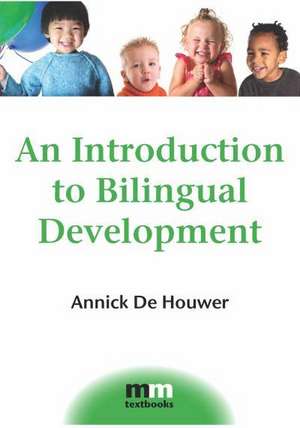
An Introduction to Bilingual Development
Autor Annick De Houweren Limba Engleză Hardback – 27 mai 2009
Preț: 375.38 lei
Preț vechi: 431.51 lei
-13%
Puncte Express: 563
Carte indisponibilă temporar
Doresc să fiu notificat când acest titlu va fi disponibil:
Se trimite...
Specificații
ISBN-13: 9781847691699
ISBN-10: 1847691692
Pagini: 104
Dimensiuni: 174 x 245 x 11 mm
Greutate: 0.35 kg
Editura: Channel View Publications Ltd
Locul publicării:United Kingdom
ISBN-10: 1847691692
Pagini: 104
Dimensiuni: 174 x 245 x 11 mm
Greutate: 0.35 kg
Editura: Channel View Publications Ltd
Locul publicării:United Kingdom
V-ar putea interesa
-
 The Bilingual BrainArturo E. Hernandez-32%Preț: 473.04 lei697.42 lei
 -
 -18%Preț: 1305.60 lei1592.20 lei
 -
 -15%Preț: 396.63 lei466.62 lei
 -
 Preț: 429.14 lei
 -
 El Bilingüismo En El Mundo HispanohablanteSilvina Montrul-15%Preț: 425.11 lei500.12 lei
 -
 Preț: 311.58 lei
 -
 The Handbook of Bilingual and Multilingual EducationWayne E Wright-9%Preț: 1210.14 lei1329.82 lei
 -
 Education in South-East AsiaDr Lorraine Pe Symaco-13%Preț: 324.94 lei371.49 lei
 -
 A Parents' and Teachers' Guide to BilingualismColin BakerPreț: 107.94 lei
 -
 The Chalk CircleTara L. MasihPreț: 85.35 lei
Cuprins
1: Introducing the fancy term for bilingual development: Bilingual First Language Acquisition 2: From birth to the comprehension of words 3: Saying words and starting to combine them 4: Making sentences 5: Preschool and beyond 6: In conclusion: Bilingual learning in context
Recenzii
De Houwer's book introduces readers to the research findings about bilingual first language acquisition through the charming stories of four imaginary bilingual children growing up in different contexts. Parents, students, and practitioners alike will discover what to expect from typical bilingual acquisition, including how individual "typical" can be!Elena Nicoladis, Department of Psychology, University of Alberta, CanadaThe kind of bilingual development which starts very early, namely bilingual first language acquisition (BFLA), seems to attract much attention and spark much curiosity. How do children manage to acquire two languages simultaneously? In what ways does early bilingual exposure affect the course of their overall language development? Behind such questions lurks the yardstick of monolingualism, by which BFLA is often inappropriately evaluated. Now prominent BFLA expert Annick de Houwer has given us an introductory book with a most balanced and fair view of BFLA as a standard in its own right, tracing the bilingual development of four fictitious prototypical children. As always, her clarity of thought and writing makes the book accessible to anyone.Masayo Yamamoto, Professor of Bilingualism Studies, Kwansei Gakuin University, Japan