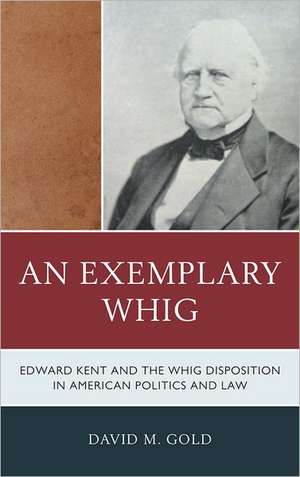
An Exemplary Whig: Edward Kent and the Whig Disposition in American Politics and Law
Autor David M. Golden Limba Engleză Hardback – 6 iul 2012
In examining Kent's career as Maine's quintessential Whig, An Exemplary Whig reveals his characteristically conservative Whig outlook, including an aversion toward disorder and a deep respect for law, for existing institutions, and for the wisdom of experience. Kent brought his conservative disposition into the Republican Party. He had no use for radical abolitionism, preferring moderation and compromise to measures that endangered social order or the integrity of the Union. Kent saw the "slave power," not abolitionism, as the disrupter of the Union, and he urged the "fusion" of all antislavery elements into a new Republican party.
In 1859, Maine's Republican governor appointed Kent to the state supreme court. During his fourteen-year tenure, Kent adopted a Whiggish jurisprudence, pragmatic and commonsensical, and displayed a reverence for the common law and a distrust of "theoretic speculation." After his retirement, he chaired a constitutional revision commission, admonishing his fellow commissioners to bear in mind the "practical wisdom" that kept dangerous innovation in check.
As a politician during the Jacksonian era, Kent exemplified Whig leadership at the local and state levels. In his jurisprudence, he carried the Whig persuasion into the Republican ascendancy and the beginnings of the Gilded Age.
Preț: 659.90 lei
Preț vechi: 1053.96 lei
-37%
Puncte Express: 990
Carte tipărită la comandă
Livrare economică 23 noiembrie-07 decembrie
Livrare prin curier în România Termenul estimat este afișat lângă disponibilitate.
Transport gratuit pentru acest produs Plată online sau ramburs, în funcție de opțiunile comenzii.
Retur gratuit în 14 zile Comandă securizată și suport în română.
Specificații
ISBN-13: 9780739172728
ISBN-10: 0739172727
Pagini: 255
Dimensiuni: 160 x 234 x 23 mm
Greutate: 0.57 kg
Editura: Bloomsbury Publishing
Colecția Lexington Books
Locul publicării:New York, United States
ISBN-10: 0739172727
Pagini: 255
Dimensiuni: 160 x 234 x 23 mm
Greutate: 0.57 kg
Editura: Bloomsbury Publishing
Colecția Lexington Books
Locul publicării:New York, United States
Cuprins
Acknowledgments
Note on Citations
Introduction
Chapter 1. Education in Federalism
Chapter 2. National Republican Legislator
Chapter 3. Mayor of Bangor
Chapter 4. Hell-Bent for Kent
Chapter 5. "The True End of Government"
Chapter 6. Running the Line
Chapter 7. Negotiating the Northeastern Boundary
Chapter 8. For Taylor and the Union
Chapter 9. Consul in Rio
Chapter 10. The Unholy Traffic
Chapter 11. The Demise of the Whigs
Chapter 12. The Rise of the Republicans
Chapter 13. A Republican on the Bench
Chapter 14. The Jurisprudence of Common Sense
Chapter 15. The Last Whig
Bibliography
Index
About the Author
Note on Citations
Introduction
Chapter 1. Education in Federalism
Chapter 2. National Republican Legislator
Chapter 3. Mayor of Bangor
Chapter 4. Hell-Bent for Kent
Chapter 5. "The True End of Government"
Chapter 6. Running the Line
Chapter 7. Negotiating the Northeastern Boundary
Chapter 8. For Taylor and the Union
Chapter 9. Consul in Rio
Chapter 10. The Unholy Traffic
Chapter 11. The Demise of the Whigs
Chapter 12. The Rise of the Republicans
Chapter 13. A Republican on the Bench
Chapter 14. The Jurisprudence of Common Sense
Chapter 15. The Last Whig
Bibliography
Index
About the Author
Recenzii
In this engaging biography of Edward Kent, a leading citizen of Bangor, Maine, David Gold reveals the quotidian texture of American public culture in the nineteenth century. Kent's significance lies in his achievement of a life devoted to what the novelist George Eliot called the 'unmemorable acts' that contribute to 'the growing good of the world.'
The partisan divisions of the Jacksonian era, the rise of the Republican Party in the 1850s, and the nature of the nineteenth-century legal system continue to puzzle American historians. What has long been deemed necessary are state and biographical studies that explore these themes in a local context. David Gold has produced such a work by this well-researched, learned, and intelligent examination of the political and legal career of Whig Edward Kent of Maine. Our field would be well served by more books based on Gold's model.
David Gold has provided an exemplary study of an exemplary Whig, readable, insightful, and unusual in its attention to a lawyer and politician who achieved state rather than national prominence. He makes a notable contribution to our understanding of the 19th-century American Whig temperament.
Through David Gold's writing Edward Kent emerges from the frontier of nineteenth-century Maine to teach us much about politics, law, and society in a transformative time in American history.
Gold effectively chronicles Governor Kent through adept mining of manuscript collections and, along with Robert J. Cook's Civil War Senator: William Pitt Fessenden and the Fight to Save the American Republic (2011), illuminates nineteenth-century Maine politics. More work like Gold's-investigating prototypical New England Democrats such as Levi Woodbury, Isaac Hill, and Isaac Toucey, for example-would greatly enrich our understanding of the antebellum political system.
The partisan divisions of the Jacksonian era, the rise of the Republican Party in the 1850s, and the nature of the nineteenth-century legal system continue to puzzle American historians. What has long been deemed necessary are state and biographical studies that explore these themes in a local context. David Gold has produced such a work by this well-researched, learned, and intelligent examination of the political and legal career of Whig Edward Kent of Maine. Our field would be well served by more books based on Gold's model.
David Gold has provided an exemplary study of an exemplary Whig, readable, insightful, and unusual in its attention to a lawyer and politician who achieved state rather than national prominence. He makes a notable contribution to our understanding of the 19th-century American Whig temperament.
Through David Gold's writing Edward Kent emerges from the frontier of nineteenth-century Maine to teach us much about politics, law, and society in a transformative time in American history.
Gold effectively chronicles Governor Kent through adept mining of manuscript collections and, along with Robert J. Cook's Civil War Senator: William Pitt Fessenden and the Fight to Save the American Republic (2011), illuminates nineteenth-century Maine politics. More work like Gold's-investigating prototypical New England Democrats such as Levi Woodbury, Isaac Hill, and Isaac Toucey, for example-would greatly enrich our understanding of the antebellum political system.