An Egg Is Quiet
Autor Dianna Aston Ilustrat de Sylvia Longen Limba Engleză Hardback – aug 2013 – vârsta până la 9 ani
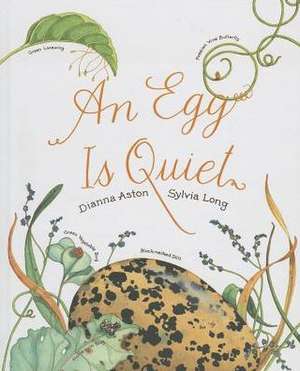
Cum le putem explica celor mici diversitatea incredibilă a naturii fără să transformăm lectura într-o simplă lecție de biologie? An Egg Is Quiet oferă un răspuns prin îmbinarea rară a preciziei științifice cu o estetică artistică deosebită. Suntem de părere că această carte reușește să transforme un obiect banal — oul — într-o poartă către explorarea lumii vii. De la ouăle minuscule de colibri până la cele gigantice de struț, sau de la formele ovale ale buburuzelor la cele tubulare ale rechinului-pisică, volumul surprinde peste 60 de variații care vor stârni curiozitatea oricărui copil între 5 și 8 ani. Merită menționat modul în care textul scris de Dianna Aston păstrează un ton evocator și calm, în timp ce ilustrațiile realizate de SYLVIA LONG aduc la viață detalii de o finețe remarcabilă. Atmosfera amintește de The Egg Book de la DK, însă, în timp ce acela se bazează pe fotografii și procesul pas cu pas al ecloziunii, An Egg Is Quiet mizează pe o abordare artistică, aproape contemplativă, care invită la observație atentă. Această lucrare continuă stilul consacrat al autoarei în titluri precum A Seed Is Sleepy sau A Butterfly Is Patient, unde natura nu este doar descrisă, ci celebrată. Recomandăm parcurgerea cărții nu doar pentru textul principal, ci și pentru informațiile dense de pe paginile de gardă, care completează experiența de învățare. Este o resursă valoroasă care se simte la fel de natural citită pe genunchii părinților sau într-un cerc de lectură la școală, oferind un echilibru perfect între poezie și enciclopedie.
Preț: 268.34 lei
Carte indisponibilă temporar
Specificații
ISBN-10: 1607533510
Pagini: 36
Dimensiuni: 235 x 282 x 10 mm
Greutate: 0.39 kg
Editura: AMICUS
V-ar putea interesa
-
 The Game of LightHerve Tullet-20%Preț: 58.03 lei72.54 lei
 -
 Ten Little Rabbits Board BookVirginia GrossmanPreț: 54.93 lei
 -
 Daddy KissesAnne GutmanPreț: 45.30 lei
 -
 Because You Are My BabyJennifer WardPreț: 100.38 lei
 -
 -22%Preț: 92.18 lei118.48 lei
 -
 A Seed Is SleepyDianna Aston-9%Preț: 40.71 lei44.51 lei
 -
 A Butterfly Is PatientDianna Hutts Aston-30%Preț: 41.20 lei58.69 lei
 -
 A Rock Is LivelyDianna Hutts Aston-9%Preț: 46.75 lei51.46 lei
 -
 A Nest Is NoisyDianna Hutts Aston-21%Preț: 41.05 lei51.66 lei
 -
 Wild FoxCherie MasonPreț: 81.12 lei
De ce să citești această carte
Recomandăm această carte părinților care doresc să cultive simțul estetic și curiozitatea științifică a copiilor. Este un instrument educativ care nu doar oferă fapte despre 60 de tipuri de ouă, ci învață micii cititori să observe frumusețea ascunsă în tăcerea naturii. Câștigul principal este o introducere fascinantă în biologie prin intermediul unor ilustrații memorabile, premiate la nivel internațional.
Despre autor
Dianna Aston este o autoare de literatură pentru copii apreciată pentru modul în care reușește să combine non-ficțiunea cu un stil narativ liric. Colaborarea sa de lungă durată cu ilustratoarea Sylvia Long a dat naștere unei serii remarcabile de cărți despre natură, care include volume dedicate semințelor, fluturilor și mineralelor. Lucrările sale sunt recunoscute pentru capacitatea de a face subiectele științifice accesibile și atractive pentru preșcolari și elevi din ciclul primar. Dianna Aston a primit numeroase distincții pentru contribuția sa, inclusiv premii din partea asociațiilor de biblioteci și grupuri de critică literară pentru copii.
Descriere
Award-winning artist Sylvia Long has teamed with up-and-coming author Dianna Aston to create this gorgeous and informative introduction to eggs. From tiny hummingbird eggs to giant ostrich eggs, oval ladybug eggs to tubular dogfish eggs, gooey frog eggs to fossilized dinosaur eggs, it magnificently captures the incredible variety of eggs and celebrates their beauty and wonder. The evocative text is sure to inspire lively questions and observations. Yet while poetic in voice and elegant in design, the book introduces children to more than 60 types of eggs and an interesting array of egg facts. Even the endpapers brim with information. A tender and fascinating guide that is equally at home being read to a child on a parent's lap as in a classroom reading circle.
Notă biografică
Dianna Aston spends a lot of time in her backyard hoping to find new eggs. She often enlists the help of her husband, children, and their assorted pets. She lives in Texas. Sylvia Long is the illustrator of many books for children including the best-selling Sylvia Long's Mother Goose, Hush Little Baby, and Snug As a Bug, all published by Chronicle Books. Ms. Long's detailed paintings are inspired by her love of animals and the outdoors. She lives in Arizona.
Recenzii
Like the subject matter it describes, this book packages with understated elegance the substantive matter found within it. "An egg is quiet. It sits there, under its mother's feathers...on top of its father's feet...buried beneath the sand," Aston ("When You Were Born") begins, as spot illustrations zero in on a hummingbird, emperor penguin and sea turtle, respectively. The narrative then launches into a kind of survey about the characteristics of eggs, which follows a simple format. In most spreads, different adjectives (colorful, shapely, textured, etc.) complete the sentence, "An egg is....." This repetitive rhythm contrasts with the visual variety of the illustrations. Long's ("Sylvia Long's Mother Goose") skilled use of contrast and compositional balance prevent monotony. For example, a border that resembles a color test pattern runs down the outer edges of a spread of nearly 40 carefully placed "colorful" examples, set against a white background, which dazzle the eye. The main text appears in large, flowery cursive, while a smaller printed typeface serves as labels and brief factual captions. "An egg is clever," in fancy script, for instance, sits alongside examples of camouflage: "An egg might be speckled to resemble the rocks around it." The letters' dramatic curlicues mimic curvy grasses and vines dappled with tiny insect eggs. Long introduces breathtaking color into the final spreads, as a concluding scene "hatches from" this peacefulness, reminding readers of an egg's purpose. This attractive volume pleases on both an aesthetic and intellectual level. -"Publishers Weekly," starred review "Worthy successor to Ruth Heller's Chickens Aren't The Only Ones (1981), this engrossing album pairs images of dozens of precisely detailed eggs and their diverse wild parents to basic facts presented in neatly hand-lettered lines. Nearly all depicted actual size (and those that aren't, are consistently so labeled), Long's eggs look real enough to pick up, whether plac
Like the subject matter it describes, this book packages with understated elegance the substantive matter found within it. "An egg is quiet. It sits there, under its mother's feathers . . . on top of its father's feet . . . buried beneath the sand," Aston ("When You Were Born") begins, as spot illustrations zero in on a hummingbird, emperor penguin and sea turtle, respectively. The narrative then launches into a kind of survey about the characteristics of eggs, which follows a simple format. In most spreads, different adjectives (colorful, shapely, textured, etc.) complete the sentence, "An egg is . . . ." This repetitive rhythm contrasts with the visual variety of the illustrations. Long's ("Sylvia Long's Mother Goose") skilled use of contrast and compositional balance prevent monotony. For example, a border that resembles a color test pattern runs down the outer edges of a spread of nearly 40 carefully placed "colorful" examples, set against a white background, which dazzle the eye. The main text appears in large, flowery cursive, while a smaller printed typeface serves as labels and brief factual captions. "An egg is clever," in fancy script, for instance, sits alongside examples of camouflage: "An egg might be speckled to resemble the rocks around it." The letters' dramatic curlicues mimic curvy grasses and vines dappled with tiny insect eggs. Long introduces breathtaking color into the final spreads, as a concluding scene "hatches from" this peacefulness, reminding readers of an egg's purpose. This attractive volume pleases on both an aesthetic and intellectual level. -"Publishers Weekly," starred review
"Worthy successor to Ruth Heller's Chickens Aren't The Only Ones (1981), this engrossing album pairs images of dozens of precisely detailed eggs and their diverse wild parents to basic facts presented in neatly hand-lettered lines. Nearly all depicted actual size (and those that aren't, are consistently so labeled), Long's eggs look real enough to pick up, w