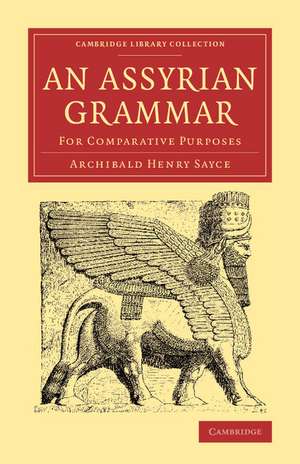
An Assyrian Grammar
Autor Archibald Henry Sayceen Limba Engleză Paperback – 30 sep 2014
Preț: 293.61 lei
Puncte Express: 440
Carte tipărită la comandă
Livrare economică 30 noiembrie-14 decembrie
Livrare prin curier în România Termenul estimat este afișat lângă disponibilitate.
Transport gratuit de la 400.00 lei Plată online sau ramburs, în funcție de opțiunile comenzii.
Retur gratuit în 14 zile Comandă securizată și suport în română.
Specificații
ISBN-13: 9781108077927
ISBN-10: 1108077927
Pagini: 210
Dimensiuni: 140 x 216 x 13 mm
Greutate: 0.3 kg
Editura: Cambridge University Press
Locul publicării:Cambridge, United Kingdom
ISBN-10: 1108077927
Pagini: 210
Dimensiuni: 140 x 216 x 13 mm
Greutate: 0.3 kg
Editura: Cambridge University Press
Locul publicării:Cambridge, United Kingdom
V-ar putea interesa
-
 -31%Preț: 964.62 lei1402.17 lei
 -
 The Evolution of Functional Left Peripheries in Hungarian SyntaxKatalin É. Kiss-31%Preț: 931.49 lei1354.93 lei
 -
 A History of Psycholinguistics: The Pre-Chomskyan EraWillem Levelt-21%Preț: 450.23 lei569.16 lei
 -
 Micro-Syntactic Variation in North American EnglishRaffaella Zanuttini-19%Preț: 369.21 lei455.81 lei
 -
 -31%Preț: 662.60 lei961.14 lei
 -
 The Life of SlangJulie Coleman-17%Preț: 85.46 lei102.80 lei
 -
 The Oxford Handbook of Linguistic FieldworkNicholas Thieberger-21%Preț: 305.53 lei386.96 lei
 -
 -31%Preț: 694.09 lei1007.38 lei
 -
 Basics of Ancient Ugaritic: A Concise Grammar, Workbook, and LexiconMichael WilliamsPreț: 295.25 lei
 -
 The Hakka DialectMantaro J. HashimotoPreț: 459.14 lei
 -
 Historical LinguisticsDon RingePreț: 290.42 lei
 -
 A History of the Korean LanguageKi-Moon Lee-23%Preț: 943.00 lei1224.67 lei
 -
 Roots of EnglishSali A. TagliamontePreț: 297.72 lei
 -
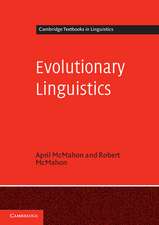 Evolutionary LinguisticsApril McmahonPreț: 356.93 lei
 -
 How Language BeganDavid McNeill-22%Preț: 224.61 lei286.35 lei
 -
 The English LanguageBarberPreț: 137.34 lei
 -
 Coptic Etymological DictionaryJaroslav ¿ErnýPreț: 308.85 lei
 -
 Preț: 139.01 lei
 -
 The Ugaritic Texts and the BibleMR Jerry D. NealPreț: 52.77 lei
 -
 Linguistic Roots of Europe: Origin & Development of European LanguagesRobert Mailhammer-24%Preț: 415.44 lei549.19 lei
Cuprins
Preface; 1. Introduction; 2. Literature of the Assyrian language; 3. Phonology; 4. The pronouns; 5. The verb; 6. The defective verb; 7. The nouns; 8. The numerals; 9. The prepositions; 10. The interjections; 11. The adverbs; 12. The conjunctions; 13. The syntax; 14. Prosody; 15. Corrections and additions.
Descriere
This 1872 grammar, using transliteration rather than cuneiform, covers the phonology, morphology, syntax and prosody of this ancient Semitic language.