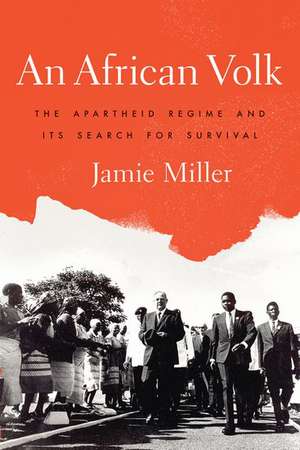
An African Volk: The Apartheid Regime and Its Search for Survival
Autor Jamie Milleren Limba Engleză Paperback – 16 oct 2019
Preț: 301.15 lei
Preț vechi: 374.35 lei
-20%
Puncte Express: 452
Carte tipărită la comandă
Livrare economică 04-09 decembrie
Livrare prin curier în România Termenul estimat este afișat lângă disponibilitate.
Transport gratuit de la 400.00 lei Plată online sau ramburs, în funcție de opțiunile comenzii.
Retur gratuit în 14 zile Comandă securizată și suport în română.
Specificații
ISBN-13: 9780190055547
ISBN-10: 0190055545
Pagini: 464
Ilustrații: 34 illus.
Dimensiuni: 155 x 231 x 31 mm
Greutate: 0.66 kg
Editura: Oxford University Press
Colecția OUP USA
Locul publicării:New York, United States
ISBN-10: 0190055545
Pagini: 464
Ilustrații: 34 illus.
Dimensiuni: 155 x 231 x 31 mm
Greutate: 0.66 kg
Editura: Oxford University Press
Colecția OUP USA
Locul publicării:New York, United States
V-ar putea interesa
-
 A Woman In ChargeCarl BernsteinPreț: 128.43 lei
 -
 The World Since 1945: A Concise HistoryKeith Robbins-17%Preț: 197.48 lei238.51 lei
 -
 Germany Since 1945Lothar Kettenacker-12%Preț: 326.63 lei370.28 lei
 -
 Grand Expectations: The United States, 1945-1974James T. Patterson-19%Preț: 162.53 lei201.85 lei
 -
 -28%Preț: 359.88 lei501.34 lei
 -
 Mandela: A Critical LifeTom Lodge-20%Preț: 121.83 lei153.21 lei
 -
 The Road to Monetary Union in Europe: The Emperor, the Kings, and the GeniesTommaso Padoa-Schioppa-29%Preț: 449.66 lei629.98 lei
 -
 -28%Preț: 392.40 lei547.56 lei
 -
 From the Soviet Bloc to the European UnionIvan T. BerendPreț: 250.79 lei
 -
 Inside the Gas ChambersShlomo VeneziaPreț: 94.06 lei
 -
 -33%Preț: 91.14 lei136.73 lei
 -
 The Spitting ImageJerry LembckePreț: 249.67 lei
 -
 Ohio StatesHammondPreț: 94.89 lei
 -
 9.11: The New Evidence: Fully Updated and RevisedIan HenshallPreț: 181.25 lei
Recenzii
Jamie Miller's analysis of apartheid diplomacy in the 1970s...delivers two important points: that local political agendas mattered to the global history of the Cold War and that international developments prompted ideological reassessment in Afrikaner nationalist circles....Miller's close reading of Afrikaner politics supports his assertion that regional specifics mattered in the Cold War. His analysis also undermines assumptions about the power of international whiteness. Even within Afrikanerdom, there were differences about whose white privilege merited protection and how it might be achieved.
[A] fresh, well-written, and deeply insightful look at the apartheid regime's efforts to escape international isolation and respond to major regional transformations in the 1970s....This re-centering of apartheid's history on an often-neglected diplomatic history approach admirably highlights its leaders' uncertainties, ambiguities, and plausible roads not taken....Miller's work is remarkable, and promises to be a standard reference for years to come....[S]hould serve as a useful model for aspiring young researchers writing their first books. It exhibits a stunningly rich knowledge of personalities and institutions....His wide-ranging use of archives, and lengthy note on their nature and availability, should serve as inspiration to future scholars, young and old. I thus highly recommend An African Volk to anyone interested in the history of apartheid, the Cold War in Southern Africa, or the burgeoning field of African international history.
Jamie Miller's An African Volk: The Apartheid Regime and the Search for Survival is the first in-depth study, based on primary sources, of Vorster's efforts to secure for South Africa a better image in the international community and attract allies in the independent African states in Southern Africa. Miller tells this entire story with great aplomb. His book is in my view the most outstanding debut of an historian of South Africa that has appeared in the last thirty to forty years....With An African Volk: The Apartheid Regime and its Search for Survival Miller has made a seminal contribution to both Cold War history and to the study of the crucial stages of the transition to black rule in Southern Africa.
While Miller's book includes several positive characteristics including convincing analysis, a lively writing style, and compelling examples of evidence throughout, arguably the most impressive aspect of An African Volk is the fact that much of the research examined documents written in Afrikaans, from a variety of South African archives....Miller succeeded in the very difficult task of putting himself into the shoes of the South African apartheid government's leadership in the 1970s, and convincingly portraying the regime as one that sought to walk a perilous tightrope and present itself as post-colonial and African, while simultaneously defending a putrid system of institutionalized racism. The remarkable result is that in Miller's account, the individuals ruling the roost from Pretoria, who are usually presented as one-dimensional, come across as human.
Unlike many scholars who have studied the apartheid regime, Miller is appreciative of the fact that the National Party leadership really did believe that apartheid was morally justi?able and that the polity established under white Afrikaner dominion was legitimate....An African Volk is an excellent addition to the South African historiography of the apartheid regime. It bears all the hallmarks of high-quality scholarship: thorough research and mastery of the secondary literature, an engaging style, profound and provocative insights, a coherent and convincing thesis and impeccable editing. Indeed, it is a consummate and exemplary piece of history writing. As such, it should establish Miller's good standing in the local and international academy.
[I]mpressive....[N]o one has researched this story in anything like the depth he has, and the result is a major contribution to knowledge of the ideology and discourse of the apartheid state in relation to the rest of Africa....[H]is book will, without doubt, long remain a key work on apartheid foreign policy in the 1970s.
Jamie Miller's important new book is perhaps the most successful monograph-length attempt to integrate a wide-ranging use of particularly South African, US and Rhodesian sources into a study of Pretoria's foreign policy during John Vorster's tenure as prime minister (1966-78). Based on a Cambridge PhD, its utilization of archival research, hard to find memoirs, newspapers and interviews makes it worthy of serious consideration....[T]his is perhaps the most important book written about South African foreign policy in the mid-Cold War era. The archival research, the interviews, and the wide reading in obscure publications will ensure that anyone who has an interest in apartheid and South African foreign policy will need to read this book and engage with its ideas.
[T]his is a valuable and important study in presenting Vorster's diplomatic efforts and his emphasis on 'multinational' 'separate development,'...as intimately linked and more than a cynical ploy, and in questioning claims in published sources through rigorous archival research. Above all, Miller refreshingly takes seriously arguments by and between Afrikaners themselves, regardless of how much he rejects such thinking.
An African Volk is the first in-depth study, based on primary sources, of Vorster's efforts to secure for South Africa a better image in the international community and attract allies in the independent African states in Southern Africa Miller tells this entire story with great aplomb. An African Volk is in my view the most outstanding debut of an historian of South Africa that has appeared in the last thirty to forty years The book is based on a very wide range of primary sources in the archives of several countries and on personal interviews with many of the main actors. Proficient in Afrikaans, the language of most white political leaders and civil servants, Miller was able to develop an acute understanding of the dynamics of Afrikaner politics and the often contradictory goals of the Department of Foreign Affairs and the military establishment.
Miller's book offers fascinating insights into the internal struggles of the apartheid regime as it tried to project its legitimacy and ensure its survival in the post-colonial, Cold War world. In this meticulously researched account, the author reveals the ways in which apartheid's ideologues appropriated language used against apartheid in an attempt to strengthen it, emphasizing the Africanness of the volk in an era of nationalism and decolonization, the nation-building claims of separate development, and the anti-communist consensus that bound White South Africa to the West.
This book is an exceptionally lucid, bold, and incisive study of the foreign policy of John Vorster. It shows vividly how after some enterprising attempts to engage African leaders, Vorster intervened in Angola in 1975, seeking to secure Afrikaner survival in terms that made the attainment of that goal impossible, and leaving him a tragic figure.
A long overdue look at the perceptions, ideology, and foreign policy of South Africa's apartheid regime during the 1970s, Miller's account is a challenge to conventional wisdom about the Cold War in Southern Africa and a significant contribution to the history of South Africa during a critical decade.
Miller's patient and careful reading of declassified South African documents tells us something new about apartheid and its relations to the countries north of the Limpopo. In the twenty years before 1994, the apartheid regime struggled, sometimes by encouraging considerable violence and sometimes at odds with the South African military, to locate and legitimate white-ruled South Africa in an anti-imperialist world of new nations.
This finely realized study of apartheid statecraft considerably deepens our understanding of the regional dynamics of South African power in the 1970s. Miller's astute analysis of Pretoria's realpolitik shows the ambitions and limits of political reforms in the era prior to the revival of mass resistance to apartheid in the 1980s.
Where apartheid South Africa's response to decolonisation has usually been seen as one of singular opposition and fear, Dr Miller's account instead tells a story of rich contradiction and nuance. He shows how the Afrikaner elite tried to rearticulate the legitimacy of their system in the new language of decolonisation and then execute ambitious statecraft feats to give this new vision substance. Incisive in its analysis, meticulously researched, and highly original, Dr Miller's work overturns much conventional wisdom in the area and lays down new paths for the study of the apartheid regime in the future.
[A] fresh, well-written, and deeply insightful look at the apartheid regime's efforts to escape international isolation and respond to major regional transformations in the 1970s....This re-centering of apartheid's history on an often-neglected diplomatic history approach admirably highlights its leaders' uncertainties, ambiguities, and plausible roads not taken....Miller's work is remarkable, and promises to be a standard reference for years to come....[S]hould serve as a useful model for aspiring young researchers writing their first books. It exhibits a stunningly rich knowledge of personalities and institutions....His wide-ranging use of archives, and lengthy note on their nature and availability, should serve as inspiration to future scholars, young and old. I thus highly recommend An African Volk to anyone interested in the history of apartheid, the Cold War in Southern Africa, or the burgeoning field of African international history.
Jamie Miller's An African Volk: The Apartheid Regime and the Search for Survival is the first in-depth study, based on primary sources, of Vorster's efforts to secure for South Africa a better image in the international community and attract allies in the independent African states in Southern Africa. Miller tells this entire story with great aplomb. His book is in my view the most outstanding debut of an historian of South Africa that has appeared in the last thirty to forty years....With An African Volk: The Apartheid Regime and its Search for Survival Miller has made a seminal contribution to both Cold War history and to the study of the crucial stages of the transition to black rule in Southern Africa.
While Miller's book includes several positive characteristics including convincing analysis, a lively writing style, and compelling examples of evidence throughout, arguably the most impressive aspect of An African Volk is the fact that much of the research examined documents written in Afrikaans, from a variety of South African archives....Miller succeeded in the very difficult task of putting himself into the shoes of the South African apartheid government's leadership in the 1970s, and convincingly portraying the regime as one that sought to walk a perilous tightrope and present itself as post-colonial and African, while simultaneously defending a putrid system of institutionalized racism. The remarkable result is that in Miller's account, the individuals ruling the roost from Pretoria, who are usually presented as one-dimensional, come across as human.
Unlike many scholars who have studied the apartheid regime, Miller is appreciative of the fact that the National Party leadership really did believe that apartheid was morally justi?able and that the polity established under white Afrikaner dominion was legitimate....An African Volk is an excellent addition to the South African historiography of the apartheid regime. It bears all the hallmarks of high-quality scholarship: thorough research and mastery of the secondary literature, an engaging style, profound and provocative insights, a coherent and convincing thesis and impeccable editing. Indeed, it is a consummate and exemplary piece of history writing. As such, it should establish Miller's good standing in the local and international academy.
[I]mpressive....[N]o one has researched this story in anything like the depth he has, and the result is a major contribution to knowledge of the ideology and discourse of the apartheid state in relation to the rest of Africa....[H]is book will, without doubt, long remain a key work on apartheid foreign policy in the 1970s.
Jamie Miller's important new book is perhaps the most successful monograph-length attempt to integrate a wide-ranging use of particularly South African, US and Rhodesian sources into a study of Pretoria's foreign policy during John Vorster's tenure as prime minister (1966-78). Based on a Cambridge PhD, its utilization of archival research, hard to find memoirs, newspapers and interviews makes it worthy of serious consideration....[T]his is perhaps the most important book written about South African foreign policy in the mid-Cold War era. The archival research, the interviews, and the wide reading in obscure publications will ensure that anyone who has an interest in apartheid and South African foreign policy will need to read this book and engage with its ideas.
[T]his is a valuable and important study in presenting Vorster's diplomatic efforts and his emphasis on 'multinational' 'separate development,'...as intimately linked and more than a cynical ploy, and in questioning claims in published sources through rigorous archival research. Above all, Miller refreshingly takes seriously arguments by and between Afrikaners themselves, regardless of how much he rejects such thinking.
An African Volk is the first in-depth study, based on primary sources, of Vorster's efforts to secure for South Africa a better image in the international community and attract allies in the independent African states in Southern Africa Miller tells this entire story with great aplomb. An African Volk is in my view the most outstanding debut of an historian of South Africa that has appeared in the last thirty to forty years The book is based on a very wide range of primary sources in the archives of several countries and on personal interviews with many of the main actors. Proficient in Afrikaans, the language of most white political leaders and civil servants, Miller was able to develop an acute understanding of the dynamics of Afrikaner politics and the often contradictory goals of the Department of Foreign Affairs and the military establishment.
Miller's book offers fascinating insights into the internal struggles of the apartheid regime as it tried to project its legitimacy and ensure its survival in the post-colonial, Cold War world. In this meticulously researched account, the author reveals the ways in which apartheid's ideologues appropriated language used against apartheid in an attempt to strengthen it, emphasizing the Africanness of the volk in an era of nationalism and decolonization, the nation-building claims of separate development, and the anti-communist consensus that bound White South Africa to the West.
This book is an exceptionally lucid, bold, and incisive study of the foreign policy of John Vorster. It shows vividly how after some enterprising attempts to engage African leaders, Vorster intervened in Angola in 1975, seeking to secure Afrikaner survival in terms that made the attainment of that goal impossible, and leaving him a tragic figure.
A long overdue look at the perceptions, ideology, and foreign policy of South Africa's apartheid regime during the 1970s, Miller's account is a challenge to conventional wisdom about the Cold War in Southern Africa and a significant contribution to the history of South Africa during a critical decade.
Miller's patient and careful reading of declassified South African documents tells us something new about apartheid and its relations to the countries north of the Limpopo. In the twenty years before 1994, the apartheid regime struggled, sometimes by encouraging considerable violence and sometimes at odds with the South African military, to locate and legitimate white-ruled South Africa in an anti-imperialist world of new nations.
This finely realized study of apartheid statecraft considerably deepens our understanding of the regional dynamics of South African power in the 1970s. Miller's astute analysis of Pretoria's realpolitik shows the ambitions and limits of political reforms in the era prior to the revival of mass resistance to apartheid in the 1980s.
Where apartheid South Africa's response to decolonisation has usually been seen as one of singular opposition and fear, Dr Miller's account instead tells a story of rich contradiction and nuance. He shows how the Afrikaner elite tried to rearticulate the legitimacy of their system in the new language of decolonisation and then execute ambitious statecraft feats to give this new vision substance. Incisive in its analysis, meticulously researched, and highly original, Dr Miller's work overturns much conventional wisdom in the area and lays down new paths for the study of the apartheid regime in the future.
Notă biografică
Jamie Miller is a Postdoctoral Fellow in the Department of History at the University of Pittsburgh. He received his PhD from the University of Cambridge and has held fellowships at Yale University and Cornell University.
Cuprins
- Acknowledgments
- Abbreviations
- Glossary of Afrikaans Terms
- Terminology
- Introduction
- Part I: From Control to Opportunity
- Ch 1 'We Are Not Europeans': Ideology and Identity in Pretoria's Golden Age
- Ch 2 Into Africa: The Outward Policy
- Ch 3 'We Must Stay Prepared': Reimagining the White Redoubt
- Ch 4 In Search of Détente: Negotiating a Transfer of Power in Rhodesia
- Part II: From Challenge to Crisis
- Ch 5 Mission Creep: South Africa's Intervention in the Angolan Civil War
- Ch 6 The Post Mortem: Lessons from Angola
- Ch 7 Dr. Kissinger, I Presume?: The 1976 Initiatives
- Part III: From Collapse to Reconstruction
- Ch 8 A New Roadmap: The Development of Total Strategy
- Ch 9 "If you say change, I'll say I can't": A New Vision
- Conclusion
- Note on Sources
- Archival Abbreviations
- Notes
- Bibliography
- Index