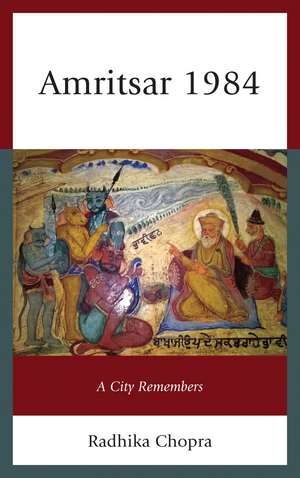
Amritsar 1984: A City Remembers
Autor Radhika Chopraen Limba Engleză Hardback – 15 aug 2018
Preț: 510.18 lei
Preț vechi: 744.23 lei
-31%
Puncte Express: 765
Carte tipărită la comandă
Livrare economică 17-31 august
Livrare prin curier în România Termenul estimat este afișat lângă disponibilitate.
Transport gratuit pentru acest produs Plată online sau ramburs, în funcție de opțiunile comenzii.
Retur gratuit în 14 zile Comandă securizată și suport în română.
Specificații
ISBN-13: 9781498571050
ISBN-10: 1498571050
Pagini: 134
Ilustrații: 19 BW Photos
Dimensiuni: 158 x 231 x 14 mm
Greutate: 0.4 kg
Editura: Bloomsbury Publishing
Colecția Lexington Books
Locul publicării:New York, United States
ISBN-10: 1498571050
Pagini: 134
Ilustrații: 19 BW Photos
Dimensiuni: 158 x 231 x 14 mm
Greutate: 0.4 kg
Editura: Bloomsbury Publishing
Colecția Lexington Books
Locul publicării:New York, United States
Cuprins
Introduction: Pasts We Cannot Forget
1. Portrait of a Martyr
2. Seeing Off the Dead
3. Bazaar Divinity
4. Curating the Sacred
1. Portrait of a Martyr
2. Seeing Off the Dead
3. Bazaar Divinity
4. Curating the Sacred
Recenzii
It is rare to come across a book that alters everything you thought you knew about a landmark event. This is such a book. Drawing on visual ethnography in and around the Darbar Sahib, Chopra crafts a compelling, almost poetic account of how Operation Bluestar in 1984 is remembered in Amritsar today. Analyzing how martyr photographs, souvenirs, buildings and frescoes are designed, placed, changed, moved or censored, this book is not merely indispensable to the study of Sikhism but also to the scholarship of religion and politics worldwide.
This book is an interesting and significant exercise in visual anthropology of a traumatic event in the recent history of Amritsar, of Darbar Sahib, of the Sikhs there, and everywhere. It unmasks the dialectical undercurrents of the sacred (divine) and secular (bazaar), remembering and forgetting, past and present, memory and event, amidst attendant forces of religion, politics, and economy.
This book is an interesting and significant exercise in visual anthropology of a traumatic event in the recent history of Amritsar, of Darbar Sahib, of the Sikhs there, and everywhere. It unmasks the dialectical undercurrents of the sacred (divine) and secular (bazaar), remembering and forgetting, past and present, memory and event, amidst attendant forces of religion, politics, and economy.