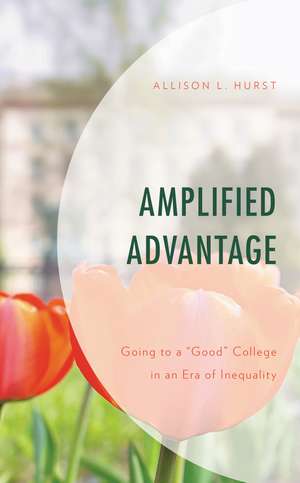
Amplified Advantage: Going to a "Good" College in an Era of Inequality: Social Class in Education
Autor Allison L. Hursten Limba Engleză Paperback – 24 iun 2021
| Toate formatele și edițiile | Preț | Express |
|---|---|---|
| Paperback (1) | 267.60 lei 6-8 săpt. | |
| Bloomsbury Publishing – 24 iun 2021 | 267.60 lei 6-8 săpt. | |
| Hardback (1) | 662.17 lei 6-8 săpt. | |
| Bloomsbury Publishing – 18 oct 2019 | 662.17 lei 6-8 săpt. |


Preț: 267.60 lei
Preț vechi: 368.90 lei
-27%
Puncte Express: 401
Preț estimativ în valută:
47.32€ • 54.90$ • 40.94£
47.32€ • 54.90$ • 40.94£
Carte tipărită la comandă
Livrare economică 08-22 mai
Specificații
ISBN-13: 9781498589673
ISBN-10: 1498589677
Pagini: 310
Ilustrații: 39 b/w illustrations; 17 tables;
Dimensiuni: 153 x 231 x 19 mm
Greutate: 0.49 kg
Editura: Bloomsbury Publishing
Colecția Lexington Books
Seria Social Class in Education
Locul publicării:New York, United States
ISBN-10: 1498589677
Pagini: 310
Ilustrații: 39 b/w illustrations; 17 tables;
Dimensiuni: 153 x 231 x 19 mm
Greutate: 0.49 kg
Editura: Bloomsbury Publishing
Colecția Lexington Books
Seria Social Class in Education
Locul publicării:New York, United States
Cuprins
Acknowledgements
Prologue
Chapter One: Introduction
Chapter Two: A Short History of Higher Education and the Small Liberal Arts College in the US
Chapter Three: Orientation: Understanding Who Goes to Small Liberal Arts Colleges and Why?
Chapter Four: Agency and Constraint in the College Selection Process
Chapter Five: Paying for College
Chapter Six: Learning the Liberal Arts: The Curriculum
Chapter Seven: Living the Liberal Arts: Campus Life
Chapter Eight: Outside the College Gates
Chapter Nine: Graduating (in a Recession)
Chapter Ten: Conclusion: Habitus, Capitals, Game
Appendix: The School to Work Study
Notes
References
Index
About the Author
Prologue
Chapter One: Introduction
Chapter Two: A Short History of Higher Education and the Small Liberal Arts College in the US
Chapter Three: Orientation: Understanding Who Goes to Small Liberal Arts Colleges and Why?
Chapter Four: Agency and Constraint in the College Selection Process
Chapter Five: Paying for College
Chapter Six: Learning the Liberal Arts: The Curriculum
Chapter Seven: Living the Liberal Arts: Campus Life
Chapter Eight: Outside the College Gates
Chapter Nine: Graduating (in a Recession)
Chapter Ten: Conclusion: Habitus, Capitals, Game
Appendix: The School to Work Study
Notes
References
Index
About the Author
Recenzii
Hurst (sociology, Oregon State Univ.) examines whether small liberal arts colleges (SLACs) amplify or ameliorate preexisting class disparities. To illustrate the impact class has on student outcomes and experiences, the author uses surveys, observations, and interview data collected from students at several SLACs. She employs central concepts of Pierre Bourdieu's theory on class, such as capital and habitus, to frame the results of her study. Through stories and thick description, Hurst unpacks the complexity of how social class influences students' strategies, such as what they choose to study and what they do after graduation. This research shows that SLACs offer an invaluable education to students of all social classes, but ultimately students from economically privileged backgrounds fare better than their peers despite having similar curricular and extracurricular experiences. Although the tone and style of this book are appropriate for academics, general audiences may also find the text appealing and highly readable. . . Hurst's well-researched book is insightful and should be read by students, faculty, and college administrators. Summing Up: Recommended. General readers, upper-division undergraduates through faculty, and professionals.
Over the past few decades, U.S. higher education institutions have increased the racial/ethnic and socioeconomic diversity of their student populations. At the same time, both wealth and income inequality have increased nationally. to the point that we are about as unequal as we have been since the Great Depression. It's in the context of this era of exceptional inequality that Allison Hurst attempts to understand how social class affects the experience and outcomes of attending a liberal arts college-the "good" college of the title. Her focus on this rather small sector of higher education is motivated by her sense that these institutions are elite and distinctive with social-justice oriented, "leveling up" missions, which lead them to aspire to having diverse student populations. Using a clear writing style and a mixed-methods approach (including her own survey), Hurst attempts to understand how social class affects both college choice and the college experience of students at small liberal arts colleges (SLACs).... Hurst's main findings both reinforce findings from other studies and highlight some patterns that should be further explored. Hurst finds that students who enter SLACs do indeed enter a "bubble" that appears to equalize experiences for all.... Ultimately, Hurst finds that the bubble may be the same for all, but those who emerge best are those who entered best.
Hurst builds on her celebrated history of explaining how class works at college. Her newest book turns our attention to liberal arts colleges - where class plays out in predictable and unpredictable ways.
Amplified Advantage is essential reading for all those concerned about inequalities in higher education. Richly theorised, evocatively reflexive, and beautifully written, the book captures and sustains the reader's interest through a rich synergy of qualitative and quantitative research that weaves together the lived experiences of young people in higher education. Its powerful and provocative message that a university degree is no longer enough to redress social class inequalities is one we all need to heed.
Over the past few decades, U.S. higher education institutions have increased the racial/ethnic and socioeconomic diversity of their student populations. At the same time, both wealth and income inequality have increased nationally. to the point that we are about as unequal as we have been since the Great Depression. It's in the context of this era of exceptional inequality that Allison Hurst attempts to understand how social class affects the experience and outcomes of attending a liberal arts college-the "good" college of the title. Her focus on this rather small sector of higher education is motivated by her sense that these institutions are elite and distinctive with social-justice oriented, "leveling up" missions, which lead them to aspire to having diverse student populations. Using a clear writing style and a mixed-methods approach (including her own survey), Hurst attempts to understand how social class affects both college choice and the college experience of students at small liberal arts colleges (SLACs).... Hurst's main findings both reinforce findings from other studies and highlight some patterns that should be further explored. Hurst finds that students who enter SLACs do indeed enter a "bubble" that appears to equalize experiences for all.... Ultimately, Hurst finds that the bubble may be the same for all, but those who emerge best are those who entered best.
Hurst builds on her celebrated history of explaining how class works at college. Her newest book turns our attention to liberal arts colleges - where class plays out in predictable and unpredictable ways.
Amplified Advantage is essential reading for all those concerned about inequalities in higher education. Richly theorised, evocatively reflexive, and beautifully written, the book captures and sustains the reader's interest through a rich synergy of qualitative and quantitative research that weaves together the lived experiences of young people in higher education. Its powerful and provocative message that a university degree is no longer enough to redress social class inequalities is one we all need to heed.