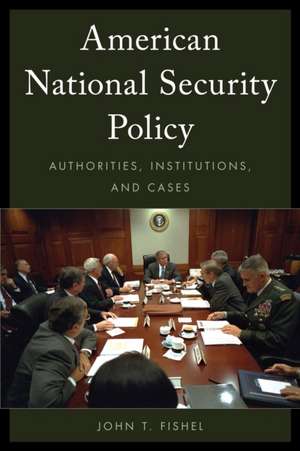
American National Security Policy: Authorities, Institutions, and Cases
Autor John T. Fishelen Limba Engleză Paperback – 15 feb 2017
Descoperim în American National Security Policy o abordare riguroasă a mecanismelor care guvernează deciziile de apărare ale Statelor Unite, fundamentată pe studii de caz concrete ce acoperă conflictele majore din ultimele decenii. Analiza pleacă de la intervenția din Panama și tragedia din Somalia, trecând prin complexitatea războaielor din Irak și Afganistan, pentru a ilustra succesul sau eșecul implementării politicilor de securitate. Subliniem faptul că autorul nu se limitează la teorie, ci oferă o perspectivă din interior asupra modului în care agenții precum CIA sau NSA interacționează în cadrul proceselor Consiliului de Securitate Națională.
Structura volumului este organizată progresiv, începând cu fundamentul teoretic al realismului politic și continuând cu analiza autorităților legale și a sistemelor de planificare a apărării. Această progresie permite cititorului să înțeleagă cum documentele strategice și rapoartele oficiale se transformă în acțiuni pe teren. Considerăm că această lucrare extinde cadrul propus de US National Security Reform de Heidi B. Demarest prin adăugarea unor date practice și lecții învățate direct din teatrele de operațiuni, oferind o viziune mai aplicată asupra birocrației de securitate.
În contextul operei sale, volumul de față reprezintă o sinteză a temelor abordate în Uncomfortable Wars Revisited și The Complexity of Modern Asymmetric Warfare. Dacă în lucrările anterioare John T. Fishel se concentra pe natura schimbătoare a inamicului și a războiului asimetric, aici acesta mută reflectorul asupra arhitecturii instituționale americane. Este o examinare critică a modului în care legislația, precum Actul Securității Naționale din 1947, limitează sau potențează capacitatea de răspuns a factorilor de decizie în fața provocărilor globale contemporane.
Preț: 279.50 lei
Preț vechi: 362.89 lei
-23%
Carte tipărită la comandă
Livrare economică 17 noiembrie-01 decembrie
Specificații
ISBN-10: 1442248386
Pagini: 240
Ilustrații: 13 graphs
Dimensiuni: 148 x 226 x 20 mm
Greutate: 0.42 kg
Editura: Bloomsbury Publishing
Colecția Rowman & Littlefield
Locul publicării:New York, United States
V-ar putea interesa
-
 How The West Was LostDambisa Moyo-32%Preț: 63.15 lei92.44 lei
 -
 The Great DegenerationNiall Ferguson-20%Preț: 61.36 lei76.86 lei
 -
 The Future of WarLawrence Freedman-30%Preț: 65.48 lei93.84 lei
 -
 The Meritocracy TrapDaniel Markovits-29%Preț: 77.02 lei108.15 lei
 -
 The Dawn of EurasiaBruno Macaes-31%Preț: 64.19 lei93.05 lei
 -
 EmpireNiall Ferguson-29%Preț: 77.42 lei108.39 lei
 -
 CivilizationNiall Ferguson-29%Preț: 77.42 lei108.39 lei
 -
 No One's World: The West, the Rising Rest, and the Coming Global TurnCharles A. Kupchan-19%Preț: 97.18 lei120.65 lei
 -
 CollapseJared Diamond-34%Preț: 90.43 lei137.46 lei
 -
 Grave New World: The End of Globalization, the Return of HistoryStephen D. KingPreț: 104.96 lei
 -
 Preț: 130.75 lei
 -
 The Great Delusion: Liberal Dreams and International RealitiesJohn J. MearsheimerPreț: 127.11 lei
 -
 Preț: 80.61 lei
 -
 -35%Preț: 203.30 lei312.21 lei
 -
 GoliathSean Mcfate-19%Preț: 63.43 lei78.09 lei
 -
 The New Cold WarEdward Lucas-27%Preț: 67.77 lei92.27 lei
 -
 The End of Normal: The Great Crisis and the Future of GrowthJames K. Galbraith-19%Preț: 58.37 lei71.68 lei
 -
 -26%Preț: 69.73 lei94.12 lei
 -
 Is This the End of the Liberal International Order?Niall FergusonPreț: 83.28 lei
 -
 Black Sea: Coasts and Conquests: From Pericles to PutinNeal Ascherson-31%Preț: 63.44 lei91.74 lei
 -
 -21%Preț: 173.13 lei219.52 lei
 -
 -15%Preț: 112.01 lei132.39 lei
 -
 IS THIS THE ASIAN CENTURY?Lee Jong-WhaPreț: 340.95 lei
De ce să citești această carte
Această carte este esențială pentru studenții și profesioniștii din domeniul relațiilor internaționale care doresc să înțeleagă nu doar „ce” decide SUA, ci mai ales „cum”. Prin combinarea teoriei realistice cu experiența practică a autorului în serviciile de informații, volumul oferă instrumentele necesare pentru a descifra procesele birocratice și legale din spatele marilor strategii militare, oferind claritate asupra modului în care instituțiile americane își proiectează puterea globală.
Despre autor
John T. Fishel este profesor emerit de politică de securitate națională la Universitatea din Oklahoma și un expert recunoscut în domeniul conflictelor de mică intensitate. Cariera sa impresionantă include 28 de ani de serviciu ca ofițer de informații în armata SUA, unde a deținut funcții cheie precum șef al Diviziei de Politică și Strategie în cadrul U.S. Southern Command și șef de cercetare în cadrul SWORD. Această experiență vastă în planificarea strategică și evaluarea operațională informează direct scrierile sale, transformându-l într-o voce autoritară în analiza politicilor de apărare și a războiului asimetric modern.
Descriere
Security policy is a key factor not only of domestic politics in the U.S., but also of foreign relations and global security. This text sets to explain the process of security policy making in the United States by looking at all the elements that shape it, from institutions and legislation to policymakers themselves and historical precedents. To understand national security policy, the book first needs to address the way national security policy makers see the world. It shows that they generally see it in realist terms where the state is a single rational actor pursuing its national interest. It then focuses on how legislative authorities enable and constrain these policy makers before looking at the organizational context in which policies are made and implemented. This means examining the legal authorities that govern how the system functions, such as the Constitution and the National Security Act of 1947, as well as the various governmental institutions whose capabilities either limit or allow execution, such as the CIA, NSA, etc. Next, the text analyzes the processes and products of national security policy making, such as reports, showing how they differ from administration to administration. Lastly, a series of case studies illustrate the challenges of implementing and developing policy. These span the post-Cold war period to the present, and include the Panama crisis, Somalia, the Balkans Haiti, the Iraq wars, and Afghanistan. By combining both the theory and process, this textbook reveals all aspects of the making of national security policy in United States from agenda setting to the successes and failures of implementation.
Cuprins
Acknowledgements
Preface
Part I: A Touch of Theory
Chapter 1. A Practitioners Guide to Realism
Part II: The Practitioners' Textbook
Chapter 2. Legal Authorities
Chapter 3. National Security Organizations
Chapter 4. The National Security Council Process
Chapter 5. Defense Planning Systems
Part III: The Cases
Chapter 6. Panama: National Security Policy from Below
Chapter 7. "I Love it When a Plan Comes Together"
Chapter 8. Adventures in Peace Enforcement: The Somalia Tragedy
Chapter 9. The "Intervasion" of Haiti
Chapter 10. "Some Damned Foolish Thing in the Balkans"
Chapter 11. 9/11 and the Invasion of Afghanistan
Chapter 12. Iraq: Snatching Defeat From the Jaws of Victory and Victory From the Jaws of Defeat
Chapter 13. The Afghanistan Surge: Obama's Finest Hour?
Part IV: Some Conclusions
Chapter 14. How National Security Policy Is Really Made: Lessons From the Cases
Bibliography
Recenzii
John Fishel provides a compelling insider's perspective on some of the most important political crises the United States has faced over the past thirty years, including conflicts in Iraq, Afghanistan, Somalia, Yugoslavia, and Panama. As he adeptly demonstrates, the details matter, and lives are lost or saved depending on a complex interaction of policies, ideological agendas, professional relationships, and decisions made by individuals at all levels of the chain of command. Fishel's work has shaped my thinking about national security strategies for a long time, and it will continue to do so for many years to come.
This is a realistic book about U.S. security policy and a superb starting point for a course on security policy for leaders or students in any country that deals with America-and that's most of the world. Fishel's case studies are redolent with the lessons of the generations who have passed through his classrooms. Security policy making is a living art, and the practice has changed with each of the operations described. This is a readable, teachable, text. We can only hope that somewhere in Moscow and Beijing there are Russian and Chinese counterparts working to explain the reality of those powers' national security policy making. I think that would help to make the world a safer place.