American Immunity
Autor Patrick Hagopianen Limba Engleză Paperback – 7 noi 2013
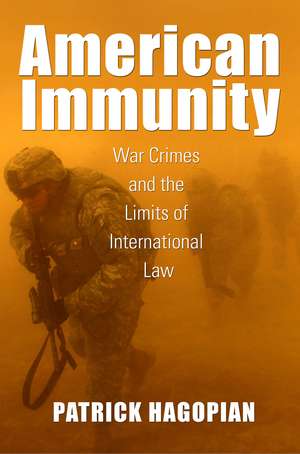
In American Immunity, Hagopian places what he calls the “superpower exemption” in the context of a long-standing tension between international law and U.S. sovereignty. He shows that despite the U.S. role in promulgating universal standards of international law and forming institutions where those standards can be enforced, the United States has repeatedly refused to submit its own citizens and troops to the jurisdiction of international tribunals and failed to uphold international standards of justice in its own courts.
In 2000 Congress attempted to close the jurisdictional gap with passage of the Military Extraterritorial Jurisdiction Act. The effectiveness of that legislation is still in question, however, since it remains unclear how willing civilian American juries will be to convict veterans for conduct in foreign war zones.
Preț: 224.91 lei
Puncte Express: 337
Preț estimativ în valută:
39.78€ • 47.17$ • 34.66£
39.78€ • 47.17$ • 34.66£
Carte indisponibilă temporar
Doresc să fiu notificat când acest titlu va fi disponibil:
Se trimite...
Specificații
ISBN-13: 9781625340474
ISBN-10: 1625340478
Pagini: 256
Dimensiuni: 156 x 236 x 19 mm
Greutate: 0.43 kg
Ediția:First Edition
Editura: University of Massachusetts Press
ISBN-10: 1625340478
Pagini: 256
Dimensiuni: 156 x 236 x 19 mm
Greutate: 0.43 kg
Ediția:First Edition
Editura: University of Massachusetts Press
Notă biografică
PATRICK HAGOPIAN is senior lecturer in History and American Studies at Lancaster University and author of The Vietnam War in American Memory: Veterans, Memorials, and the Politics of Healing (University of Massachusetts Press, 2009).
Cuprins
Acknowledgments
Introduction: The American Exemption
1. “A Very Simple Provision”: The Uniform Code of Military Justice and the Jurisdictional Gap
2. “Treaty Law” and “Murdering Wives”: The Widening of the Jurisdictional Gap
3. “A Very Undesirable Situation”: Sam Ervin and the Constitutional Rights Subcommittee
4. “Uncharted Legal Waters”: The My Lai Massacre and the Jordan Memorandum
5. A “Tragedy of Major Proportions”: The Peers Inquiry and the House Subcommittee Report
6. “Inexcusable and Terrible”: The Calley Conviction and the Abandonment of the Effort to Try the My Lai Veterans
7. “Why Can’t We Just Shoot Them All?”: MEJA and the First Prosecutions in Federal District Courts
Conclusion: “The One Significant Holdout”
Abbreviations
Notes
Index
Introduction: The American Exemption
1. “A Very Simple Provision”: The Uniform Code of Military Justice and the Jurisdictional Gap
2. “Treaty Law” and “Murdering Wives”: The Widening of the Jurisdictional Gap
3. “A Very Undesirable Situation”: Sam Ervin and the Constitutional Rights Subcommittee
4. “Uncharted Legal Waters”: The My Lai Massacre and the Jordan Memorandum
5. A “Tragedy of Major Proportions”: The Peers Inquiry and the House Subcommittee Report
6. “Inexcusable and Terrible”: The Calley Conviction and the Abandonment of the Effort to Try the My Lai Veterans
7. “Why Can’t We Just Shoot Them All?”: MEJA and the First Prosecutions in Federal District Courts
Conclusion: “The One Significant Holdout”
Abbreviations
Notes
Index
Recenzii
“The question of whether the rule of law applies to America's own military is at the heart of Patrick Hagopian's searing study American Immunity. The book is a thorough and powerful indictment of a system that has allowed some Americans, as the author puts it, to ‘get away with murder.’ . . . His palpable outrage makes American Immunity a compelling read."—American Historical Review
“At first glance, Patrick Hagopian's important and insightful book might appear of interest to only historians of military law. His careful reconstruction of events, however, reveals a decades-long political episode that let some people get away with murder—literally. . . . American Immunity is comprehensive but concise, impressively documented by primary sources (in sixty pages of footnotes) and clearly written. . . . It is an important and troubling story.”—Journal of American History
“An impressive, wide-ranging, multilayered work. Patrick Hagopian uses the problem of the jurisdictional gap to open up much larger questions—including public attitudes toward military justice and the death of civilians, the hostility toward international law and international legal institutions within sections of U.S. political culture, and the defensive response of political and military hierarchies to any effort to link individual war crimes to the principle of command responsibility.”—Kendrick Oliver, author of My Lai in American History and Memory
“At first glance, Patrick Hagopian's important and insightful book might appear of interest to only historians of military law. His careful reconstruction of events, however, reveals a decades-long political episode that let some people get away with murder—literally. . . . American Immunity is comprehensive but concise, impressively documented by primary sources (in sixty pages of footnotes) and clearly written. . . . It is an important and troubling story.”—Journal of American History
“An impressive, wide-ranging, multilayered work. Patrick Hagopian uses the problem of the jurisdictional gap to open up much larger questions—including public attitudes toward military justice and the death of civilians, the hostility toward international law and international legal institutions within sections of U.S. political culture, and the defensive response of political and military hierarchies to any effort to link individual war crimes to the principle of command responsibility.”—Kendrick Oliver, author of My Lai in American History and Memory