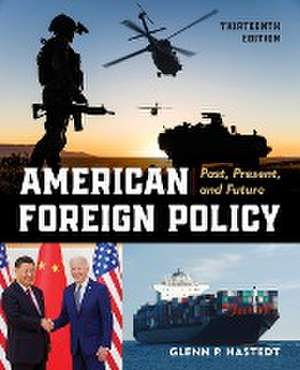
American Foreign Policy: Past, Present, and Future
Autor Glenn P. Hastedten Limba Engleză Paperback – 6 feb 2023
Ne-a atras atenția modul în care ediția a 13-a a lucrării American Foreign Policy reușește să ancoreze evenimentele geopolitice recente în structuri teoretice solide, oferind studenților instrumentele necesare pentru a naviga o lume în continuă schimbare. Un capitol central, „Defining American Foreign Policy Problems”, utilizează retragerea din Afganistan ca studiu de caz pentru a ilustra complexitatea interesului național și selecția instrumentelor de politică externă. Reținem că autorul nu se limitează la o expunere cronologică, ci invită la o analiză profundă a modului în care tranziția de la administrația Trump la președinția lui Biden a reconfigurat alianțele tradiționale și a readus în prim-plan politica marilor puteri.
Structura volumului este riguros organizată pentru uz didactic, introducând obiective de învățare clare pentru fiecare capitol și rubrici precum „On the Agenda” sau „Historical Lesson”. Acestea din urmă sunt esențiale pentru înțelegerea modului în care doctrinele prezidențiale, de la Truman la Bush, influențează deciziile de astăzi. Față de lucrările anterioare ale autorului, precum Introduction to International Politics, unde accentul cădea pe legătura dintre teorie și politică globală, acest titlu se concentrează specific pe mecanismele interne, guvernamentale și civile ale Statelor Unite.
Putem afirma că American Foreign Policy reprezintă o alternativă solidă la Foreign Policy de Robert J. Lieber pentru cursurile de relații internaționale, având avantajul unei actualizări proaspete ce include diplomația sănătății post-COVID și analiza războiului din Ucraina. În timp ce alte volume din bibliografie se pot concentra pe eseuri tematice, textul lui Glenn P. Hastedt oferă o coerență pedagogică superioară prin utilizarea a 28 de tabele și a numeroaselor întrebări de gândire critică ce transformă lectura într-un proces activ de evaluare a strategiei americane.
Preț: 437.66 lei
Preț vechi: 592.48 lei
-26%
Carte tipărită la comandă
Livrare economică 17 noiembrie-01 decembrie
Specificații
ISBN-10: 1538173751
Pagini: 386
Ilustrații: 1 b/w illustration; 14 b/w photos; 28 tables; 3 textboxes
Dimensiuni: 188 x 234 x 24 mm
Greutate: 0.66 kg
Ediția:Thirteenth Edition
Editura: Bloomsbury Publishing
Colecția Rowman & Littlefield
Locul publicării:New York, United States
De ce să citești această carte
Această ediție este esențială pentru studenții la științe politice și relații internaționale care doresc să înțeleagă nu doar 'ce' se întâmplă pe scena mondială, ci și 'de ce'. Cititorul câștigă o perspectivă clară asupra modului în care instituțiile americane procesează crizele actuale, de la Ucraina la Afganistan. Este o resursă valoroasă pentru oricine caută să decodifice mecanismele puterii din spatele titlurilor de știri, oferind un context istoric și teoretic indispensabil.
Despre autor
Glenn P. Hastedt este profesor emerit la James Madison University, unde a condus departamentele de Științe Politice și Studii de Justiție. Cu un doctorat obținut la Indiana University, Hastedt și-a dedicat peste trei decenii predării politicii externe americane și relațiilor internaționale. Este un autor prolific, semnând lucrări de referință precum American Foreign Policy: Past, Present, Future și Introduction to International Politics. Expertiza sa extinsă include și domeniul serviciilor de informații, fiind editorul volumului Controlling Intelligence. Abordarea sa pedagogică pune accent pe dezvoltarea gândirii critice, reflectând o carieră dedicată formării noilor generații de analiști politici.
Cuprins
1. DEFINING AMERICAN FOREIGN POLICY PROBLEMS
On the Agenda: Leaving Afghanistan
Thinking about Foreign Policy Problems
Choices
What Do Americans Want in Foreign Policy?
The National Interest
Costs
Building Consensus
Selecting a Policy Instrument
Hard Power and Soft Power
Unilateral or Multilateral Action
Historical Lesson: Into Afghanistan
Presidential Foreign Policy Doctrines
The Truman Doctrine
The Nixon Doctrine
The Carter Doctrine
The Reagan Doctrine
The Bush Doctrine
In Search of the Trump Doctrine
Is There a Trump Foreign Policy Legacy?
Assessing Foreign Policy Results
Intellectual Coherence
The Dominance of Domestic Politics
Consistency of Application
Over the Horizon: The Future of Grand Strategy
2. THE GLOBAL CONTEXT
On the Agenda: The Ukraine War
Thinking about the World
Realism
Neoliberalism
Constructivism
International System: Structural Constants
Decentralization
Self-Help System
A Stratified System
International System: Evolutionary Trends
Diffusion of Power
Issue Proliferation
Actor Proliferation
Historical Lesson: NATO
Regional Diversity
Dominant Features Today
Terrorism
Globalization
American Hegemony
America and the World: Attitudes and Perceptions
Over the Horizon: 2040
3. THE AMERICAN NATIONAL STYLE
On the Agenda: The Mexican Border
The Importance of Ideas
Isolationism versus Internationalism
Historical Sources of the American National Style
Patterns
Unilateralism
Moral Pragmatism
Legalism
Consequences of the American National Style
Historical Lesson: The Bracero Program
Voices from the Past
Over the Horizon: A Millennial Foreign Policy?
4. LEARNING FROM THE PAST
On the Agenda: Covid-19
How Do Policy Makers Learn from the Past?
Events From Which Policy Makers Learn
Types of Calculations Made
Lessons Learned
Historical Lesson: Ebola
Case Studies
The Vietnam War
The Iraq War
Over the Horizon: Searching for Lessons from Afghanistan
5. SOCIETY
On the Agenda: Quincy Institute for Responsible Statecraft
Public Awareness of Foreign Policy Issues
Public Opinion
Trends and Content
Public Opinion and the Use of Force
Impact of Public Opinion
Elections
Voting and Foreign Policy
Impact of Elections
Interest Groups
Historical Lesson: America First Committee, 1940
Types of Interest Groups
Impact of Interest Groups
Political Protest
The Media and American Foreign Policy
Newspapers and Television
The New Media and American Foreign Policy
Shaping the Public's View
States and Cities: The New Foreign Policy Battleground
Policy Makers' Responses
Over the Horizon: An Intelligence-Industrial Complex?
6. CONGRESS
On the Agenda: Aid for Ukraine
Constitutional Powers
Treaty-Making Power
Appointment Powers
War Powers
Historical Lesson: War Powers Act
Commerce Powers
Congressional Structure and Foreign Policy
Blunt Foreign Policy Tools
The Absence of a Single Voice
Policy Entrepreneurship
Staff Aides
Influence of Party and Region
Outsourcing Foreign Policy
Congress and the President: The Changing Relationship
Over the Horizon: A New War Powers Act?
7. PRESIDENCY
On the Agenda: Biden's First 100 Days
Historical Lesson: John F. Kennedy's First 100 Days
Weak President or Strong President
Presidential Power and Supreme Court Decisions
The President and the Foreign Affairs Constitution
Executive Agreements
Signing Statements
Executive Orders, Spending, and Administrative Powers
Informal Ambassadors
Undeclared Wars
When Does the President Matter?
Presidential Personality
Presidential Managerial Style
The National Security Council
Other White House Voices
The Vice President
The U.S. Trade Representative
The White House Chief of Staff
The First Lady
Over the Horizon: Improving Presidential Transitions
8. BUREAUCRACY
On the Agenda: Fixing the State Department
Presidents and the Bureaucracy
The State Department
Structure and Growth of the State Department
The State Department's Value System
Impact of the State Department on Foreign Policy
The Department of Defense
Structure and Growth of the Department of Defense
Historical Lesson: Integrating the Military
The Value System of the Department of Defense
Impact of the Defense Department on Foreign Policy
The CIA and the Intelligence Community
Structure and Growth of the CIA and the Intelligence Community
The Intelligence Community's Value System
Impact of the CIA and the Intelligence Community on Foreign Policy
The Domestic Bureaucracies
Treasury, Commerce, and Agriculture
Homeland Security
Policy Makers' Response to Bureaucracy
Over the Horizon: U.S. Space Command
9. POLICY-MAKING MODELS
On the Agenda: Ukraine War Decision Making
Foreign Policy Decisions and Models
The Rational Actor Model
The Bureaucratic Politics Model
The Small-Group Decision-Making Model
Elite Theory and Pluralism
Historical Lesson: The War to End All Wars
Integrating Models
The Cuban Missile Crisis
The Crisis: An Overview
Applying the Rational Actor Model to the Crisis
Applying the Bureaucratic Politics Model to the Crisis
Applying the Small-Group Decision-Making Model to the Crisis
Models: A Policy Maker Critique
Over the Horizon: Individual-Centered Models
10. DIPLOMACY
On the Agenda: The Paris Agreement
Diplomacy: Choices and Dilemmas
The Diplomatic Tool Kit
Bilateralism versus Multilateralism
Process versus Product
Incentives versus Sanctions
Bilateral Diplomacy: Allies, Friends, Adversaries
Shuttle Diplomacy
Summit Diplomacy
Economic Summits
East-West Superpower Summits
Conference Diplomacy
The General Agreement on Tariffs and Trade (GATT) and the World Trade Organization (WTO)
Historical Lesson: The Kyoto Protocol and Copenhagen Accord
Environmental Conferences
Human Rights Conferences
Global Heath Conferences
UN Diplomacy
Public Diplomacy and Digital Diplomacy
The Political Use of Force
Coercive Diplomacy
Nuclear Diplomacy
Arms Transfers
Over the Horizon: Coalitions of the Willing
11. ECONOMIC INSTRUMENTS
On the Agenda: United States-Mexico-Canada Agreement (USMCA)
Economic Statecraft
Inventory of Options
Strategic Outlooks
Free Trade
Strategic Trade
Monetary Strategies
Varieties of Trade Agreements
Bilateral Trade Agreements
Regional Trade Agreements
Global Trade Agreements
The China Trade War
Economic Sanctions
Using Sanctions
Sanctions in Action: Iran, Cuba, Russia
Foreign Aid
Types of Foreign Aid
Cold War Foreign Aid
Post-Cold War Foreign Aid
Historical Lesson: NAFTA
Post-9/11 Foreign Aid
Contemporary Foreign Aid
Over the Horizon: How Trade Wars End
12. MILITARY INSTRUMENTS: BIG WARS
On the Agenda: North Korean Denuclearization
Cold War Nuclear Thinking
The U.S. Cold War Strategic Arsenal
U.S. Cold War Nuclear Strategy
Historical Lesson: The Baruch Plan
Post-Cold War Nuclear Thinking
The U.S. Post-Cold War Strategic Nuclear Arsenal
U.S. Post-Cold War Nuclear Strategy: Content
Bridging the Nuclear-Conventional Divide
Deterrence
Preemption
Using Large-Scale Conventional Military Force
Reducing the Danger of War: Arms Control and Disarmament
The Cold War Record
The Post-Cold War Record
Defense
The Strategic Defense Initiative
National Missile Defense Systems
Over the Horizon: A New Age of Nuclear Proliferation
13. MILITARY INSTRUMENTS: SMALL WARS
On the Agenda: Cyber Warfare
Separating Big Wars from Small Wars
Exiting Small Wars
Types of Small Wars
Hybrid Warfare
Counterinsurgency
Counterterrorism
The Return of Small Wars?
Small Wars by Other Means
Cold War Covert Action
Post-Cold War Covert Action
The Covert War against Osama bin Laden
Cyber Warfare
Small Wars for Peace
Humanitarian/Peacekeeping Operations
Historical Lesson: The Path to Mogadishu
Stability Operations
Conventional, Cyberspace, and WMD Arms Control
Chemical and Biological Weapons
Recovering Loose WMD Material
Cyberspace
Conventional Weapons
Counterproliferation
Over the Horizon: Drone Wars
14. ALTERNATIVE FUTURES
On the Agenda: The South China Sea
Foreign Policy Visions
The United States as an Ordinary State
Reformed America
Pragmatic America
American Crusader
America the Balancer
Disengaged America
Historical Lesson: The First Asian Pivot: Commodore Perry's Opening of Japan
Over the Horizon: A New Cold War?
Glossary
Notes
About the Author
Index
Recenzii
In light of the Russian invasion of Ukraine, this edition explains well the role and the process the United States plays in preserving Post World War II international order.
Glenn Hastedt offers a practical overview of history, theories, and institutions that shape U.S. foreign policy. Excerpt vignettes throughout the chapters add historical accounts that support the reading. The book's final chapters are dedicated to the output of foreign policy decisions providing readable analysis of complex foreign policy problems. This book will prove valuable to students of foreign policy.
Descriere scurtă
World affairs are constantly in flux, so students need to be prepared not just to know what’s happening in the headlines but how to make sense of those events. Hastedt’s American Foreign Policy helps students develop the critical thinking skills needed to participate in debates about foreign relations—today and throughout their lives. Rather than focus on normative questions about what direction the country should take on the world stage, this text is designed to provide the historical and institutional context for the foreign policy process, from the governmental and civil society actors involved to the issues that comprise the conduct and content of American foreign policy.
This thirteenth edition comes at a time when Biden’s presidency is facing some of the most important foreign policy questions in a generation, from the U.S.-withdrawal from Afghanistan to what we should do about the Russian invasion of Ukraine. These issues have emerged as many of the traditional foundations in American foreign policy have been disrupted during the Trump administration, pleasing some and angering others but almost uniformly raising political tensions at home and abroad. The revision includes up-to-date coverage of the war in Ukraine, the U.S.
exit from Afghanistan, health diplomacy and the response to COVID, the resurgence of great power politics, and other features of the Biden administration’s foreign policy. Features: NEW! Learning Objectives frame the expected student outcomes for each chapterUpdated On the Agenda features open each chapter to set the stage and tie a current policy issue into the chapter content. (formerly called “Dateline”)Updated Historical Lesson boxes provide context from the past to help understand today’s policy challenges, including “Applying the Lessons” critical thinking questionsUpdated Over the Horizon chapter-ending features present a speculative view to the future to spur student thinking about how American foreign policy might evolveExpanded Critical Thinking Questions at the end of each chapter engage students in higher order thinking beyond rote memorizationKey Terms lists at the end of each chapter are a useful study aid for studentsExpanded art program includes additional tables to help engage diverse learning styles