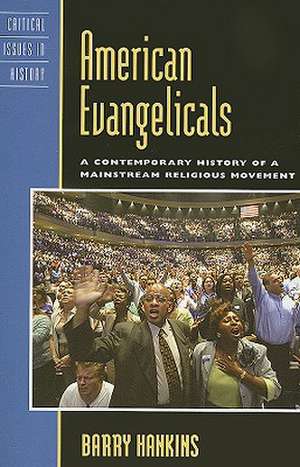
American Evangelicals: A Contemporary History of a Mainstream Religious Movement: Critical Issues in American History
Autor Barry Hankinsen Limba Engleză Paperback – 16 apr 2009

Preț: 211.23 lei
Preț vechi: 284.06 lei
-26%
Puncte Express: 317
Carte tipărită la comandă
Livrare economică 09-23 iunie
Specificații
ISBN-13: 9780742570252
ISBN-10: 0742570258
Pagini: 220
Dimensiuni: 155 x 232 x 17 mm
Greutate: 0.33 kg
Editura: Bloomsbury Publishing
Colecția Rowman & Littlefield
Seria Critical Issues in American History
Locul publicării:New York, United States
ISBN-10: 0742570258
Pagini: 220
Dimensiuni: 155 x 232 x 17 mm
Greutate: 0.33 kg
Editura: Bloomsbury Publishing
Colecția Rowman & Littlefield
Seria Critical Issues in American History
Locul publicării:New York, United States
Cuprins
Preface
Introduction: Awakenings and the Beginning of American Evangelicalism
Chapter 1: The Struggle with Modernism: Origins of the Culture Wars
Chapter 2: Battling with Science: From Anti-Evolution to the Intelligent Design
Chapter 3: Millennialism: Folk Religion and the Career of End-Times Prophecy
Chapter 4: Considering Equality: The Tradition of Gender, Race, and Gay Rights
Chapter 5: Inspired Politics: Evangelical Religion in the Political Marketplace
Chapter 6: Back to the Academy: Evangelical Scholars and the American Mind
Conclusion
Bibliography
Introduction: Awakenings and the Beginning of American Evangelicalism
Chapter 1: The Struggle with Modernism: Origins of the Culture Wars
Chapter 2: Battling with Science: From Anti-Evolution to the Intelligent Design
Chapter 3: Millennialism: Folk Religion and the Career of End-Times Prophecy
Chapter 4: Considering Equality: The Tradition of Gender, Race, and Gay Rights
Chapter 5: Inspired Politics: Evangelical Religion in the Political Marketplace
Chapter 6: Back to the Academy: Evangelical Scholars and the American Mind
Conclusion
Bibliography
Recenzii
[Hankins] draws from the best secondary sources to explicate the evangelical intersection with theological liberalism and the beginnings of fundamentalism. . . . Recommended.
In this informed, sympathetic, and critical book, Barry Hankins combats our culture's ongoing tendency to reduce evangelicals to unquestioning devotees of the religious Right, revealing them instead to be part of a movement with a rich and varied history. The book judiciously summarizes the major scholarship from the past generation, filtering it for an audience of nonspecialists. Hankins' book is one of the best and most accessible introductions to the history of American evangelicalism available for undergraduate courses.
Most [evangelical studies] focus on doctrinal or theological standards . . . and the evolving definitional and identity crisis. Barry Hankins's American Evangelicals breaks in some ways with this pattern, offering instead a more historical approach to evangelical Christianity within the United States. . . . Hankins supports his claims quite well by drawing on evangelical biographies, regional studies, and numerous secondary works in the field of American evangelicalism. . . . Hankins affords rich insights into the diversity and complexity within the evangelical subculture as a whole, giving some attention to the ways in which fundamentalists and evangelicals critique each other. . . . Hankins writes well and has a strong grasp of the many issues and problems as they have unfolded in the history of American evangelicalism. The book has something to offer those who have little knowledge of evangelical Christianity, and it is most suitable for undergraduate courses on the subject and for ordinary persons in churches. It serves quite well as an introduction to the history of American evangelicalism.
Those who wish to gain a better picture of evangelical presence in American culture would do well to at least browse the book.
Historically informed, well balanced, and richly detailed, this book is an essential guide to American evangelicals' cultural and political concerns. Hankins goes beyond the headlines of the contemporary culture wars to explain what evangelicals really believe and practice.
Hankins has a way of turning movements into readable stories; this storytelling ability is what makes this book enjoyable.
In this informed, sympathetic, and critical book, Barry Hankins combats our culture's ongoing tendency to reduce evangelicals to unquestioning devotees of the religious Right, revealing them instead to be part of a movement with a rich and varied history. The book judiciously summarizes the major scholarship from the past generation, filtering it for an audience of nonspecialists. Hankins' book is one of the best and most accessible introductions to the history of American evangelicalism available for undergraduate courses.
Most [evangelical studies] focus on doctrinal or theological standards . . . and the evolving definitional and identity crisis. Barry Hankins's American Evangelicals breaks in some ways with this pattern, offering instead a more historical approach to evangelical Christianity within the United States. . . . Hankins supports his claims quite well by drawing on evangelical biographies, regional studies, and numerous secondary works in the field of American evangelicalism. . . . Hankins affords rich insights into the diversity and complexity within the evangelical subculture as a whole, giving some attention to the ways in which fundamentalists and evangelicals critique each other. . . . Hankins writes well and has a strong grasp of the many issues and problems as they have unfolded in the history of American evangelicalism. The book has something to offer those who have little knowledge of evangelical Christianity, and it is most suitable for undergraduate courses on the subject and for ordinary persons in churches. It serves quite well as an introduction to the history of American evangelicalism.
Those who wish to gain a better picture of evangelical presence in American culture would do well to at least browse the book.
Historically informed, well balanced, and richly detailed, this book is an essential guide to American evangelicals' cultural and political concerns. Hankins goes beyond the headlines of the contemporary culture wars to explain what evangelicals really believe and practice.
Hankins has a way of turning movements into readable stories; this storytelling ability is what makes this book enjoyable.