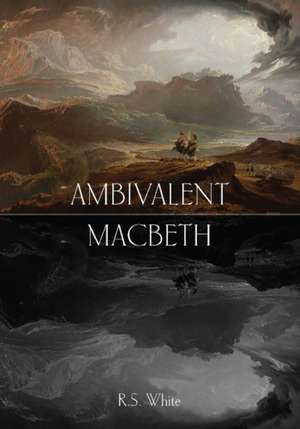
Ambivalent Macbeth
Autor Professor Robert S. Whiteen Limba Engleză Paperback – 18 mai 2018
White explores how radical ambivalence permeates the atmosphere, imagery, themes and characterisation of ‘the Scottish play’. He considers Shakespeare’s historical context and source material, and examines key cinematic, theatrical and other adaptations of the play. Throughout, he argues that an open-minded acceptance of ambivalence can inspire a multitude of readings, and that this complexity helps to explain the play’s intriguing longevity.
Preț: 129.74 lei
Puncte Express: 195
Carte tipărită la comandă
Livrare economică 25 noiembrie-09 decembrie
Livrare prin curier în România Termenul estimat este afișat lângă disponibilitate.
Transport gratuit de la 400.00 lei Plată online sau ramburs, în funcție de opțiunile comenzii.
Retur gratuit în 14 zile Comandă securizată și suport în română.
Specificații
ISBN-13: 9781743325483
ISBN-10: 1743325487
Pagini: 222
Dimensiuni: 148 x 210 x 12 mm
Greutate: 0.27 kg
Editura: Sydney University Press
Colecția Sydney University Press
Locul publicării:Sydney, Australia
ISBN-10: 1743325487
Pagini: 222
Dimensiuni: 148 x 210 x 12 mm
Greutate: 0.27 kg
Editura: Sydney University Press
Colecția Sydney University Press
Locul publicării:Sydney, Australia
Cuprins
Preface and acknowledgements
Prologue: sinners as heroes
1. Contexts of ambiguity: text, sources, history
2. ‘Fair is foul and foul is fair’: the radical ambivalence of Macbeth
3. ‘Nothing is but what is not’: emotional worlds of characters in Macbeth
4. ‘The seeds of time’ and the Macbeths
5. ‘Palter with us in a double sense’: leading ideas – temptation, equivocation, evil
6. ‘This is the very painting of your fear’: imagery and the emotional world of Macbeth
7. Macbeth on stage and screen
Bibliography
Index
Prologue: sinners as heroes
1. Contexts of ambiguity: text, sources, history
2. ‘Fair is foul and foul is fair’: the radical ambivalence of Macbeth
3. ‘Nothing is but what is not’: emotional worlds of characters in Macbeth
4. ‘The seeds of time’ and the Macbeths
5. ‘Palter with us in a double sense’: leading ideas – temptation, equivocation, evil
6. ‘This is the very painting of your fear’: imagery and the emotional world of Macbeth
7. Macbeth on stage and screen
Bibliography
Index
Recenzii
‘Having seen two Macbeths already this year ... I was glad to have this exploration of why it is so perennially reinterpretable. … It is informed, too, by his work for the Centre for the History of Emotions, resulting in a fine discussion of the characters’ emotional worlds. Other highlights are the account of the problematics of blending pro-Scot and pro-English sources and of the play’s insistence on the numbers two and three; the performance history; and a revisiting of the almost lost art of the study of Shakespeare’s imagery.’
‘For White, Shakespeare poses open and problematic questions, and insists our answers must be indeterminate and inconclusive. [White] goes further to suggest that this is the essence of the quality of the play.’
'[A demonstration of] White’s hope for this work to provide ‘suggestions which other scholars might take up’ ... Ambivalent Macbeth helpfully foregrounds the many questions that Macbeth raises and certainly prompts further research.'
'Themed chapters treat an impressive array of topics, including sources, scholarship, character and emotion, time, equivocation, evil, imagery, and dramatic history.'
‘For White, Shakespeare poses open and problematic questions, and insists our answers must be indeterminate and inconclusive. [White] goes further to suggest that this is the essence of the quality of the play.’
'[A demonstration of] White’s hope for this work to provide ‘suggestions which other scholars might take up’ ... Ambivalent Macbeth helpfully foregrounds the many questions that Macbeth raises and certainly prompts further research.'
'Themed chapters treat an impressive array of topics, including sources, scholarship, character and emotion, time, equivocation, evil, imagery, and dramatic history.'
Notă biografică
R.S. White is Winthrop professor of English at the University of Western Australia. He has published many books and articles on Shakespeare, the most recent Shakespeare's "Cinema of Love" (Manchester University Press).