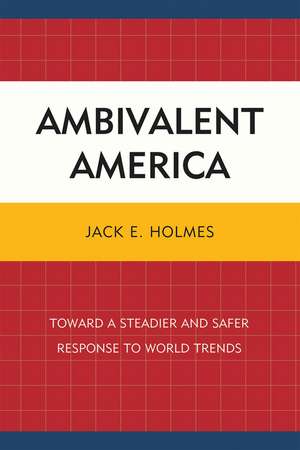
Ambivalent America: Toward a Steadier and Safer Response to World Trends
Autor Jack E. Holmesen Limba Engleză Paperback – 4 noi 2010
Preț: 256.79 lei
Preț vechi: 348.38 lei
-26%
Puncte Express: 385
Preț estimativ în valută:
45.45€ • 53.11$ • 39.46£
45.45€ • 53.11$ • 39.46£
Carte tipărită la comandă
Livrare economică 19 februarie-05 martie
Preluare comenzi: 021 569.72.76
Specificații
ISBN-13: 9780761854036
ISBN-10: 0761854037
Pagini: 171
Ilustrații: Illustrations
Dimensiuni: 154 x 233 x 11 mm
Greutate: 0.29 kg
Editura: Bloomsbury Publishing
Colecția University Press of America
Locul publicării:New York, United States
ISBN-10: 0761854037
Pagini: 171
Ilustrații: Illustrations
Dimensiuni: 154 x 233 x 11 mm
Greutate: 0.29 kg
Editura: Bloomsbury Publishing
Colecția University Press of America
Locul publicării:New York, United States
Cuprins
Chapter 1 Preface
Chapter 2 Acknowledgments
Chapter 3 Chapter 1: A Long-Cycle Approach to American Foreign Policy
Chapter 4 Chapter 2: Separate Yet Unlimited: A Macro Analysis of Foreign Policy Mood
Chapter 5 Chapter 3: An Expanding Nation Divided: 1824-70
Chapter 6 Chapter 4: Path to Preeminence: 1871-1918
Chapter 7 Chapter 5: Foreign Policy Mood since 1968
Chapter 8 Chapter 6: A New Vision of Foreign Policy Mood
Chapter 9 Endnotes
Chapter 10 Bibliography
Chapter 11 Index
Chapter 2 Acknowledgments
Chapter 3 Chapter 1: A Long-Cycle Approach to American Foreign Policy
Chapter 4 Chapter 2: Separate Yet Unlimited: A Macro Analysis of Foreign Policy Mood
Chapter 5 Chapter 3: An Expanding Nation Divided: 1824-70
Chapter 6 Chapter 4: Path to Preeminence: 1871-1918
Chapter 7 Chapter 5: Foreign Policy Mood since 1968
Chapter 8 Chapter 6: A New Vision of Foreign Policy Mood
Chapter 9 Endnotes
Chapter 10 Bibliography
Chapter 11 Index
Recenzii
Holmes' book is rich in data which supports what his theory suggests. According to his mood theory, we are entering a period of extreme extroversion (over involvement) in the rest of the world, a period where throughout American history we have done more than our strategic interests warrant. His theory suggests a rebalancing in the decades ahead in which our strategic interests will be less protected than necessary. Popular reaction will occur against this current drawn out, inconclusive, two war period in the midst of a period of intensifying economic distress. A must read for all graduate students in the area of American foreign policy or international relations.
.Timely-given the turbulence of Iraq, Afghanistan, and the Muslim world-and is a culmination of his own efforts over a half century to gain recognition for the power of American society. It's an important read for those of us who are the critical observers with a moment for contemplation, who then must pass on our views to policy makers who are rushing headlong into the Clash of Civilizations.
.Timely-given the turbulence of Iraq, Afghanistan, and the Muslim world-and is a culmination of his own efforts over a half century to gain recognition for the power of American society. It's an important read for those of us who are the critical observers with a moment for contemplation, who then must pass on our views to policy makers who are rushing headlong into the Clash of Civilizations.