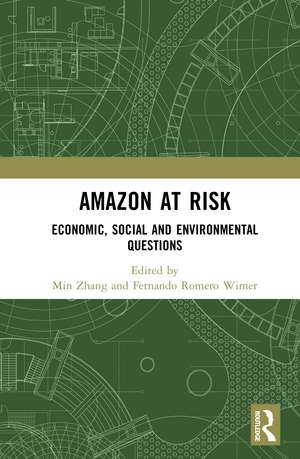
Amazon at Risk: Economic, Social and Environmental Issues
Editat de Min Zhang, Fernando Romero Wimeren Limba Engleză Hardback – 5 noi 2026
Readers will gain a critical understanding of the structural tensions between conservation and development through landmark cases, including the Chevron pollution lawsuit, Ecuador’s Yasuní referendum, and illegal mining in Peru’s Madre de Dios. The concluding assessment of the Amazon’s tipping point underscores the urgency of rainforest protection for global climate stability. Additionally, the book offers historical and structural analytical tools for exploring the complex relationship between society and nature.
This volume will be valuable for researchers, policymakers, and practitioners in the fields of environmental governance, economic history, political ecology, and Latin American studies.
Preț: 1337.33 lei
Preț vechi: 1630.89 lei
-18% Precomandă
Puncte Express: 2006
Carte nepublicată încă
Livrare prin curier în România Precomanda se expediază când titlul devine disponibil.
Transport gratuit pentru acest produs Plată online sau ramburs, în funcție de opțiunile comenzii.
Retur gratuit în 14 zile Comandă securizată și suport în română.
Doresc să fiu notificat când acest titlu va fi disponibil:
Se trimite...
Specificații
ISBN-13: 9781041319801
ISBN-10: 1041319800
Pagini: 130
Dimensiuni: 156 x 234 mm
Greutate: 0.36 kg
Ediția:1
Editura: Taylor & Francis
Colecția Routledge
Locul publicării:Oxford, United Kingdom
ISBN-10: 1041319800
Pagini: 130
Dimensiuni: 156 x 234 mm
Greutate: 0.36 kg
Ediția:1
Editura: Taylor & Francis
Colecția Routledge
Locul publicării:Oxford, United Kingdom
Public țintă
Postgraduate and Professional ReferenceRecenzii
“Amazon at Risk offers a rigorous structural analysis that illuminates the complex tensions between extractive development and conservation in the Amazon basin. This volume is an invaluable analytical tool for researchers, policymakers, and academics engaged in environmental governance and Latin American studies.”
Dr. Kar M. Hernández P., Andrés Bello Catholic University (UCAB), Venezuela.
"Amazon at Risk offers a compelling analysis of the Amazon as a socio-environmental space shaped by competing perspectives on development. Its historical and comparative perspective provides valuable analytical tools for understanding the tensions among resource extraction, conservation, and social justice across the region."
Dr. Valdemar Wesz Junior, Federal University of Latin American Integration (UNILA), Brazil.
"Through a meticulous approach to the Amazon crisis, Amazon at Risk highlights the urgency of the Amazon's tipping point, making it clear that its protection is not just a regional challenge, but a key global issue for the world's climate stability. An invaluable resource. I highly recommend reading it."
Professor Alberto José Hurtado Briceño, Center for Global Thought (CEPEG), Cooperative University of Colombia (UCC), Colombia.
“Amazon at Risk is a compelling study of the economic and environmental contradictions facing the Amazon, from the perspective of the countries and communities that comprise it. It is an urgent appeal from the standpoint of environmental justice for the balanced preservation of the world's largest rainforest, combating dominant extractive and commercial practices.”
Prof. Alejandro Casas, University of the Republic (UdelaR), Uruguay.
“A fundamental book on the impact of extractivism is Amazon at Risk, which rigorously exposes the increase in socio-environmental tensions and territorial disputes.
I recommend reading it to understand the gap between state accumulation strategies and ecological and socio-cultural sustainability.
Dr. Alexis Romero Salazar, President of the Venezuelan Association of Sociology (AVS), Venezuela.
“For decades, Latin America has suffered the clash between two constantly opposing logics: the logic of capitalist accumulation versus the logic of nature. Amazon at Risk is a valuable research project that contributes to the study of this problem.”
Dr. Alejandro Schneider, University of Buenos Aires (UBA), Argentina.
Cuprins
Introduction 1 Economy, society, and environmental issues in the Brazilian Amazon 2 Economy, society, and environmental issues in the Peruvian Amazon 3 Economy, society, and environmental issues in the Colombian Amazon 4 Economy, society, and environmental issues in the Ecuadorian Amazon 5 Economy, society, and environmental issues in the Bolivian Amazon 6 Economy, society, and environmental issues in the Venezuelan Amazon 7 Economy, society, and environmental issues in the Surinamese Amazon 8 Economy, society, and environmental issues in the Guyanese Amazon 9 Economy, society and environmental issues in the Amazon of French Guiana Final conclusions
Notă biografică
Min Zhang is Associate Professor at the Center for American Studies, Nanjing Agricultural University, China. Her research interest is international environmental governance.
Fernando Romero Wimer is Professor of History from the National University of the South (UNS), Argentina. He earned his master’s degree in development and territorial management from UNS and his PhD in history from the University of Buenos Aires (UBA), Argentina. He currently serves as a professor of undergraduate and graduate courses in international relations at the Federal University for Latin American Integration (UNILA), Brazil, the director of the Interdisciplinary Group for Studies and Research on Transnational Capital, States, Dominant Classes, and Conflict in Latin America and the Caribbean (GIEPTALC) and of the Center for Studies on Nature and Capital in Latin America and the Caribbean (NUNACAL) at the Mercosur Institute for Advanced Studies (IMEA), Brazil. He is also a researcher at the Collective for Social Studies and Research (CEISO) of Argentina and at the Interdisciplinary Center for Agrarian Studies (CIEA) at UBA.
Fernando Romero Wimer is Professor of History from the National University of the South (UNS), Argentina. He earned his master’s degree in development and territorial management from UNS and his PhD in history from the University of Buenos Aires (UBA), Argentina. He currently serves as a professor of undergraduate and graduate courses in international relations at the Federal University for Latin American Integration (UNILA), Brazil, the director of the Interdisciplinary Group for Studies and Research on Transnational Capital, States, Dominant Classes, and Conflict in Latin America and the Caribbean (GIEPTALC) and of the Center for Studies on Nature and Capital in Latin America and the Caribbean (NUNACAL) at the Mercosur Institute for Advanced Studies (IMEA), Brazil. He is also a researcher at the Collective for Social Studies and Research (CEISO) of Argentina and at the Interdisciplinary Center for Agrarian Studies (CIEA) at UBA.
Descriere
The book offers a systematic analysis of economic development in the eight Amazonian countries—Brazil, Peru, Colombia, Bolivia, Ecuador, Venezuela, Guyana and Suriname—and the territory of French Guiana, revealing how resource-intensive growth has exacerbated deforestation, ecological degradation and the erosion of indigenous rights.