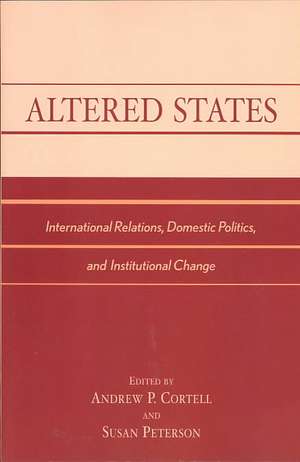
Altered States: International Relations, Domestic Politics, and Institutional Change
Editat de Andrew P. Cortell, Susan Peterson Contribuţii de Eva Busza, Jeffrey T. Checkel, Lisa Conant, Darren Hawkins, C S. Eliot Kang, David Richards, Martin J. Smith, Christopher Wenken Limba Engleză Paperback – 13 feb 2003
Preț: 308.29 lei
Preț vechi: 407.94 lei
-24%
Puncte Express: 462
Carte tipărită la comandă
Livrare economică 26 noiembrie-10 decembrie
Livrare prin curier în România Termenul estimat este afișat lângă disponibilitate.
Transport gratuit de la 400.00 lei Plată online sau ramburs, în funcție de opțiunile comenzii.
Retur gratuit în 14 zile Comandă securizată și suport în română.
Specificații
ISBN-13: 9780739106068
ISBN-10: 0739106066
Pagini: 241
Dimensiuni: 154 x 227 x 19 mm
Greutate: 0.4 kg
Editura: Bloomsbury Publishing
Colecția Lexington Books
Locul publicării:New York, United States
ISBN-10: 0739106066
Pagini: 241
Dimensiuni: 154 x 227 x 19 mm
Greutate: 0.4 kg
Editura: Bloomsbury Publishing
Colecția Lexington Books
Locul publicării:New York, United States
V-ar putea interesa
-
 -12%Preț: 344.50 lei391.80 lei
 -
 RadicalismP. MclaughlinPreț: 392.00 lei
 -
 Can Russia Modernise?Alena V. LedenevaPreț: 253.21 lei
 -
 The Price of InequalityJoseph E. Stiglitz-18%Preț: 89.49 lei109.16 lei
 -
 U.S. Political & Trade Relations with AfricaGregory D Ferro-27%Preț: 778.07 lei1058.64 lei
 -
 -27%Preț: 998.03 lei1361.43 lei
 -
 -27%Preț: 1243.39 lei1698.52 lei
 -
 -26%Preț: 500.87 lei675.07 lei
 -
 Preț: 110.15 lei
 -
 A Short History of PowerSimon HefferPreț: 112.74 lei
 -
 Delivering Public Services That Work Volume 2Charlotte PellPreț: 146.83 lei
Cuprins
Chapter 1 Agents, Structures, and Domestic Institutional Change
Chapter 2 European Judicial Review and National Institutional Change
Chapter 3 Explaining the Lack of Institutional Change in Cuba
Chapter 4 Altering the U.S. State: Post-Vietnam Changes in Foreign Policy Authority
Chapter 5 Institutional Change and Post-Communist States: The Transformation of Civilian Control in Poland, Hungary, the Czech Republic, and Russia
Chapter 6 Institutional Dynamics in Collapsing Empires: Domestic Structural Change in the USSR, Post-Soviet Russia, and Independent Ukraine
Chapter 7 Institutionalizing the Regulation of Inward Foreign Direct Investment
Chapter 8 Breaking the Policy Bias: Windows of Opportunity and the Realignment of Structural Constraints in Three Government Departments
Chapter 9 The Causes and Consequences of Institutional Change
Chapter 2 European Judicial Review and National Institutional Change
Chapter 3 Explaining the Lack of Institutional Change in Cuba
Chapter 4 Altering the U.S. State: Post-Vietnam Changes in Foreign Policy Authority
Chapter 5 Institutional Change and Post-Communist States: The Transformation of Civilian Control in Poland, Hungary, the Czech Republic, and Russia
Chapter 6 Institutional Dynamics in Collapsing Empires: Domestic Structural Change in the USSR, Post-Soviet Russia, and Independent Ukraine
Chapter 7 Institutionalizing the Regulation of Inward Foreign Direct Investment
Chapter 8 Breaking the Policy Bias: Windows of Opportunity and the Realignment of Structural Constraints in Three Government Departments
Chapter 9 The Causes and Consequences of Institutional Change
Recenzii
Altered States is an important study of the sources of institutional change. It rightly focuses on advancing our understanding of incremental change and intentional design. The rich variety of empirical examples highlight the important consequences of institutional reforms.
[This book] will open many avenues for conducting new research into a field of international relations and comparative politics, and will further sharpen our understanding of the politics of this world in which institutions clearly "matter."
Over the years scholars of international and comparative politics have made great progress in understanding the impact of state structures and institutions on foreign and domestic policy. They often associated dramatic changes in policy with prior institutional changes, yet left open the key question of when and why instituttions themselves change. In this pathbreaking volume, Andrew Cortell and Susan Peterson have assembled a collection of high-quality essays addressing this question in a wide range of issue-areas and with a geographical scope that encompasses the European Union, the former Soviet Union and Eastern Europe, Cuba, the United States, Britain, and Japan. The chapters are theoretically sophisticated, empirically rich, and the volume as a whole constitutes an important advance in our understanding of institutional change.
[This book] will open many avenues for conducting new research into a field of international relations and comparative politics, and will further sharpen our understanding of the politics of this world in which institutions clearly "matter."
Over the years scholars of international and comparative politics have made great progress in understanding the impact of state structures and institutions on foreign and domestic policy. They often associated dramatic changes in policy with prior institutional changes, yet left open the key question of when and why instituttions themselves change. In this pathbreaking volume, Andrew Cortell and Susan Peterson have assembled a collection of high-quality essays addressing this question in a wide range of issue-areas and with a geographical scope that encompasses the European Union, the former Soviet Union and Eastern Europe, Cuba, the United States, Britain, and Japan. The chapters are theoretically sophisticated, empirically rich, and the volume as a whole constitutes an important advance in our understanding of institutional change.