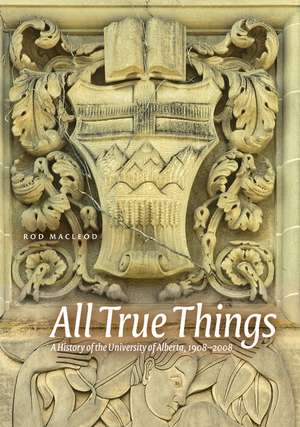
All True Things: A History of the University of Alberta, 1908-2008
Autor Rod Macleoden Limba Engleză Hardback – 16 sep 2008
Preț: 326.32 lei
Preț vechi: 387.05 lei
-16%
Puncte Express: 489
Carte disponibilă
Livrare economică 12-26 noiembrie
Livrare prin curier în România Termenul estimat este afișat lângă disponibilitate.
Transport gratuit de la 400.00 lei Plată online sau ramburs, în funcție de opțiunile comenzii.
Retur gratuit în 14 zile Comandă securizată și suport în română.
Specificații
ISBN-13: 9780888644442
ISBN-10: 0888644442
Pagini: 392
Ilustrații: 130+ b/w photos
Dimensiuni: 178 x 254 x 29 mm
Greutate: 0.96 kg
Editura: University of Alberta Press
Colecția University of Alberta Press
Locul publicării:Edmonton, Canada
ISBN-10: 0888644442
Pagini: 392
Ilustrații: 130+ b/w photos
Dimensiuni: 178 x 254 x 29 mm
Greutate: 0.96 kg
Editura: University of Alberta Press
Colecția University of Alberta Press
Locul publicării:Edmonton, Canada
V-ar putea interesa
-
 The Dark SideJane MayerPreț: 107.54 lei
 -
 Slavery by Another Name (Pulitzer Prize Winner)Douglas A. BlackmonPreț: 119.81 lei
 -
 The Forgotten ManAmity ShlaesPreț: 139.95 lei
 -
 Brown Skin, White MasksHamid DabashiPreț: 264.06 lei
 -
 Preț: 267.18 lei
 -
 American TranscendentalismPhilip F. GuraPreț: 157.84 lei
 -
 Creating Minnesota: A History from the Inside OutAnnette AtkinsPreț: 139.38 lei
 -
 Preț: 129.86 lei
 -
 J.B. Harkin: Father of Canada's National ParksE. J. (Ted) HartPreț: 206.04 lei
 -
 Canada's Constitutional RevolutionBarry L. Strayer-23%Preț: 201.15 lei260.18 lei
 -
 Preț: 116.16 lei
 -
 Preț: 149.88 lei
 -
 Preț: 181.30 lei
 -
 Living in Two WorldsCharles EastmanPreț: 161.01 lei
Comentariile autorului
Over 130 B&W photographs, tables, notes, bibliography, index, foreword
Recenzii
BACK COVER de cetero.quaecumque.haec cogitate. For the rest.whatsoever things are true.think on these things. -The Epistle of St. Paul to the Philippians, 4:8. All True Things is a critical history of the genesis and evolution of the University of Alberta to mark the University's centennial. Rod Macleod relates the University's coming of age against the parallel history of the Province of Alberta's remarkable growth. What emerges is an enduring narrative of an institutional will to thrive and become a vibrant centre of learning. As the University embarks on its second century, this definitive source of information and reflection on institutional history and governance will inspire future leaders and policy makers and reach out to the University of Alberta's many friends and alumni. "Professor Macleod was an inspired choice as author for this project." -Professor Kenneth Harold Norrie Faculty of Social Science, McMaster University FRONT FLAP Milestones Along the Way Decima Robinson was one of seven women in the University's very first class, and she was the very first student to graduate. The Faculty of Extension emerged from the University of Alberta's early outreach efforts of sending faculty on lecture tours to towns throughout the province. During World War I, founding president Henry Marshall Tory headed to France (becoming Colonel Tory) in order to spearhead the "Khaki University of Canada," a massive initiative to extend provisional education to military personnel serving overseas. Dr. J. B. Collip-University of Alberta biochemistry professor-was a major research contributor to Banting and Best's breakthrough insulin therapy for treatment of diabetes. By the 1920s, while working for what would eventually become the Alberta Research Council, Dr. Karl Clark had already developed the technology for separating heavy oil from Alberta's rich deposits of oilsands. University of Alberta alumnus George F. Stanley (BA '29), who led an exemplary career as a pre-eminent historian and who became Lieutenant Governor of New Brunswick, provided the design for the Canadian flag in the 1960s. CKUA radio, Canada's oldest running independent radio station, began as a campus radio station in the 1920s, introducing listeners to live musical performances, sports coverage, and even lectures as an innovative component of President Tory's vision of community engagement. The seeds of the internationally renowned Banff Centre-a learning facility for the Arts, Mountain Culture, and Leadership-were planted when E.A. Corbett initiated an "Experimental School in the Arts Related to the Theatre" in the summer of 1933. Former Prime Minister Joe Clark,' 60 BA, '73 MA, '85 LLD (Honorary), was editor of the student's newspaper, The Gateway, in 1959-60. BACK FLAP About the Author Rod Macleod was professor of History and Classics at the University of Alberta from 1969 until he retired in 2005. He has written extensively on the history of Western Canada as well as Canadian legal and military history. He is currently the Alberta representative on the Historic Sites and Monuments Board of Canada. He lives in Edmonton.
"This book is a critical history of the university. In it my concern has been to understand how it differed from other universities and why it evolved the way it did. In doing the research and writing it became apparent that the history of the university was entwined with the political history of the province. For the first half century it completely dominated the intellectual and cultural history of Alberta. From its inception the university has had a powerful sense of mission, summed best in founding president Henry Marshall Tory's dictum 'the uplifting of the whole people shall be its final goal.' The university's remarkable extension activities led to the founding of CKUA radio and the Banff Centre." Rod Macleod, April 2008
"Loyal alumni can choose from a handful of tomes honouring the University of Alberta on this, its 100th anniversary year. All True Things places the U of A in the larger context of our province's history, revealing a dynamic learning centre influenced by a diverse and fast-growing population." Edmonton Journal, Christmas Gift Guide, November 19, 2008
"In the early years of the province's history, the location of the yet-to-be-built University of Alberta was one of the most hotly contested issues of the day. ... The controversy surrounding the U of A's location is one of the pivotal moments discussed in Macleod's new book All True Things, which traces the evolution of the university from a fledgling Prairie school to one of Canada's most powerful academic institutions. ... "I wanted this (book) to be a real history, not a public relations exercise ... I wanted to look in a serious way at how the institution developed, how was it different from other Canadian universities and what were the down parts of the experience as well as the ups." Macleod thinks much of the U of A's success can be traced back to the first president, Henry Marshall Tory, who laid out an ambitious vision that essentially remains intact today. ... For example, female students were admitted from Day 1, and Tory insisted the first faculty be arts and science rather than an agricultural school many in the province wanted. In hiring the first group of professors, he demanded they all have PhDs and went as far as Harvard and McGill to recruit them." Keith Gerein, Edmonton Journal, Sept. 17, 2008
"... a terrific little institutional history..."
"This book is a critical history of the university. In it my concern has been to understand how it differed from other universities and why it evolved the way it did. In doing the research and writing it became apparent that the history of the university was entwined with the political history of the province. For the first half century it completely dominated the intellectual and cultural history of Alberta. From its inception the university has had a powerful sense of mission, summed best in founding president Henry Marshall Tory's dictum 'the uplifting of the whole people shall be its final goal.' The university's remarkable extension activities led to the founding of CKUA radio and the Banff Centre." Rod Macleod, April 2008
"Loyal alumni can choose from a handful of tomes honouring the University of Alberta on this, its 100th anniversary year. All True Things places the U of A in the larger context of our province's history, revealing a dynamic learning centre influenced by a diverse and fast-growing population." Edmonton Journal, Christmas Gift Guide, November 19, 2008
"In the early years of the province's history, the location of the yet-to-be-built University of Alberta was one of the most hotly contested issues of the day. ... The controversy surrounding the U of A's location is one of the pivotal moments discussed in Macleod's new book All True Things, which traces the evolution of the university from a fledgling Prairie school to one of Canada's most powerful academic institutions. ... "I wanted this (book) to be a real history, not a public relations exercise ... I wanted to look in a serious way at how the institution developed, how was it different from other Canadian universities and what were the down parts of the experience as well as the ups." Macleod thinks much of the U of A's success can be traced back to the first president, Henry Marshall Tory, who laid out an ambitious vision that essentially remains intact today. ... For example, female students were admitted from Day 1, and Tory insisted the first faculty be arts and science rather than an agricultural school many in the province wanted. In hiring the first group of professors, he demanded they all have PhDs and went as far as Harvard and McGill to recruit them." Keith Gerein, Edmonton Journal, Sept. 17, 2008
"... a terrific little institutional history..."