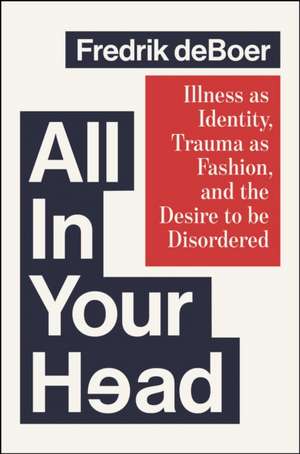
All in Your Head: Illness as Identity, Trauma as Fashion, and the Desire to be Disordered
Autor Fredrik deBoeren Limba Engleză Hardback – 19 noi 2026
Mental health culture in the 21st century is broken. After decades of influence from the anti-psychiatry movement, our conception of mental illness has become hopelessly romanticized, distorted by fictional depictions of madness that minimize the harms of debilitating conditions. It’s become fashionable to insist that mental illness is socially constructed, politically imposed, or secretly empowering. But these claims are dishonest and destructive. Psychosis is not creativity; delusion is not just another way of knowing; schizophrenia is not a sane response to an insane world. Mental illnesses are real, biological conditions that cause profound torment and destroy lives. Treating them as metaphors or identities does not liberate the afflicted. It condemns them.
With All in Your Head, Fredrik deBoer offers a powerful and long-overdue critique of modern mental health culture. He shows how deinstitutionalization, a well-intentioned but ultimately doomed corrective to psychiatry’s early abuses, collapsed into disaster, leaving the severely mentally ill to cycle through homelessness, incarceration, and neglect. More recently, the “gentrification of disability” has turned mental illness into social currency. Implausible self-diagnoses spread through social media, turning rare disorders into identity theater, while those with the most disabling conditions are left out of the conversation.
Bracing and rigorously argued, All in Your Head is a call for an honest reckoning. Caring for people with mental illness requires material support, institutional capacity, and medical intervention. Psychiatry, despite its flaws, remains the only lifeline for millions. To abandon it is to abandon the most vulnerable among us.
Preț: 178.55 lei
Nou
Puncte Express: 268
Carte disponibilă
Livrare economică 17 noiembrie-01 decembrie
Livrare express 31 octombrie-06 noiembrie pentru 47.90 lei
Livrare prin curier în România Termenul estimat este afișat lângă disponibilitate.
Transport gratuit de la 400.00 lei Plată online sau ramburs, în funcție de opțiunile comenzii.
Retur gratuit în 14 zile Comandă securizată și suport în română.
Specificații
ISBN-13: 9781668081037
ISBN-10: 1668081032
Pagini: 336
Dimensiuni: 140 x 213 x 28 mm
Greutate: 0.41 kg
Editura: Simon&Schuster
Colecția Simon & Schuster
ISBN-10: 1668081032
Pagini: 336
Dimensiuni: 140 x 213 x 28 mm
Greutate: 0.41 kg
Editura: Simon&Schuster
Colecția Simon & Schuster
Notă biografică
Fredrik deBoer is a writer and academic. His writing has appeared in The New York Times, the Los Angeles Times, The Washington Post, New York magazine, The Boston Globe, Playboy, and Harper’s Magazine, among many others. He is the author of The Cult of Smart, How Elites Ate the Social Justice Movement, and the novel The Mind Reels. He holds a PhD in English with a concentration in writing assessment and higher education policy from Purdue University. He lives in Connecticut with his family.
Extras
Chapter 1: The Birth of a Bad Idea: The Origins of the Anti-Psychiatry Movement CHAPTER 1 The Birth of a Bad Idea: The Origins of the Anti-Psychiatry Movement
I have been aware of the anti-psychiatry movement for most of my life, even long before I was diagnosed with bipolar disorder when I was twenty years old. It would be difficult for an American not to be aware of it, given how well it’s penetrated our cultural consciousness. And no one could wander through our strange, feudal mental health care system without rubbing up against the large and passionate group—or cult—that reflexively rejects all psychiatric medicine and sees it as a fraud, a tool of the pharmaceutical companies, and a system of social control maintained by an elite cabal. Anyone who has gone through the wringer—anyone who has gone inpatient a half-dozen times and sat through group therapy and support groups with strangers united by dysfunction—will have heard other patients mutter dark conspiracies about psychiatry and the hidden motives behind it. And as someone who did the usual bipolar thing, drifting into and out of treatment, repetitively convincing myself that I was cured, then falling back into delusion and paranoia… well, there was always a part of me that wanted the anti-psychiatry message to be true, that there was nothing wrong with me, just something wrong with society.
Lucky for me, and my eventual recovery, I never fell into that quicksand. I’d long known that there was a community out there that rejected psychiatric diagnoses, offering a whole satchel full of convenient reasons I shouldn’t take the medications I hated to take. Yet I never turned to anti-psychiatry to justify my lifelong efforts to evade my disorder. This was largely an artifact of my primary means of avoidance, which is to say, pure denial. To use anti-psychiatry to justify my refusal to treat my condition would have entailed acknowledging, to myself if no one else, that my condition actually existed; to be angry about the psychiatric treatment I had received would have been to admit that I had received psychiatric treatment. It was far easier to let those past events drift into the haze of memory, aided in that journey by the dimming effects of the psychiatric medications I had taken in the immediate aftermath of each crisis.
But I also believe some part of my brain always knew that psychiatry had saved my life. Even in the midst of all my denial, and even as I refused to take the medications that could have stabilized me, I was in some sense aware that had I kept going the way I was going during my initial manic period in 2002, I would not have survived. In time, when I finally embraced treatment, I saw firsthand the lifesaving power of entirely conventional psychiatric medicine, and my indifference toward the anti-psychiatry movement grew into resentment. As I embraced mental illness and psychiatry as research interests, I learned more and more about how pernicious the anti-psychiatry movement has been, about its deep connections to the anti-vaccine movement and radical right-wing libertarianism. But it was the emails I received after going public about my crisis and my recovery that truly intensified my disdain.
After my last, unfortunately public psychotic meltdown in 2017, I started to hear from anti-psychiatry zealots in great numbers, particularly once I reemerged into public life a few years later and shared the details of my recovery. This correspondence did not endear me to the movement. Dismissive, self-righteous, and drenched in false sympathy, they came in such volume, and with such unanimity in theme and scope, that I have long harbored a suspicion that they were being coordinated on some anti-psychiatry online forum—in fact, I have a pretty good idea which one—but I have no way to prove it.
Digging around in my Gmail, I find a representative missive. There’s nothing particularly notable about it; I’ve chosen it only because it’s so typical. It’s also one of the few that I never got around to ritualistically deleting.
“I think you’re an amazing cautionary tale of what happens when one allows oneself to be conned by psychiatry,” says my interlocutor, expressing the anti-psychiatric notion that the entire field of mental health medicine is a con, a scam. “You’ve basically been indoctrinated hook, line and sinker.… I could have been you. Thankfully I got out.” This, too, is classic anti-psychiatry rhetoric, the notion that the speaker could have easily fallen victim to said con if things had been different. “To read your stuff on this topic is just a how-to-manual in how to completely become a lifelong dependent on this quackery.… Another one bites the dust to lifelong welfare and psychiatric drugging I guess.” This reference to “welfare” reflects the odd strain of conservatism common to anti-psychiatry; for as much as they anoint themselves the champions of those “abused” by psychiatric medicine, they also frequently complain that the chronic mentally ill are a strain on society and its coffers. As is typical of this sort of thing, I find myself a little destabilized by the dedication to insulting me displayed by a person who insists that they have my best interests at heart.
This email insists that psychiatric illnesses are not diseases of the brain; it insists that psychiatric drugs are neurotoxic; it insists that I have been indoctrinated. There’s a great deal I could say in response. Whether conventional psychiatric disorders are in fact best understood as brain diseases is a matter of controversy even within establishment psychiatry; I think that they plainly are, given that these are disorders of behavior and cognition, and both behavior and cognition are products of the nervous system. But I’m not dogmatic about that notion. Who knows, really? Either way, I’m in possession of two decades of experience that tells me that the drugs I take, for all their ugly side effects, are the difference between me living a stable and happy life and living in a state of permanent chaos and friendlessness. If I have been indoctrinated, it has been by my own, bitter, lived experience. The notion that psychiatric medications are neurotoxic conveniently avoids evidence that untreated psychotic disorders themselves are associated with eventual serious brain damage. I believe in fast and slow bipolar cycles because I have been treated alongside patients who share my disorder whose own cycles are different from mine. I am not on welfare and have never applied for disability benefits, and in fact the only time when the state has paid for my day-to-day existence has been when I have been forced into inpatient care—that is, precisely because I refused treatment until it was too late. It has been my medications that have allowed me to work and earn a living and avoid “welfare.” Etc.
The most telling words in that email are “Thankfully I got out.” A vast swath of anti-psychiatry discourse is made up of complaints from ex-patients who claim to have been misdiagnosed or prescribed the wrong medications or otherwise mistreated. The anti-psychiatry narrative is almost universally a revelation narrative, a “once I was blind but now I see” narrative; if that sounds self-flattering, that’s because it is. Core to the whole culture is a kind of relentless self-promotion, the insistence by the people within it that they see things others don’t see, that they are wise and perceptive where others are deluded and naïve. I have some sympathy for this impulse, given how the experience of dealing with a severe mental illness can so relentlessly undermine one’s sense of self-worth and value. But I’ve often been left to wonder whether most anti-psychiatry types would be so zealous if it weren’t for this sense of superiority, this opportunity to look down their noses at those of us who are not as savvy or (for lack of a better word) woke as they are. Life is degrading in many petty ways for all of us, and especially for those of us who have been through the psychiatric system. The trouble is that, over time, the desire to divide everyone into groups of the enlightened and the deluded starts to overwhelm the actual underlying issues at hand in a way that perversely replicates the schizophrenic’s belief that they have seen the hidden truth that the rest of the human race cannot.
There are of course people out there who have been genuinely mistreated by psychiatric medicine, and sometimes that mistreatment follows the broad contours found in the anti-psychiatric critique. (Sometimes.) No one doubts that psychiatry requires reform, and the end of this book will express my own personal desires in that domain. But central to anti-psychiatric sentiment in this country is the axe-grinding of a highly motivated fringe, and that fringe is not a spontaneous collection of well-intentioned rabble-rousers, as its members sometimes insist. Instead, we must see the anti-psychiatry movement for what it really is: an identifiable social force with a clear intellectual lineage and an obvious ideological origin. It has always nominated high priests who helped set the movement’s agenda, drawn from a set of disparate organizations and communities, and it has always, opportunistically, found unlikely allies in religious and political groups that align on the question of psychiatry but are otherwise very distinct cultures. The movement has proven to be unusually successful; it is the reason many people who have no background in its theories or propaganda are nevertheless reflexively opposed to the practice of modern psychiatric medicine. And, like most insurgent movements, anti-psychiatry’s claims contain certain kernels of truth, some valid complaints and observations, which then congeal into an ugly caricature and a hateful ideology. An ideology with serious consequences.
The effort to prevent the mentally ill from utilizing modern psychiatric medicine succeeds too often, and in doing so keeps patients from badly needed therapies. This is a point I come back to again and again: most Americans who experience a period of serious mental illness will, by later adulthood, report that their illness has been managed or is in remission.1 This is how medical care is supposed to function—you have a medical issue, you receive care from appropriately trained personnel, and eventually you recover. Unfortunately, because mental illness is usually a private affair, people who experience it and then recover in this way tend to keep it a secret. That is of course their right. But this dynamic contributes to an unbalanced perception of the reality of mental illness. Those whose mental illnesses are chronic or untreated are unusually visible in our society, relative to those who quietly receive appropriate treatment and slowly become healthier over time. It’s the difference between someone with schizophrenia who lives in an assisted care facility, takes their meds, and lives as normal a life as possible, and someone with schizophrenia who acts erratically on the subway. The former strives for privacy. The latter lives in full view of society.
The only way to combat this asymmetry of publicity is to call attention to the positive power of psychiatry and to expose the ignorance and deception within the anti-psychiatry movement. Because of their propensity to demonize psychiatric care and the degree to which that attitude has infiltrated our society—because of the success of the anti-psychiatric movement—it’s necessary to expose that movement for the right-wing, conspiratorial cult that it is.
A Brief History: Precursors
The anti-psychiatry movement is a modern phenomenon, a true child of the late twentieth century. With influences stemming from the countercultures of the 1950s, ’60s, and ’70s, particularly the hippie movement, anti-psychiatry is written into the story of the late 1900s in America as much as that period is written into anti-psychiatry. But like any intellectual and political movement, anti-psychiatry has intellectual antecedents, past thinkers and ideologies that contributed to its modern form. The roots of anti-psychiatry can be traced back well before the modern movement, to figures and philosophies that criticized the treatment of individuals deemed mentally ill and questioned the legitimacy of psychiatric authority.
In the late eighteenth century, the French physician Philippe Pinel became one of the earliest prominent voices calling for compassionate psychiatric care. Sometimes referred to as the father of modern psychiatry, he was among the first to address mental illnesses as genuine medical maladies rather than moral failings and to see them as a separate and worthy branch of medical science.2 In Pinel’s time, it genuinely was the case that what we now call stigma was one of the biggest impediments to effective treatment. The mentally ill, who went by all manner of nasty names, were broadly understood to be fundamentally defective, low-born, and irredeemable. Pinel was one of the earliest to forcefully reject those attitudes. Indeed, his most beneficial legacy is likely the role he played in articulating what was at the time a radical notion: that those with mental illness could often be cured.
Pinel’s critiques of the harsh, prisonlike conditions in asylums laid the groundwork for questioning how society treated mental illness. His call for “moral treatment” reflected skepticism toward the prevailing practices of confinement and coercion, skepticism which has endured and intensified in the following two centuries. He did not categorically reject either confinement or coercion, as figures in the anti-psychiatry movement later would, yet Pinel’s attitudes presaged modern complaints about the psychiatric establishment. He praised practitioner restraint and the power of doing less, both of which would go on to become core elements of many modern reform efforts, and not just among the explicitly anti-psychiatry set. That bit of wisdom, to do no more in psychiatry than what is necessary, dovetails nicely with the famous maxim from Hippocrates, “First, do no harm.”
The same can’t be said for another of Pinel’s habits that presaged modern tendencies: romanticizing the mentally ill. Writing of the noble hearts of the insane, Pinel says, “I have nowhere met, excepting in romances, with fonder husbands, more affectionate parents, more impassioned… than in the lunatic asylum, during their intervals of calmness and reason.”3 Certainly there are good souls in psychiatric hospitals—I would like to think that I once was one—but the idealization of the severely mentally ill is dangerous, as it dulls public sympathy for those who suffer under mental illness, misleads us in making treatment decisions, and creates a standard that’s impossible for recovering patients to meet. Some severely mentally ill people have hearts of gold, just as some are genuinely malevolent people. Most are simply human beings, meaning they’re complicated and many different things at once.
Another early figure who offered strong critiques of psychiatry, at least as practiced in that earlier era, was the crusading activist Elizabeth Packard. In the mid-nineteenth century, Packard became an advocate for the rights of psychiatric patients after being institutionalized by her husband as a means of dominance and control. In an act that exemplified the cruel patriarchy of her era, and serves as a cautionary tale about the potential misuses of any formalized system of power, her husband was able to use his society’s total deference to a husband’s wishes to keep her confined against her will and without medical justification.4 She would go on to form the Anti-Insane Asylum Society, one of the first explicitly anti-psychiatric organizations in American history. Packard’s activism highlighted the dangers of using psychiatric treatment as a tool of social control, particularly against women, and she campaigned for laws to protect patients from wrongful confinement. All of that is to the good, but when Packard is invoked by modern anti-psychiatry activists, it’s done with the distortions and false equivalences common to that movement: pretending that the standards for involuntary commitment are as low now as they were in the 1860s, when those standards are in fact now extremely high. Such opportunistic invocation of Packard also tends to ignore the fact that the ultimate villains in her story are institutional sexism and misogyny, not psychiatry.
As the treatment of mental illness developed as a modern medical practice, a counterculture that looked for both causes and cures inevitably developed alongside it. For example, in the late eighteenth and early nineteenth centuries, the notorious German physician and (pseudo)scientist Franz Mesmer proposed a controversial theory, known as “mesmerism,” of “animal magnetism” as an explanation for mental and physical ailments. Mesmerism (which is indeed the root of the word “mesmerize”) is a theory that holds that all living things possess a kind of supernatural power that governs our vitality, personalities, and healing ability.5 While mesmerism was eventually debunked and fell out of favor along with similar pseudoscientific ideas about the body, it attracted followers who were critical of mainstream medical and psychiatric practices, paving the way for alternative approaches that rejected institutional psychiatry. In particular, the tendency to ascribe what we might call mental illness not to scientifically observable phenomena but instead to vague and capacious “natural forces” has proven to have great staying power. The role of mysticism and the supernatural in anti-psychiatric attitudes persists to this day.
Various philosophical, artistic, and aesthetic movements have also provided material to those who reject conventional psychiatric medicine. The Romantic movement of the nineteenth century, with its emphasis on individuality and skepticism of institutions, contributed to critiques of psychiatry. Writers and thinkers such as William Blake and Ralph Waldo Emerson expressed distrust of institutional authority, including medical authority, and valorized personal experience and subjective truth over standardized, institutionalized care. Emerson’s quote that “Sanity is very rare; every man almost and every woman has a dash of madness” is another older nostrum that would become common in modern American culture, to the point that you can now find it in “inspirational” Instagram memes.6 (The question, of course, is what exactly constitutes a dash of madness, and what we should do with those who have quite a bit more than a dash.)
Not long after, in the late 1800s, the philosopher Friedrich Nietzsche published work critical of the burgeoning field of psychiatry. He viewed psychiatric diagnoses as a way of pathologizing individuality and enforcing conformity to societal norms, an idea that proved quite influential with later existentialist and anti-psychiatry thinkers.7 The difficulty in trusting Nietzsche on such issues stems in part from the fact that he himself suffered from serious psychiatric illness later in his life, illness that rendered him incapable of functioning and brought his monumentally influential career as a philosopher to a close.
The early twentieth century saw the birth of what we would loosely refer to as modern psychology and psychiatry. As part of a broad embrace of the scientific method and systematic approaches to the formulation of medical knowledge, clinicians and researchers began to develop a standardized vocabulary for understanding mental health and a set of shared approaches to exploring it. One core figure in that development was Emil Kraepelin, a German doctor who helped to formalize and systemize the investigation of mental illness, integrating psychiatric practices into ongoing efforts to reform medicine to be more evidence-based and scientific. Kraepelin was one of the most influential voices calling for disorders of the mind to be investigated with equal objectivity and rigor as disorders of the body.8
While Kraepelin is considered a founder of modern psychiatric classification, his work spurred controversy and critique in his time, critiques that would help set the template for later anti-psychiatric attitudes. Early opponents of Kraepelin’s diagnostic framework argued that it reduced complex human experiences to simplistic categories and failed to consider the social and cultural factors influencing mental health. This perspective, which persists today, suggests that psychiatric issues should be treated differently from other types of medicine because mental health simply is different from other kinds of human health, more complicated by the lives we live and our endlessly complex cultures. Like many of his era, Kraepelin was also a eugenicist, which obviously does not help his modern reputation. That too has proven durable; the various political and personal failings of prominent figures in the development of modern psychiatry are typically hung on the field itself.
These historical antecedents reveal that skepticism toward psychiatry is not new. While these early figures and their work all differed significantly from modern anti-psychiatry in some ways, they share a common thread of questioning psychiatric authority and advocating for alternative approaches to understanding and treating mental distress. Skepticism toward “the establishment” and a commitment to humane treatment and due process were highly welcome developments in a field traditionally plagued by elitism and unaccountable authority, but the history of anti-psychiatry is a history of good intentions that produced ugly outcomes, and in time sensible skepticism of psychiatry curdled into a bizarre mix of New Age spiritualism, anti-government conspiracy theories, and misguided libertarian politics. It would be an exaggeration, but not a very big one, to blame that evolution on the hippies. There is no modern anti-psychiatry movement without the 1960s and all that they signify. But before the anti-establishment fervor of the latter decades of the twentieth century, there had to be an establishment, and before the revolution, there was Freud.
Big Daddy: Sigmund Freud and Anti-Psychiatry
If Kraepelin is the father of modern psychiatry, the father of modern psychology is of course Sigmund Freud, a figure who has haunted the study of the mind to a truly unprecedented extent. It should go without saying that Freud has proven to be one of the most controversial intellectual figures of the nineteenth and twentieth centuries, constantly subject to new critiques and fresh controversies. There have been an immense number of books written reconsidering Freud’s legacy, and I can’t do the work of fully assessing his influence on modern attitudes toward mental illness in this text. It is, however, essential to attempt to attend to Freud and his influence on psychology; to fail to do so would be like attempting to understand modern cosmology without considering the influence of Albert Einstein.
Given that Freud was for so long associated with the mental health establishment, it’s worth noting that the early psychoanalytic movement initially posed challenges to traditional psychiatric models, including Kraepelin’s tidy classifications of behavioral problems into mental illnesses. Psychoanalytic theory militated against the purely biological explanations of mental illness that had gathered steam in the nineteenth century, instead emphasizing subjective experience, opening the door for broader critiques of reductionist approaches to mental health. Psychoanalytic theory also set the stage for all kinds of faulty ideas, like the notion that schizophrenia was the product of distant mothers—we now know far too much about genetic influences on schizophrenia specifically and mental illness generally to believe in purely experiential causes—but its emphasis on causes that were psychological rather than neurological, and its insistence on psychotherapy as the default treatment for psychiatric disorders, helped make the Freudian school an early alternative to establishment psychiatry, even as it did so much to define modern theories of mind. By the midpoint of the twentieth century, the Freudian school had become establishment psychiatry, and the general public largely believed that psychiatry was fundamentally the study of unconscious mental conflicts within each individual, conflicts typically having to do with parents, sex, and the repression of animal urges.
Freud’s legacy in influencing the anti-psychiatry movement is paradoxical; his work was foundational in the development of modern psychiatry and simultaneously a philosophical precursor to some of its most strident critics. As noted, Freud’s early work, in the late nineteenth and early twentieth centuries, presaged modern complaints about biological reductionism, or the suggestion that psychological dysfunction can be purely or simply explained as a result of physiological problems in the body, divorced from the mind, consciousness, memory, and emotion.9 At a time when mental illness was often understood purely in terms of neurological damage or degeneration, Freud insisted that the major psychiatric conditions defined in his era—hysteria, obsession, melancholia—could be meaningful expressions of internal psychic conflict. In this sense, his work was deeply humanistic, and he predicted much modern skepticism of pharmacological psychiatry in treating mental suffering not as a defect to be surgically removed but as a form of communication, communication between the individual and themselves, perhaps, or between the individual and their loved ones, and, in his famous interpretive largesse, as a puzzle to be solved.
This interpretive stance led directly to what Freud called the “talking cure,” that is, to therapy. While therapy was not unheard of prior to Freud’s domination of psychology, his insistence on its preeminence—and his ability to influence future generations sufficiently that therapy became the default treatment for many mental woes—represented a sharp break from physical and often inhumane interventions like institutional warehousing. (That is, imprisonment and seclusion of psychiatric patients without adequate treatment efforts and the safeguarding of rights and comfort.)
Though prominent anti-psychiatry thinkers of the 1960s and ’70s, such as R. D. Laing and Thomas Szasz, would later reject much of Freud’s model, they shared his central suspicion of purely biological or mechanistic explanations of mental illness. Freud’s view that mental distress was rooted in personal history, unconscious conflict, and meaning, rather than defective biology, paved the way for later critiques of psychiatry as insufficiently attentive to context, narrative, and experience; this was the precursor to modern allegations, usually unfounded, that most psychiatrists simply throw pills at their patients, perhaps in thrall to “Big Pharma.”
Nevertheless, if we are to categorize Freud, we must put him firmly on the side of establishment psychiatry rather than its critics. In large measure, this simply comes down to Freud’s enormous role in shaping that establishment, even if most of the individuals and institutions within it now disavow his theories. (Like Karl Marx, Freud has proven so profoundly influential in Western culture that even those who explicitly denounce him inevitably think in ways conditioned by his ideas.) Moreover, as revolutionary as his approach proved to be, Freud was in many ways a classic institutionalist, one who sought the approval of the mainstream medical establishment. He was trained as a neurologist, sought the approval of conventional doctors and researchers, and took pains to ground his psychoanalysis in biological theory. His claims would later be dismissed as pseudoscientific, true, but no one could read his work without an appreciation of his dogged commitment to a fundamentally systematic and orderly pursuit of scientific truth. This tendency stands in sharp contrast with the New Age mysticism that is so deeply ingrained in anti-psychiatry.
Damningly, at least from the perspective of psychiatry’s harshest critics, Freud also participated in and reinforced some of the power structures that anti-psychiatry would later attack. After all, Freud’s model assumed a fundamentally hierarchical relationship between analyst and patient, in which the analyst interpreted and often overruled the patient’s own understanding of their condition. This is core to a Freudian approach; the analyst’s most important purpose, in that tradition, is to observe the ways that a patient deludes themselves and help them open their eyes to this self-deception. Freud had a tendency to pathologize dissent from his views as resistance or repression, and while there’s no doubt that patients do participate in such behaviors, in a way that makes healing more difficult, this tendency also had a way of shielding Freud’s psychoanalytic orthodoxy from criticism. And, now notorious thanks to decades of feminist critics, his theories often relied on universalizing and gendered assumptions, particularly regarding female sexuality and development, which undermined their emancipatory potential.10
Perhaps worst of all from the perspective of contemporary anti-psychiatry, Freud was deeply invested in the language of illness, disorder, and dysfunction. The modern insistence that disability is merely difference would be entirely foreign to Freud. He used medicalized terminology (neurosis, psychosis, repression) even as he sought to reconceptualize what those terms meant. This dual allegiance to both medicine and meaning makes Freud’s legacy inherently conflicted, at least from a modern point of view. Freud’s views are now perceived to lack the legitimacy of medical science, but he was a proud and unwavering advocate for the superiority of that science. It happens that I think that it’s a terrible idea to abandon the concept of pathology, which is always contestable and never simple but speaks to the simple reality that some human conditions are just bad. But this is an argument I’ve lost, in a culture that refuses to say, as Freud did, that some ways of thinking are just plain unhealthy.
When the anti-psychiatry movement reached full bloom in the late 1960s and 1970s, drawing on a culture-wide spirit of rebelliousness, Freud was still widely seen as the singular genius who created modern psychology. His intellectual empire was both expansive and embattled. Psychoanalysis had become institutionalized, embedded in university departments, psychoanalytic societies, and even popular culture. Far from being a radical practice, it had become a pillar of psychiatric respectability. This made his work an attractive subject for cranks, revolutionaries, and polemicists; every rebel needs something to rebel against. Still, critics of psychiatry often found themselves reacting to Freud in complex ways.
Thomas Szasz, who we will examine in detail in the next chapter, viewed Freud as a transitional figure: important for challenging biology, but ultimately still part of the psychiatric establishment he sought to dismantle.11 R. D. Laing, though trained as a psychoanalyst, took Freud’s emphasis on subjectivity in a more existential and phenomenological direction, away from the scientific rigor Freud pursued. In his 1960 book The Divided Self, Laing regards schizophrenia not as a broken brain but as a coherent (if painful) strategy for surviving impossible interpersonal dynamics.12 He was inspired by Freud’s method of deep listening but sought to discard the theory-laden interpretive machinery of drives and complexes. In Madness and Civilization (1961), the French poststructuralist Michel Foucault treated Freud as a turning point in the history of psychiatric power, regarding him as someone who internalized social control rather than disrupted it.13 Freud, Foucault claimed, re-inscribed norms by interpreting deviation through a framework of repression, thus extending rather than challenging the reach of psychiatric authority.
Despite their differences, these figures all saw in Freud a mixture of revolution and retrenchment—a thinker who opened new ways of understanding the psyche but ultimately failed to question the authority structures that made psychiatry coercive and exclusionary.
Many have argued that his influence is best understood in terms of culture rather than medicine, that he is best seen not as a medical researcher or clinician but as one of the chroniclers of modernity who taught us how to understand our place in a world undergoing incredibly rapid change. In that sense, Freud’s influence endures. It’s remarkable, though, how little his theories factor into my life as a patient with a serious mental illness in the twenty-first century, how rarely his thinking comes up in therapy or support groups, how little of his jargon and theories and approaches survive in the day-to-day life of your average mental patient. His direct influence in psychology has waned that much.
In retrospect, Freud can be seen as a threshold figure. He broke with the crude materialism of nineteenth-century psychiatry and demanded that inner life (thoughts, feelings, memory, dreams, the unconscious, all of our scattered and diffuse internal impulses) be taken seriously, even with all of the contradictions, traumas, and mysteries inherent in the human mind. He asked those interested in healing the mentally unwell to listen to patients, not merely observe them. But he also failed to break with many of the hierarchical and patriarchal assumptions of his time, offering an existentially sexist vision of human psychology, and he did so based almost entirely on his own intuition.
In time, a growing body of research demonstrated superior outcomes for techniques like cognitive behavioral therapy and pharmacotherapy as compared to Freudian analysis. By the 1990s, his reputation had fallen sufficiently that Time magazine ran a cover story with the title “Is Freud Dead?” Of course, many answered “no,” and counterarguments popped up pointing out the many ways that his influence remained considerable.14 But by the turn of the millennium, public appreciation of Freud had certainly taken a hit, from which it has never recovered. Books with titles like Killing Freud: 20th Century Culture and the Death of Psychoanalysis piled up in the early twenty-first century, and many have regarded Frederick Crews’s 2017 jeremiad Freud: The Making of an Illusion as something of a final nail in the coffin for Freudianism as an intellectual heritage. At least, for now.
But the decline of his ideas in the establishment sphere left an opening in the anti-establishment world; now that Freud is a discarded relic in the eyes of many elite institutions, those who orient their entire mental lives against such institutions have new reason to embrace his ideas, even if they avoid referring to him directly. And indeed the anti-psychiatry movement, in challenging the medical and institutional authority of psychiatry, has in time borrowed Freud’s tools—especially the idea that symptoms carry meaning, that pathological thoughts and emotions are not just indicators of dysfunction but history-bearing insights that are key to treatment—even as they rejected many of his conclusions. In this way, Freud serves as a kind of ambivalent ancestor to anti-psychiatry: not quite a fellow traveler, but not a mere antagonist either. This ambivalence helped set the stage for the full flowering of anti-psychiatric critique in the 1960s and beyond, when questions of power, language, diagnosis, and control would come to dominate debates about mental illness. But that domination was not the work of psychiatrists, psychologists, or other experts, but rather of citizen activists whose critiques of psychiatry were expressed in novels and songs and pamphlets rather than in research papers or diagnostic guidelines. Anti-psychiatry as we know it is fundamentally a product of culture, rather than of science, an expression of art and media rather than medicine.
Hippies Against Shrinks: Ken Kesey, One Flew Over the Cuckoo’s Nest, and the Birth of the Modern Anti-Psychiatry Movement
While anti-Freudian sentiment slowly built over time in the latter half of the twentieth century, the youth movements of the era succeeded in introducing generalized skepticism toward every form of traditional authority or expertise. Psychiatry, as the dominant medical system managing mental health, was a particular target.
And not for no reason. I will here once again acknowledge that prior to the gradual reform of psychiatric institutions in the modern period, the practice of inpatient psychiatry was typically inhumane and indifferent to patient rights, at best. State asylums were not universally squalid and abusive sites of Kafkaesque abuse, as their reputation suggests, but there’s no doubt that many of them were dark, cruel places. The public largely preferred not to think about such facilities, thanks to their inherently unpleasant nature, and no doubt many innocent patients festered in that darkness. Outpatient psychiatry was still rather crude, hard for ordinary people to access, and lacking in particularly rigorous professional guidelines or evidence-based practice. In the 1960s and ’70s, increasing public awareness of how psychiatric medicine worked cast a light on a part of the human experience many would have preferred to keep hidden under a rock, and what the public saw was not flattering.
The rise of modern mass media and the adventuring school of investigative journalism helped to pull back this veil of secrecy, leading to broader public understanding of just how inhumane the practice of psychiatry could be. The sociologist Erving Goffman’s 1961 book Asylums: Essays on the Social Situations of Mental Patients and Other Inmates was pioneering in this regard. Though its status as a work of academic research limited its immediate public impact, Goffman’s book helped define conventional critiques of psychiatric facilities as sites of deliberate social conformity and the repression of individual freedom. From the journalistic side, a particularly influential such investigation was undertaken by the reporter Jack Nelson, writing for The Atlanta Constitution in the early 1960s. Over the course of years, Nelson published a string of stories that exposed the overcrowding, filthy conditions and cruel use of long-term constraint and corporal punishment at Milledgeville State Hospital in Georgia. Particularly consequential investigations were later undertaken in the early 1970s by the ABC News reporter Geraldo Rivera. (Yes, that Geraldo Rivera.)
Such exposés thrust psychiatric institutions into the light of public debate at a historical moment in which the public was primed to criticize institutions with a previously unthinkable fervor. The United States was experiencing a gradual degradation of the legitimacy of authority in the wake of ongoing institutional racism and sexism, a hideously destructive war of choice in Southeast Asia, and growing public belief that the Christian mores that dominated society were doing more harm than good. It’s little wonder that growing public knowledge of the widespread use of institutionalization, electroconvulsive therapy, and psychotropic drugs (often administered without informed consent) came to epitomize, for many in the counterculture, the coercive and dehumanizing forces of modern society. The psychiatric hospital became a powerful symbol of authoritarian control and repression, reinforcing the counterculture’s opposition to conformity and the suppression of individuality. The public only needed leaders and symbols to rally around. Enter Ken Kesey and Randle Patrick McMurphy.
Kenneth Elton Kesey, who died in 2001 at only sixty-six years old, spent much of his life as one of the most recognizable figures within the American counterculture. Rivaled perhaps only by the LSD guru turned mystic Timothy Leary as a symbol of hippie culture, Kesey had a Forrest Gump-like knack for finding himself in the center of the social and artistic upheaval of the 1960s. Few within the hippie movement were more deliberately or successfully evangelical than Kesey and his Merry Pranksters, who became key figures in the spread of LSD as a touchstone of late-twentieth-century arts and culture. They led the infamous “Acid Tests” in the San Francisco Bay area, which helped normalize the use of powerful psychedelics for the expansion of minds and artistic inspiration. Repeated arrests for drug possession in the later 1960s led to a partial retreat from public life, and following the death of his son in 1984, Kesey largely withdrew into seclusion, although he would occasionally go on the road to promote his work.
A former psychiatric technician who worked in a Veterans Affairs institution, Kesey became an iconic figure in the counterculture principally because of his 1962 novel One Flew Over the Cuckoo’s Nest. At the Menlo Park Veterans’ Hospital, Kesey observed the use of forced electroconvulsive therapy, psychotropic medications, and rigid institutional routines, fueling his critique of what he saw as dehumanizing practices in psychiatry. His immersion in the countercultural milieu of the 1960s, including his involvement with psychedelic drugs and radical social experimentation, further shaped his antagonistic stance toward conventional treatment of mental illness. Kesey’s experiences profoundly shaped the novel, which depicted the psychiatric ward as a microcosm of authoritarian society.
The novel’s protagonist, Randle McMurphy, feigns mental illness in a bid to escape a jail sentence, preferring to spend his time in an asylum rather than a prison; the indifferent institution, epitomized by the cruel Nurse Ratched (“Big Nurse”), cares little about whether McMurphy is really sick, only that he conform to their authority. The book is told from the perspective of the mysterious Chief Bromden, a massive Native American patient who appears nearly catatonic to those around him and who experiences paranoid delusions about what he calls “The Combine,” the mechanized, dehumanizing forces that make up modern society and its many forms of coercive power. After the novel’s remarkable commercial success, McMurphy came to be seen as a symbol of rebellion against institutional oppression, embodied by Big Nurse’s cold and controlling regime—and, unfortunately, as a symbol of resistance to the psychiatric establishment. This influence only increased with the release of the 1975 film version, which was a box office hit and won the coveted “Big Five” Academy Awards—Best Actor, Best Actress, Best Adapted Screenplay, Best Director, and Best Picture. The story remains a cultural touchstone for millions.
Me? I hate One Flew Over the Cuckoo’s Nest, book and film alike. My god, how I hate them.
The book’s foundation is a simplistic, patronizing dichotomy of oppressors and victims. Kesey’s story sets up a Manichean conflict between the rebellious individual (McMurphy) and the institution (embodied by Nurse Ratched), which risks reducing complex clinical realities to a simplistic battle of good versus evil. This is bad enough from an artistic and literary standpoint. From the point of view of influence on public attitudes and public policy, it’s a disaster. There are almost no meaningful ethical issues that benefit from becoming more simplistic and more binary, and this is especially true in the field of psychiatric medicine, a world notoriously rife with scientific, moral, and social complexity. Many millions of patients have moved through the world of conventional psychiatry into long periods of peace and stability, but in One Flew Over the Cuckoo’s Nest, psychiatric medicine is presented purely as an instrument of repression rather than a nuanced field with both benefits and failures. It’s not the job of a novel or novelist to present every issue with perfect nuance, but given how the book has come to be regarded as a treatise on psychiatric care, and Kesey’s own willingness to play into that narrative, the influence has proven to be destructive.
The narrative’s simplification is itself dependent on a relentless romanticization of mental illness and the mentally ill. McMurphy, despite being an unapologetic criminal, is portrayed as heroic, free-spirited, and almost superhuman in his defiance. Chief Bromden’s delusions and inability to grapple with reality are treated not as destructive pathologies but as a lens through which to see the truth of society. The other patients are almost universally portrayed as charming rascals, harmless and friendly. Nurse Ratched has no redeeming qualities, and the rest of the staff of the asylum are only portrayed positively to the extent that they subtly subvert the institution.
The book glosses over both the positive consequences of treatment and the very real suffering and incapacitation that many patients endure. Such an artistic choice risks trivializing the severity of psychiatric disorders by minimizing actual ugly symptoms and elevating rebellion over treatment. Meanwhile, Kesey keeps his roster of mentally ill characters firmly in the realm of quirky individualists rather than repetitively violent schizophrenics, drug-addicted bipolar patients, or self-injuring psychotics. This is in keeping with the novel’s exclusion of broader perspectives within psychiatric care, such as patients who find relief or empowerment through treatment. As Stephen Eide wrote in a 2022 piece commemorating the book’s legacy at sixty years old, “In the world of Cuckoo, in fact, no one’s really fully mentally ill per se—and to the extent they are mentally ill, it’s a good thing.”15 There’s almost nothing negative about the conditions of any of the men locked up with McMurphy, not even Chief Bromden, the one character whose illness seems unambiguously real. Kesey showed little interest in actual mental illness. Among other things, this narrow viewpoint stigmatizes those who choose or benefit from conventional psychiatric interventions. Did any of the patients in that asylum receive any medical benefit?
This absence also amounts to the erasure of a very real set of patients, who ultimately can benefit from public attention only if we’re honest about them. What might this book have looked like if one of the patients was a serial sexual predator? If one of the patients engaged in relentless self-harm? The patient suicide in the story is directly motivated by Ratched and her cruelty, making the institution and authority the author of that sad death; what if instead it was mental illness itself that provoked an innocent character to take his own life, as is the case in the vast majority of patient suicides? The book might not have become such an enduring statement of a sunny, false vision of anti-psychiatry. Indeed, it might not have come to be seen as a classic at all. In a direct way, Kesey’s novel and its film adaptation have benefitted from a rigid refusal to actually confront the ugly realities of real mental illness.
Despite the fact that One Flew Over the Cuckoo’s Nest was published during the Kennedy administration, it maintains a profound influence on modern conceptions of psychiatric care. Speaking as someone with a very public serious mental illness, it’s bizarre how many discussions with average people inevitably lead back to Cuckoo’s Nest, despite its age and status as something of a fantasy. Even if Kesey had prioritized accuracy rather than symbolism and political commentary, his depiction of an institutional setting in the early 1960s would have little relevance to any discussion of mental health institutions in 2026; the past sixty years have seen significant reforms and advances in psychiatry, including the development of new medications, community-based care, and patient rights movements that have reshaped the field. Of course, it does not appear that Kesey was particularly interested in a fair depiction at all.
Which brings me to my own personal axe to grind: it is bizarre that Randle McMurphy has become a symbol of noble anti-psychiatric resistance, because he is a character who explicitly does not have a mental illness! The direct, unambiguous reality in the story is that McMurphy is faking his condition in an effort to avoid jail time. McMurphy is a con man, not a real mentally ill patient resisting social control. In other words, perhaps the most iconic figure of American anti-psychiatric attitudes is a man who never needed psychiatry at all. The movie that has done more than any other to define our culture’s impression of psychiatric hospitals takes as protagonist a character whose interaction with actual psychiatric medicine is purely a fraud. This should disqualify the story from informing general perceptions of mental health treatment at all; the experiences of a fictional character who is only faking a mental illness just cannot have much to say about how the real thing is and should be treated. And yet more than sixty years after the book’s publication and fifty years after the movie’s release, One Flew Over the Cuckoo’s Nest hangs over America’s conception of the medical treatment of insanity like a shroud. It’s bizarre.
Oh, and another thing about elevating McMurphy as a hero: Why did he have to pretend to be mentally ill? To avoid a prison sentence. But why was he facing a prison sentence? Because, among other crimes, he had raped a fifteen-year-old girl, which he proudly admits to in the book. This is a strange, strange figure to nominate as a symbol of free-thinking and principled resistance to authority.
Neither Kesey nor his most famous work are coterminous with the entire American counterculture or the hippie movement writ large, obviously. But nothing better exemplifies the interplay between a generalized resistance to authority, legitimate skepticism toward conventional community norms, and a thoughtless and crude anti-psychiatric impulse than One Flew Over the Cuckoo’s Nest. You can imagine different progressive impulses in the story of psychiatric medicine. After all, publicly run and funded asylums were once thought of as humane alternatives to neglect, and ensuring such institutions operate effectively is a matter of good government, which has long been a primary left-of-center concern. But as the now-inescapable cliché goes, politics is downstream of culture, and popular culture swung hard against psychiatry in the latter decades of the 1900s. Cuckoo’s Nest specifically has been repeatedly cited in academic literature as having played a major role in the deinstitutionalization effort that reduced the population of America’s public psychiatric hospitals by more than 90 percent.16
Sitting in a crowded movie theater, watching Nurse Ratched cruelly enforce her authority on powerless patients, cheering on Chief Bromden as he frees himself from confinement—who would want to stand with the institutions in such a cultural moment? The fact that there are very few Chief Bromdens in the real world, and many debilitated by mental illness, was and remains easily ignored.
The Anti-Psychiatric 1960s
Kesey and Cuckoo’s Nest are of course not the only influences from the American counterculture of the 1960s and 1970s that contributed to the burgeoning anti-psychiatry movement. The upheavals of that era—spanning civil rights, antiwar protest, second-wave feminism, and the broader counterculture—provided both the philosophical fuel and the practical networks for questioning the authority of psychiatry. During this era, psychiatry came to be seen not just as a flawed medical field, but as an institution entangled in broader systems of repression, marginalization, and control. Several key developments illustrate how anti-psychiatric sentiment took root and flourished in this climate, all of them connected to the widespread rejection of tradition, institutions, and authority that swept the culture in that period.
The civil rights movement, as well as its more radical successors in the Black Power era, explicitly criticized psychiatric institutions for their complicity in racial injustice. Black activists called attention to the overrepresentation of African Americans in mental institutions and the way that psychiatric diagnoses were often used to pathologize resistance to racism and criminalize Black anger.17 In some cases, political dissenters were diagnosed with paranoia or schizophrenia simply for expressing anti-establishment views, particularly in high-tension settings like urban uprisings or student protests. The fact that Black Americans were much poorer than white, and correspondingly much more likely to be homeless, dovetailed with this tendency in a particularly bleak way; the image of the raving Black schizophrenic on the street served as implicit justification for a politicized and opportunistic tendency to treat Black dissidents as inherently unstable.
Figures like Huey Newton of the Black Panther Party criticized psychiatry as a tool of white supremacy and capitalist repression. The Panthers’ community health clinics and calls for “survival programs” included alternative approaches to mental health grounded in solidarity, mutual aid, and political consciousness rather than medicalization. Radical Black critiques of psychiatry intersected with broader anti-institutional politics that cast state-run hospitals and social work as mechanisms of control rather than care.18 This dynamic represents a perfect example of how legitimate critiques can contribute to illegitimate assumptions: Black Americans really were subject to unjust scrutiny by the mental health establishment, a reality which has been woven into a far broader and fundamentally false rejection of psychiatry writ large.
The Vietnam War also played a powerful role in shaping attitudes toward psychiatry. As draft resistance intensified, some antiwar activists found themselves subjected to psychiatric evaluations, often interpreted as attempts to discredit or neutralize political opposition. This created a deep suspicion of psychiatric authority within activist communities. The notion that psychiatry could be used to label dissent as delusion resonated with the broader critique that modern society defines sanity according to conformity.
The influence of drugs on soldiers and the war effort is also connected to anti-psychiatric tendencies. In the last years of American participation in the war, in the early to mid 1970s, morale among US troops was notoriously low, with various forms of bad behavior and insubordination growing dramatically as enlisted men (that is, volunteers) were gradually replaced with draftees. The availability of illegal drugs played a major role in these conditions; heroin, in particular, was famously easy to come by for bored American GIs.19 How many veterans returned home from the war nursing heroin addictions, and the degree to which they tended to remain addicted in civilian life, have proven to be contentious and difficult questions. But there’s no debating the fact that participation in the Vietnam military adventure exposed many Americans to hard drugs who ordinarily would not have been, and this in turn brought many into contact with rehabilitation and mental health services, creating greater opportunity for dissatisfaction with the psychiatric establishment.
Moreover, Vietnam veterans suffering from what would later be diagnosed as PTSD were often misunderstood, misdiagnosed, or dismissed by psychiatric institutions ill-equipped to recognize the psychological toll of combat. The “crazy homeless Vietnam vet,” as ugly a cultural stereotype as it may have been, did not emerge from nowhere. Thousands of former soldiers found themselves entirely unequipped for reintegration into civilian life, and for very understandable reasons many of them nurtured a deep distrust of the military and government that had sent them to a slaughterhouse in a vicious and senseless war of choice. Every former soldier who found that the VA hospital system could not serve their mental health needs became a potential member of an anti-psychiatric movement; every passing citizen who saw a homeless veteran behaving erratically in public might be moved to think that our institutional mental health system was broken. These compounding failures fed the growing view that psychiatry served the state before it served the individual, and that its definitions of illness were politically and culturally contingent.
Few critiques of psychiatry have been more sensible or deserved than those that emerged from the rapidly growing feminist movement. In the 1960s and ’70s, the rights-based first wave of American feminism gave way to the emancipation-based second wave. Where first wave feminists frequently stressed that they were only seeking the same basic legal rights as men, often avoiding any critiques that might suggest that they were the enemies of normalcy, the second wave was an explicitly radical movement that interrogated gender discrimination in every facet of modern life.
Liberated from the first wave’s timidity, second wave feminists critiqued the toxic power of patriarchy in all arenas of American society, including in medicine generally and psychiatry specifically. They brought sharp attention to the gendered dimensions of psychiatric diagnosis and treatment. Feminist writers, such as Phyllis Chesler in her influential 1972 book Women and Madness, documented how women had historically been overdiagnosed with mental illnesses and disproportionately subjected to institutionalization, electroshock therapy, and medication.20 Psychiatry, Chesler argued, enforced normative gender roles by medicalizing women’s dissatisfaction, anger, or independence.
This critique gained momentum as feminists questioned the legitimacy of diagnoses like borderline personality disorder, the notoriously gendered concept of hysteria, or “frigidity,” all of which were often applied to women who resisted traditional gender roles. Whether these diagnoses had any medical legitimacy or not, the frequency with which they were used to attempt to control nonconformist women did not go unnoticed by a generation of young feminists eager to confront the many ways patriarchy asserted itself. The pill-popping suburban housewife became a cultural shorthand for the medical suppression of female discontent. In this context, psychiatry appeared less like a neutral healing science and more like a mechanism for disciplining women whose behavior threatened patriarchal norms.
The 1960s and ’70s also witnessed a turn toward holistic, spiritual, and communal approaches to health, which came packaged with deep suspicion toward psychiatry and psychopharmacology. The back-to-the-land movement, the rise of communes, and the popularity of alternative therapies such as gestalt therapy, bodywork, psychodrama, and psychedelics all reflected a desire for authenticity and self-discovery beyond the perceived artificiality of medicalized life. This “crunchy” element of 1960s counterculture has proven to be one of the most enduring parts of that era and its convulsive effects on American life, and New Age spiritualism and the back-to-nature anti-establishment tendency has proven to be inextricable from the anti-psychiatry movement. For now it’s enough to say that the drugs used in psychiatric medicine, developed in labs by scientists in white coats, proved attractive targets to those who cast skepticism on anything “unnatural,” while the inevitable use of state coercion to control the violently mentally ill played directly into the rhetoric of anti-institutionalists. These intellectual and cultural movements continue to provide fuel for anti-psychiatric sentiment through their emphasis on personal growth over diagnosis, spiritual insight over symptom suppression, and community over the state.
Finally, American intellectual life in the sixties and seventies was infused with a deep suspicion of institutions, inspired by theorists such as Michel Foucault (whose Madness and Civilization was translated into English in 1965), Herbert Marcuse, and the members of the Frankfurt School.21 These thinkers argued that modern institutions—whether prisons, schools, or hospitals—functioned to discipline and normalize behavior in the service of capitalist or authoritarian power structures. Foucault in particular had a profound influence on how people thought about the history of psychiatric institutions. His analysis suggested that madness had been medicalized in order to exclude the nonconforming individual from public life, and that this exclusion was not a form of healing, but of social control. In the political climate of the 1970s, such arguments found fertile ground among activists, artists, and students who were increasingly skeptical of institutional legitimacy.22 They directly influenced the work of Thomas Szasz and his intellectual children, who I will turn to in the next chapter.
The anti-psychiatry movement did not arise solely from literary sources or isolated medical critiques. It emerged from a broader cultural reckoning with power, legitimacy, and the boundaries of normality, driven by movements that questioned not just psychiatry but the very fabric of postwar American life. From Black Power to feminism, from communes to consciousness-raising, the belief that psychiatry was not neutral, but was instead deeply political, became a central tenet of dissident thought. Even if these movements sometimes lacked a unified theory of mental illness, they powerfully advanced the argument that psychiatric authority needed to be challenged, not just refined. And though these critiques were sweeping and sometimes unfair, they nonetheless forced psychiatry to reckon with its historical entanglements and its cultural assumptions.
The trouble is that the spiritual and intellectual descendants of these critics have refused to take note of the most important development of the past fifty years of psychiatry: that the psychiatric establishment noticed these critiques, took them seriously, and in some cases internalized them, leading to reforms that have made psychiatry a more consensus-oriented and humane field. Psychiatry’s voluble critics go on making the same old criticisms and thus ignore this progress. (I will detail this progress later in this volume.) As is so often true in American life, a deeply influential intellectual and cultural movement seems offended by the notion that it may have been effective.
In sum, the hippie movement and 1960s counterculture were crucibles for the modern anti-psychiatry movement. One Flew Over the Cuckoo’s Nest crystallized cultural anxieties about psychiatry’s power and the suppression of individuality, setting a template for novels and movies and television that has rarely been deviated from, even more than a half century after the film debuted. This cultural groundwork enabled more directly academic, legal, and scientific thinkers (that is, those working in nonfiction rather than fiction, in research rather than artistic creation) to develop philosophical critiques that challenged psychiatry’s legitimacy and practices on deeper theoretical grounds. The convergence of cultural rebellion and intellectual skepticism forged a powerful anti-psychiatric movement that continues to influence debates about mental health, autonomy, and the ethics of care. And no one did more for that movement than Thomas Szasz.
Recenzii
“Journalist and cultural critic deBoer brings righteous fury to this convincing takedown of society’s tendency to downplay mental illness…a biting critique of how good intentions have contributed to a mental health landscape that fails patients.”
—Publishers Weekly
"As someone whose own misdiagnosis nearly killed her, I know how much labels matter. In All in Your Head, Fredrik deBoer follows the aftershocks of the 1970s antipsychiatry movement to the current rise of TikTok self-diagnosis, exposing the dangers of turning illness into identity and offering a necessary corrective to the mental illness meme culture running rampant on and off our screens. Bold, bracing, and badly needed, All in Your Head is a must-read."
—Susannah Cahalan, New York Times bestselling author of Brain on Fire
"All in Your Head is one of those books that asks uncomfortable questions yet provides practical answers. Patients, families, clinicians, and policy makers will find this book provocative because it is both a defense of and a critique of psychiatry. But it is ultimately hopeful and personal and a must read for anyone who cares about serious mental illness."
—Thomas R. Insel, MD, former Director, National Institute of Mental Health
"Fredrik deBoer is the smartest and most relentless cultural commentator I'm aware of, particularly regarding modern mental health and the nauseating "culture" that engulfs it. In this book, he delivers a pitiless survey of the current mental health landscape, the shocking and insightful history of how we arrived here, and a blunt prescription for improving the treatment of the least considered (yet most important) people in this whole debacle: The Truly Mentally Ill. My friends openly make fun of me for how often I send them DeBoer's writing. Now you can make fun of me too. Have you read his new book, All in Your Head? He's so sharp. You gotta read it."
—Neal Brennan
Descriere
A searing account of the ways in which mental health culture distorts our understanding of mental illness, abandons the severely ill, and threatens the lives of millions who desperately need care.