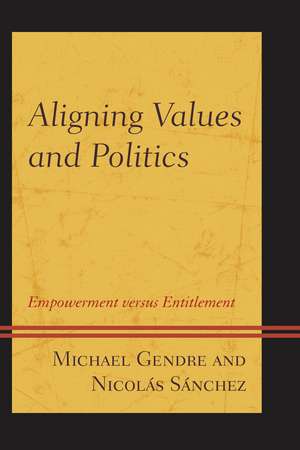
Aligning Values and Politics: Empowerment Versus Entitlement
Autor Michael Gendre, Nicolás Sánchezen Limba Engleză Paperback – 2 mar 2016
Preț: 217.40 lei
Preț vechi: 306.74 lei
-29%
Puncte Express: 326
Carte tipărită la comandă
Livrare economică 04-18 decembrie
Livrare prin curier în România Termenul estimat este afișat lângă disponibilitate.
Transport gratuit de la 400.00 lei Plată online sau ramburs, în funcție de opțiunile comenzii.
Retur gratuit în 14 zile Comandă securizată și suport în română.
Specificații
ISBN-13: 9780761867234
ISBN-10: 0761867236
Pagini: 180
Dimensiuni: 150 x 230 x 13 mm
Greutate: 0.27 kg
Editura: Bloomsbury Publishing
Colecția University Press of America
Locul publicării:New York, United States
ISBN-10: 0761867236
Pagini: 180
Dimensiuni: 150 x 230 x 13 mm
Greutate: 0.27 kg
Editura: Bloomsbury Publishing
Colecția University Press of America
Locul publicării:New York, United States
Cuprins
Dedication
Acknowledgments
Preface,by Michael Gendre
1 Introduction: Empowering People Through Institutional Change
2 Manipulating People by Means of "Bread and Circuses;" Then and Now
3 The Philosophical Case for Limiting Government
4 Caring for Others Requires a Principle of Duty
5 Drawing the Line Between Self-Actualization and Our Duty to Others
6 Private Property Expands Our Opportunities
7 Imposing Restrictions on Inheritance
8 Using Property Rights to Better Understand Abortion and Adoption
9 The Market Is the Best Engine for Conflict Resolution
10 Discrimination As a Moral and Strategic Challenge
11 The Rise of Property Rights in Historical Context: Their Use and Misuse
12 Bringing Back Legitimacy to Government
13 Proposed Legal and Constitutional Changes
14 The Obstacles That We Still Face
15 The Road to Wealth Creation in a Society With Meaningful Lives
16 Imperialism as a Threat to American Governance
17 From Ancients to Moderns: Balancing Individual Rights and Duties to Others
Afterword and Summary in the Form of an Open Letter,by Nicolás Sánchez
Appendix A: Our Assumptions
Appendix B: Our Understanding of Scholarship
Appendix C: The Kantian Texts and Their Contexts
About the Authors
Bibliography
Index
Acknowledgments
Preface,by Michael Gendre
1 Introduction: Empowering People Through Institutional Change
2 Manipulating People by Means of "Bread and Circuses;" Then and Now
3 The Philosophical Case for Limiting Government
4 Caring for Others Requires a Principle of Duty
5 Drawing the Line Between Self-Actualization and Our Duty to Others
6 Private Property Expands Our Opportunities
7 Imposing Restrictions on Inheritance
8 Using Property Rights to Better Understand Abortion and Adoption
9 The Market Is the Best Engine for Conflict Resolution
10 Discrimination As a Moral and Strategic Challenge
11 The Rise of Property Rights in Historical Context: Their Use and Misuse
12 Bringing Back Legitimacy to Government
13 Proposed Legal and Constitutional Changes
14 The Obstacles That We Still Face
15 The Road to Wealth Creation in a Society With Meaningful Lives
16 Imperialism as a Threat to American Governance
17 From Ancients to Moderns: Balancing Individual Rights and Duties to Others
Afterword and Summary in the Form of an Open Letter,by Nicolás Sánchez
Appendix A: Our Assumptions
Appendix B: Our Understanding of Scholarship
Appendix C: The Kantian Texts and Their Contexts
About the Authors
Bibliography
Index
Recenzii
Gendre and Sánchez challenge American citizens to rise up to better versions of themselves, individually and collectively, by questioning the pursuit of mere happiness and pleasure and striving instead for self-actualization built upon Kantian ethical principles. Rejecting the tired dichotomies and slogans of Left and Right, Republican and Democrat, and Us against Them, Gendre and Sánchez challenge readers to reconsider their assumptions, political and economic loyalties, and self-awareness in the light of historical lessons and moral principles. If you are looking for a book that you will agree with across the board, you should pass by on the other side. If, instead, you seek to be challenged and stretched in your thinking about economics, politics, and the purposes and limits of government, this book is for you.
The authors explain how President Kennedy's simple injunction 'Ask not what your country can do for you, ask what you can do for your country' has been turned on its head-by both major political parties. Worse yet, an inverted and perverted injunction has become the ethical norm in our public school system, especially for the most talented children in it. In a short, readable book, the authors spell out the ethical values that they believe will help a new generation of Americans create a more gratifying sense of purpose for themselves and their educational institutions. This compelling book could be the basis for the teaching of Philosophy to an increasingly content-empty high school curriculum, elevating the kind of thinking needed to preserve and build up from what is left of our civic culture.
Oftentimes philosophers operate with little knowledge of economics and economists ignore ethical arguments. Gendre and Sanchez are to be commended for their efforts to overcome that bifurcation. Their use of Immanuel Kant as a moral framework for understanding and critiquing modern American society leads to a wide range of interesting insights and provocative policy recommendations.
The authors explain how President Kennedy's simple injunction 'Ask not what your country can do for you, ask what you can do for your country' has been turned on its head-by both major political parties. Worse yet, an inverted and perverted injunction has become the ethical norm in our public school system, especially for the most talented children in it. In a short, readable book, the authors spell out the ethical values that they believe will help a new generation of Americans create a more gratifying sense of purpose for themselves and their educational institutions. This compelling book could be the basis for the teaching of Philosophy to an increasingly content-empty high school curriculum, elevating the kind of thinking needed to preserve and build up from what is left of our civic culture.
Oftentimes philosophers operate with little knowledge of economics and economists ignore ethical arguments. Gendre and Sanchez are to be commended for their efforts to overcome that bifurcation. Their use of Immanuel Kant as a moral framework for understanding and critiquing modern American society leads to a wide range of interesting insights and provocative policy recommendations.