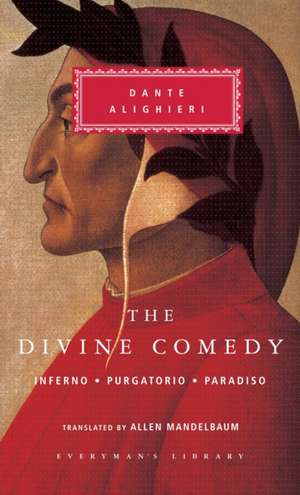
Alighieri, D: Divine Comedy
en Limba Engleză Hardback – aug 1995
Mandelbaum’s astonishingly Dantean translation, which captures so much of the life of the original, renders whole for us the masterpiece of that genius whom our greatest poets have recognized as a central model for all poets.
This Everyman’s editionߝcontaining in one volume all three cantos, Inferno, Purgatorio, and Paradisoߝincludes an introduction by Nobel Prize—winning poet Eugenio Montale, a chronology, notes, and a bibliography. Also included are forty-two drawings selected from Botticelli's marvelous late-fifteenth-century series of illustrations.
(Book Jacket Status: Jacketed)
Preț: 257.66 lei
Puncte Express: 386
Carte indisponibilă temporar
Doresc să fiu notificat când acest titlu va fi disponibil:
Se trimite...
Specificații
ISBN-13: 9780679433132
ISBN-10: 0679433139
Pagini: 960
Dimensiuni: 134 x 212 x 43 mm
Greutate: 0.84 kg
Editura: Knopf Doubleday Publishing Group
ISBN-10: 0679433139
Pagini: 960
Dimensiuni: 134 x 212 x 43 mm
Greutate: 0.84 kg
Editura: Knopf Doubleday Publishing Group
V-ar putea interesa
-
 FrankensteinMary ShelleyPreț: 28.01 lei
 -
 CLASSICS PARADISE LOST AND PAJohn MiltonPreț: 28.01 lei
 -
 HamletCollins GcsePreț: 28.01 lei
 -
 -5%Preț: 118.55 lei124.79 lei
 -
 The TempestWilliam ShakespearePreț: 28.01 lei
 -
 RepublicPlatoPreț: 30.76 lei
 -
 BeautyRobin MckinleyPreț: 59.61 lei
 -
 Small Is BeautifulE F Schumacher-37%Preț: 58.04 lei92.61 lei
 -
 Kafka on the ShoreHaruki Murakami-24%Preț: 61.49 lei80.62 lei
 -
 The LeopardJo Nesbo-13%Preț: 53.26 lei61.38 leiRecomandat
 -
 CockroachesJo NesboPreț: 58.46 leiRecomandat
 -
 The Canterbury TalesGeoffrey ChaucerPreț: 53.87 lei
 -
 The Gods Will Have BloodAnatole France-37%Preț: 58.20 lei92.60 lei
 -
 The Woman in the DunesKobo AbePreț: 78.79 lei
 -
 -16%Preț: 68.98 lei81.85 lei
 -
 The LusiadsLuis Vaz de CamõesPreț: 74.43 lei
 -
 Mystical Poems of RumiJalal al-Din RumiPreț: 134.37 lei
 -
 Of Mice and MenJohn Steinbeck-29%Preț: 49.89 lei70.16 lei
 -
 Frankenstein, Dracula, Dr. Jekyll and Mr. HydeBram StokerPreț: 64.98 lei
Recenzii
“The English Dante of choice.” –Hugh Kenner
“Exactly what we have waited for these years, a Dante with clarity, eloquence, terror, and profoundly moving depths.” –Robert Fagles, Princeton University
“A marvel of fidelity to the original, of sobriety, and truly, of inspired poetry.” –Henri Peyre, Yale University
“Exactly what we have waited for these years, a Dante with clarity, eloquence, terror, and profoundly moving depths.” –Robert Fagles, Princeton University
“A marvel of fidelity to the original, of sobriety, and truly, of inspired poetry.” –Henri Peyre, Yale University
Textul de pe ultima copertă
This story begins in a shadowed forest on Good Friday in the year of our Lord 1300. It proceeds on a journey that, in its intense re-creation of the depths and the heights of human experience, has become the key with which Western civilization has sought to unlock the mystery of its own identity.
Notă biografică
Dante Alighieri was born in 1265. Considered Italy's greatest poet, he is the author The Inferno, The Purgatorio, and The Paradiso. Politically active in Florence, he was banished to Italy in 1302. In 1274, he met the love of his life, Beatrice, whom he immortalized in La Vita Nuova (1292) and The Divine Comedy. He died in 1321.