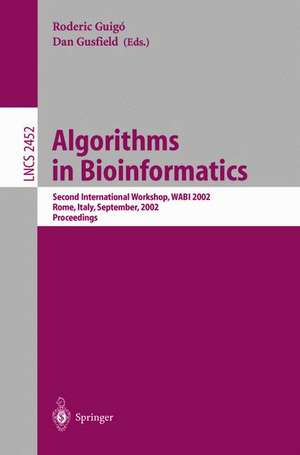
Algorithms in Bioinformatics
Editat de Roderic Guigó, Dan Gusfielden Limba Engleză Paperback – 2 sep 2002
Preț: 637.81 lei
Preț vechi: 797.26 lei
-20%
Puncte Express: 957
Carte tipărită la comandă
Livrare economică 26 noiembrie-10 decembrie
Livrare prin curier în România Termenul estimat este afișat lângă disponibilitate.
Transport gratuit pentru acest produs Plată online sau ramburs, în funcție de opțiunile comenzii.
Retur gratuit în 14 zile Comandă securizată și suport în română.
Specificații
ISBN-13: 9783540442110
ISBN-10: 3540442111
Pagini: 572
Ilustrații: X, 554 p.
Dimensiuni: 155 x 235 x 31 mm
Greutate: 0.86 kg
Ediția:2002
Editura: Springer
Locul publicării:Berlin, Heidelberg, Germany
ISBN-10: 3540442111
Pagini: 572
Ilustrații: X, 554 p.
Dimensiuni: 155 x 235 x 31 mm
Greutate: 0.86 kg
Ediția:2002
Editura: Springer
Locul publicării:Berlin, Heidelberg, Germany
V-ar putea interesa
-
 Software Evangelism and the Rhetoric of Morality: Coding Justice in a Digital DemocracyJennifer Helene Maher-18%Preț: 963.80 lei1175.37 lei
 -
 Algorithms on Strings, Trees and SequencesDan Gusfield-20%Preț: 674.87 lei843.59 lei
 -
 -8%Preț: 458.49 lei498.36 lei
 -
 Introduction to Programming Using Python, An, Global EditionDavid Schneider-20%Preț: 533.81 lei667.27 lei
 -
 Programming for the Absolute BeginnerJerry Lee Ford Jr.-13%Preț: 304.12 lei350.43 lei
 -
 Computer Algorithms: Design, Analysis and ApplicationsAaron Armstrong-20%Preț: 845.15 lei1056.44 lei
 -
 JMP EssentialsCurt Hinrichs-20%Preț: 384.26 lei480.32 lei
 -
 Clojure High Performance Programming Second EditionShantanu Kumar-20%Preț: 203.64 lei254.55 lei
 -
 Learning RxJava - Second EditionNick Samoylov-20%Preț: 217.14 lei271.43 lei
 -
 -18%Preț: 1217.03 lei1484.18 lei
 -
 Expert C++Vardan Grigoryan-20%Preț: 258.22 lei322.78 lei
 -
 Hands-On RESTful Web Services with Go, Second EditionNaren Yellavula-20%Preț: 245.47 lei306.83 lei
 -
 The Deep Learning with PyTorch WorkshopHyatt Saleh-20%Preț: 211.94 lei264.93 lei
 -
 Learn SwiftUIChris Barker-20%Preț: 181.80 lei227.25 lei
 -
 Algebraic InformaticsAndreas Maletti-20%Preț: 331.42 lei414.27 lei
 -
 Correct System DesignRoland Meyer-20%Preț: 334.59 lei418.24 lei
 -
 Fields of Logic and Computation IILev D. Beklemishev-20%Preț: 336.75 lei420.93 lei
 -
 Combinatorial Pattern MatchingMaxime Crochemore-20%Preț: 324.22 lei405.27 lei
 -
 Static AnalysisSandrine Blazy-20%Preț: 337.80 lei422.24 lei
 -
 Algorithms - ESA 2015Nikhil Bansal-20%Preț: 690.49 lei863.11 lei
 -
 -20%Preț: 533.09 lei666.36 lei
 -
 Semi-Automatic Generation of Three-Dimensional Algorithm SimulationsAshraf Abu Baker-20%Preț: 490.60 lei613.24 lei
 -
 -20%Preț: 518.88 lei648.61 lei
Public țintă
ResearchCuprins
Simultaneous Relevant Feature Identification and Classification in High-Dimensional Spaces.- Pooled Genomic Indexing (PGI): Mathematical Analysis and Experiment Design.- Practical Algorithms and Fixed-Parameter Tractability for the Single Individual SNP Haplotyping Problem.- Methods for Inferring Block-Wise Ancestral History from Haploid Sequences.- Finding Signal Peptides in Human Protein Sequences Using Recurrent Neural Networks.- Generating Peptide Candidates from Amino-Acid Sequence Databases for Protein Identification via Mass Spectrometry.- Improved Approximation Algorithms for NMR Spectral Peak Assignment.- Efficient Methods for Inferring Tandem Duplication History.- Genome Rearrangement Phylogeny Using Weighbor.- Segment Match Refinement and Applications.- Extracting Common Motifs under the Levenshtein Measure: Theory and Experimentation.- Fast Algorithms for Finding Maximum-Density Segments of a Sequence with Applications to Bioinformatics.- FAUST: An Algorithm for Extracting Functionally Relevant Templates from Protein Structures.- Efficient Unbound Docking of Rigid Molecules.- A Method of Consolidating and Combining EST and mRNA Alignments to a Genome to Enumerate Supported Splice Variants.- A Method to Improve the Performance of Translation Start Site Detection and Its Application for Gene Finding.- Comparative Methods for Gene Structure Prediction in Homologous Sequences.- MultiProt — A Multiple Protein Structural Alignment Algorithm.- A Hybrid Scoring Function for Protein Multiple Alignment.- Functional Consequences in Metabolic Pathways from Phylogenetic Profiles.- Finding Founder Sequences from a Set of Recombinants.- Estimating the Deviation from a Molecular Clock.- Exploring the Set of All Minimal Sequences of Reversals — An Application to Test theReplication-Directed Reversal Hypothesis.- Approximating the Expected Number of Inversions Given the Number of Breakpoints.- Invited Lecture — Accelerating Smith-Waterman Searches.- Sequence-Length Requirements for Phylogenetic Methods.- Fast and Accurate Phylogeny Reconstruction Algorithms Based on the Minimum-Evolution Principle.- NeighborNet: An Agglomerative Method for the Construction of Planar Phylogenetic Networks.- On the Control of Hybridization Noise in DNA Sequencing-by-Hybridization.- Restricting SBH Ambiguity via Restriction Enzymes.- Invited Lecture — Molecule as Computation: Towards an Abstraction of Biomolecular Systems.- Fast Optimal Genome Tiling with Applications to Microarray Design and Homology Search.- Rapid Large-Scale Oligonucleotide Selection for Microarrays.- Border Length Minimization in DNA Array Design*.- The Enhanced Suffix Array and Its Applications to Genome Analysis.- The Algorithmic of Gene Teams.- Combinatorial Use of Short Probes for Differential Gene Expression Profiling.- Designing Specific Oligonucleotide Probes for the Entire S. cerevisiae Transcriptome.- K-ary Clustering with Optimal Leaf Ordering for Gene Expression Data.- Inversion Medians Outperform Breakpoint Medians in Phylogeny Reconstruction from Gene-Order Data.- Modified Mincut Supertrees.