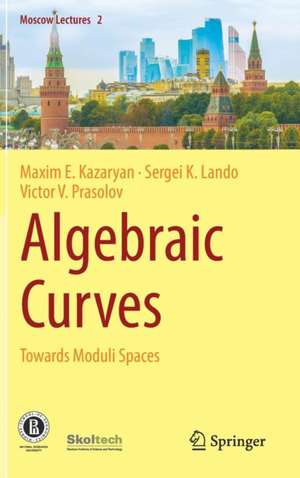
Algebraic Curves: Moscow Lectures, cartea 2
Autor Maxim E. Kazaryan, Sergei K. Lando, Victor V. Prasolov Traducere de Natalia Tsilevichen Limba Engleză Hardback – 6 feb 2019
Evoluția geometriei algebrice din ultimele decenii a transformat studiul curbelor dintr-o disciplină izolată într-un pilon central al fizicii matematice, în special în teoria corzilor. Observăm în Algebraic Curves o schimbare de paradigmă pedagogică: trecerea de la analiza curbelor individuale la studiul familiilor de curbe și al spațiilor lor moduli. Această abordare reflectă o maturizare a domeniului, unde spațiile care parametrizează curbele devin obiecte geometrice în sine, adesea mai ușor de studiat decât elementele lor constitutive. Lucrarea, publicată în seria Moscow Lectures de către Springer, extinde cadrul propus de Complex Algebraic Curves de Frances Kirwan cu date noi din cercetările secolului XX, în special contribuțiile lui Deligne și Mumford. Reținem că autorii reușesc să prezinte noțiuni fundamentale — precum Jacobianul, spațiul diferențialelor holomorfe și teorema Riemann-Roch — fără a recurge la limbajul tehnic al schemelor, făcând materia accesibilă studenților de la licență. Structura textului urmează o progresie logică riguroasă: primele capitole stabilesc fundamentele topologice și proiective (formulele Plücker, divizori), capitolele centrale demonstrează teorema Riemann-Roch și teorema lui Abel, pentru ca ultima treime a cărții să fie dedicată construcției efective a spațiilor moduli și curbelor stabile. Spre deosebire de Moduli of Curves de Joe Harris, care utilizează tehnici avansate de geometrie birațională, volumul de față se concentrează pe o introducere „prietenoasă” dar riguroasă, menținând un echilibru între intuiția geometrică și calculul practic. Apreciem includerea unui set generos de probleme de examen la final, ceea ce confirmă statutul lucrării de manual universitar modern, adaptat cerințelor curriculare actuale.



Preț: 520.60 lei
Preț vechi: 612.48 lei
-15%
Carte tipărită la comandă
Livrare economică 28 noiembrie-12 decembrie
Specificații
ISBN-10: 3030029425
Pagini: 248
Ilustrații: XIV, 231 p. 37 illus.
Dimensiuni: 160 x 241 x 20 mm
Greutate: 0.49 kg
Ediția:1st ed. 2018
Editura: Springer
Colecția Moscow Lectures
Seria Moscow Lectures
Locul publicării:Cham, Switzerland
De ce să citești această carte
Această lucrare este ideală pentru studenții la matematică sau fizică teoretică care doresc o introducere rapidă și clară în spațiile moduli, fără a se pierde în formalismul abstract al geometriei algebrice moderne. Cititorul câștigă o înțelegere solidă a teoremei Riemann-Roch și a curbelor stabile, beneficiind de rigoarea școlii ruse de matematică și de exerciții practice care consolidează teoria prezentată la curs.
Despre autor
Maxim E. Kazaryan, Sergei K. Lando și Victor V. Prasolov sunt matematicieni reputați, afiliați unor instituții de prestigiu precum Universitatea Independentă din Moscova și Școala Superioară de Economie (HSE). Expertiza lor acoperă geometria algebrică, topologia și combinatorica enumerativă. Sergei K. Lando este cunoscut pentru contribuțiile sale în teoria invariantelor și a spațiilor moduli, în timp ce Victor V. Prasolov este un autor prolific de manuale de referință în geometrie și algebră. Colaborarea lor pentru acest volum din seria Moscow Lectures sintetizează decenii de experiență pedagogică în formarea unora dintre cei mai buni matematicieni contemporani.
Cuprins
Recenzii
Notă biografică
Sergei Lando is a professor of mathematics at the NRU Higher School of Economics since 2008 and at the Skolkovo Institute of Science and Technology since 2016. He was the first Dean of the Department of Mathematics at the NRU HSE. He also is a Vice-President of the Moscow Mathematical Society.
Victor Prasolov is a permanent teacher of mathematics at the Independent University of Moscow.
Textul de pe ultima copertă
Based on several lecture courses given by the authors at the Independent University of Moscow and Higher School of Economics, the book also includes a wealth of problems, making it suitable not only for individual research, but also as a textbook for undergraduate and graduate coursework