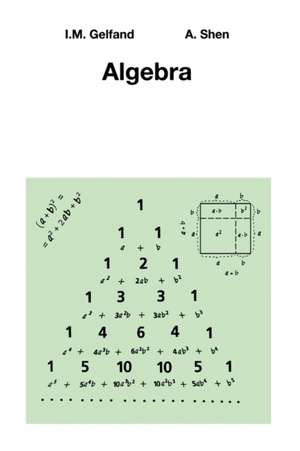
Algebra
Autor I. M. Gelfand, Alexander Shenen Limba Engleză Paperback – 17 sep 1993
Ediția din 2004 a lucrării Algebra reprezintă o revitalizare a acestei discipline fundamentale, propunând o metodologie de învățare activă ce se distanțează de manualele convenționale. Descoperim aici o structură riguroasă, unde accentul nu cade pe expunerea teoretică aridă, ci pe un dialog constant între autor și cititor prin intermediul problemelor. Față de abordările pedagogice anterioare, această ediție rafinează trecerea de la aritmetica elementară la abstracția algebrică, introducând capitole noi sau extinse despre sistemul binar, puteri negative și polinoame. Suntem de părere că forța acestui volum rezidă în capacitatea de a „reîmprospăta” bijuteriile matematice care și-au pierdut farmecul prin utilizarea cotidiană. Organizarea conținutului este progresivă: pornim de la legile comutative și distributive, trecem prin formulele de calcul prescurtat și ajungem la triunghiul lui Pascal. Comparabil cu Mathematics Problems with Separate Progressive Solutions de Catalin Barboianu în rigurozitate, volumul lui I. M. Gelfand și Alexander Shen se diferențiază prin stilul narativ și concentrarea pe intuiția matematică, fiind actualizat pentru nevoile curriculare ale studenților de la nivel licență. Această lucrare se înscrie perfect în ansamblul operei lui I. M. Gelfand, continuând spiritul explorator din The Method of Coordinates și Functions and Graphs. Dacă în Trigonometry autorul investiga raporturile geometrice, în Algebra el consolidează limbajul simbolic necesar oricărei științe exacte. Credem că este o resursă esențială care transformă rezolvarea de probleme dintr-o sarcină repetitivă într-un proces de descoperire intelectuală, oferind indicii strategice acolo unde dificultatea testelor crește.
Preț: 402.63 lei
Preț vechi: 485.09 lei
-17%
Carte disponibilă
Livrare economică 16-30 octombrie
Livrare express 01-07 octombrie pentru 24.93 lei
Specificații
ISBN-10: 0817636773
Pagini: 160
Ilustrații: 160 p. 3 illus.
Dimensiuni: 155 x 235 x 9 mm
Greutate: 0.25 kg
Ediția:2004
Editura: birkhäuser
Locul publicării:Boston, MA, United States
V-ar putea interesa
-
 Circuit Board Square - Volume 1Alexander ShenPreț: 81.19 lei
 -
 A Beginner's Guide to Mathematical LogicRaymond M. SmullyanPreț: 138.27 lei
 -
 Representation TheoryM. I. Graev-11%Preț: 537.36 lei603.77 lei
 -
 General Theory of Lie Groupoids and Lie AlgebroidsKirill C. H. Mackenzie-14%Preț: 734.81 lei854.42 lei
 -
 Handbook of Tilting TheoryLidia Angeleri Hugel-11%Preț: 627.78 lei705.37 lei
 -
 Noncommutative Localization in Algebra and TopologyAndrew Ranicki-11%Preț: 442.80 lei497.54 lei
 -
 Functions and GraphsI. M. GelfandPreț: 333.69 lei
 -
 The Method of CoordinatesI. M. GelfandPreț: 298.58 lei
 -
 TrigonometryI. M. GelfandPreț: 304.45 lei
 -
 Elements of AlgebraArthur SchultzePreț: 205.75 lei
 -
 -15%Preț: 611.17 lei719.01 lei
 -
 The Gelfand Mathematical Seminars, 1993-1995I. M. Gelfand-15%Preț: 612.76 lei720.90 lei
 -
 The Arnold-Gelfand Mathematical SeminarsV. Arnold-18%Preț: 914.66 lei1115.44 lei
 -
 Preț: 144.60 lei
 -
 -9%Preț: 1468.42 lei1613.65 lei
 -
 Poset Codes: Partial Orders, Metrics and Coding TheoryMarcelo FirerPreț: 394.24 lei
 -
 Linear AlgebraM. Thamban NairPreț: 468.08 lei
Public țintă
Lower undergraduateDe ce să citești această carte
Recomandăm această carte studenților și pasionaților de matematică care doresc să înțeleagă fundamentele algebrei dincolo de simple formule. Prin metoda propusă de I. M. Gelfand — rezolvare, comparare, corectare — cititorul câștigă o autonomie reală în gândire. Este o investiție în logica matematică, oferind claritate asupra unor teme complexe precum polinoamele și puterile, totul într-un format accesibil de tip paperback.
Descriere scurtă
Cuprins
Recenzii
“Were‘Algebra’to be used solely for supplementary reading, it could be wholeheartedly recommended to any high school student of any teacher … In fact, given the long tradition of mistreating algebra as a disjointed collection of techniques in the schools, there should be some urgency in making this book compulsory reading for anyone interested in learning mathematics.” —The Mathematical Intelligencer