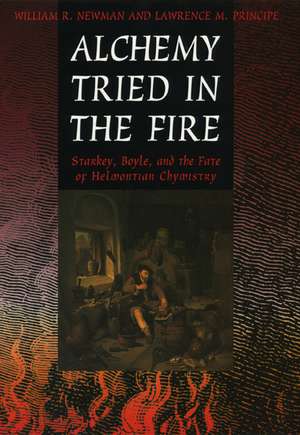
Alchemy Tried in the Fire: Starkey, Boyle, and the Fate of Helmontian Chymistry
Autor William R. Newman, Lawrence M. Principeen Limba Engleză Paperback – iun 2005
Notăm cu interes apariția volumului Alchemy Tried in the Fire, o lucrare fundamentală pentru istoria științei care reevaluează tranziția de la alchimie la chimie în secolul al XVII-lea. Lucrarea se încadrează în nucleul dur al programelor de studiu privind Revoluția Științifică, oferind o perspectivă tehnică asupra practicilor de laborator care au precedat chimia modernă. Autorii, William R. Newman și Lawrence M. Principe, investighează relația complexă dintre Robert Boyle și americanul George Starkey, demonstrând că fundamentele chimiei nu au apărut prin respingerea alchimiei, ci prin rafinarea riguroasă a metodelor acesteia.
Reținem modul în care autorii decodează caietele de laborator ale lui Starkey, transformând limbajul alegoric al tratatelor semnate sub pseudonimul Eirenaeus Philalethes în date experimentale cuantificabile. Cititorii familiarizați cu Gehennical Fire vor aprecia modul în care acest volum extinde analiza asupra lui Starkey, trecând de la biografie la o examinare microscopică a metodologiei sale de lucru. Structura cărții urmărește o progresie logică: primele capitole stabilesc contextul medieval și influența lui Joan Baptista Van Helmont, în timp ce secțiunile centrale se concentrează pe tehnici specifice precum volatilizarea alcaliilor și metalurgia industrială. Spre deosebire de The Aspiring Adept, care se focalizează strict pe Boyle, acest volum oferă o viziune simbiotică asupra colaborării dintre cei doi, evidențiind modul în care Starkey a servit drept punte între tradiția hermetică și rigoarea empirică a lui Boyle. Este o analiză densă, care înlocuiește imaginea misticului cu cea a experimentatorului meticulos, ancorat în greutate, măsură și număr.
Preț: 310.02 lei
Carte tipărită la comandă
Livrare economică 06-20 iunie
Specificații
ISBN-10: 0226577023
Pagini: 359
Ilustrații: 7 halftones
Dimensiuni: 152 x 229 x 15 mm
Greutate: 0.51 kg
Editura: University of Chicago Press
Colecția University of Chicago Press
V-ar putea interesa
-
 The Devil's DoctorPhilip BallPreț: 130.60 lei
 -
 The Book of MagicBrian Copenhaver-18%Preț: 75.70 lei91.86 lei
 -
 The Penguin Book of WitchesKatherine HowePreț: 70.20 lei
 -
 Preț: 277.62 lei
 -
 The Scientific Revolution: A Very Short IntroductionLawrence M. Principe-21%Preț: 53.45 lei67.77 lei
 -
 Magic: A Very Short IntroductionOwen Davies-21%Preț: 53.45 lei67.77 lei
 -
 Grimoires: A History of Magic BooksOwen DaviesPreț: 161.44 lei
 -
 The Secrets of AlchemyLawrence M. PrincipePreț: 130.30 lei
 -
 Magical Treasure Hunting in Europe and North AmericaJ. Dillinger-18%Preț: 857.18 lei1045.33 lei
 -
 Charms, Charmers and CharmingJ. Roper-18%Preț: 910.40 lei1110.24 lei
 -
 A General Theory of MagicMarcel MaussPreț: 125.50 lei
 -
 Giordano Bruno and the Hermetic TraditionFrances YatesPreț: 162.56 lei
 -
 Preț: 381.68 lei
 -
 The Alchemy Reader: From Hermes Trismegistus to Isaac NewtonStanton J. LindenPreț: 166.99 lei
 -
 Alchemical Active ImaginationMarie-Louise Von Franz-22%Preț: 120.86 lei154.67 lei
 -
 The Book of AbramelinAbraham von WormsPreț: 256.82 lei
 -
 The Black SunStanton MarlanPreț: 133.26 lei
 -
 Shamans: Siberian Spirituality and the Western ImaginationProf Ronald Hutton-44%Preț: 191.09 lei341.89 lei
 -
 Alchemist's KitchenGuy OgilvyPreț: 50.49 lei
De ce să citești această carte
Această carte este esențială pentru cercetătorii și studenții la istoria științei care doresc să înțeleagă originile reale ale chimiei moderne. Cititorul câștigă o perspectivă documentată asupra modului în care experimentele alchimice au pus bazele metodologiei științifice. Este un argument solid împotriva ideii că alchimia a fost o pseudo-știință, demonstrând, prin analiza premiată cu Pfizer Prize, rigoarea cantitativă a laboratoarelor din secolul al XVII-lea.
Despre autor
William R. Newman este profesor de istoria și filosofia științei la Indiana University, Bloomington. Opera sa este dedicată explorării granițelor dintre natural și artificial, temă centrală și în lucrarea sa Promethean Ambitions. Newman este recunoscut la nivel internațional pentru revitalizarea interesului academic față de alchimie, demonstrând în lucrări precum Atoms and Alchemy rădăcinile alchimice ale filosofiei mecanice. Expertiza sa în decriptarea textelor vechi și a practicilor de laborator îi permite să poziționeze figuri precum George Starkey în centrul discursului științific modern, transformând percepția asupra evoluției chimiei.
Descriere scurtă
What actually took place in the private laboratory of a mid-seventeenth century alchemist? How did he direct his quest after the secrets of Nature? What instruments and theoretical principles did he employ?
Using, as their guide, the previously misunderstood interactions between Robert Boyle, widely known as "the father of chemistry," and George Starkey, an alchemist and the most prominent American scientific writer before Benjamin Franklin as their guide, Newman and Principe reveal the hitherto hidden laboratory operations of a famous alchemist and argue that many of the principles and practices characteristic of modern chemistry derive from alchemy. By analyzing Starkey's extraordinary laboratory notebooks, the authors show how this American "chymist" translated the wildly figurative writings of traditional alchemy into quantitative, carefully reasoned laboratory practice—and then encoded his own work in allegorical, secretive treatises under the name of Eirenaeus Philalethes. The intriguing "mystic" Joan Baptista Van Helmont—a favorite of Starkey, Boyle, and even of Lavoisier—emerges from this study as a surprisingly central figure in seventeenth-century "chymistry." A common emphasis on quantification, material production, and analysis/synthesis, the authors argue, illustrates a continuity of goals and practices from late medieval alchemy down to and beyond the Chemical Revolution.
For anyone who wants to understand how alchemy was actually practiced during the Scientific Revolution and what it contributed to the development of modern chemistry, Alchemy Tried in the Fire will be a veritable philosopher's stone.
Notă biografică
Lawrence M. Principe is professor of the history of science and technology and of chemistry at The Johns Hopkins University. He is the author of The Aspiring Adept: Robert Boyle and His Alchemical Quest and coeditor of The Correspondence of Robert Boyle.
Cuprins
Acknowledgments
Preface
Abbreviations
Introduction
Chapter 1 - Worlds Apart
Boyle's Portrayal of His Relationship to Chymistry
Conclusions
Chapter 2 - Number, Weight, Measure, and Experiment in Chymistry: From the Medievals to Van Helmont
Testing, Analysis, and Assaying in Late Medieval Alchemy
Alexander von Suchten and the Sixteenth-Century Synthesis of Chymical Traditions
Joan Baptista Van Helmont: Art, Nature, and Experiment
Conclusions
Chapter 3 - Theory and Practice: Starkey's Laboratory Methodology
The Use and Format of Starkey's Notebooks
Starkey's Laboratory
Starkey's Experimental Methodology: Conjectural Processes and Fiery Refutations
Quantitative Methods and Analyses in Transmutational Alchemy
The Volatilization of Alkalies and Starkey's Grand Design for Medicine
Conclusions
Chapter 4 - Scholasticism, Metallurgy, and Secrecy in the Laboratory: The Style and Origin of Starkey's Notebooks
Sources of Starkey's Industrial Chymistry
The Structure of Starkey's Laboratory Notebooks
Starkey and Textual Authority
The Place of Divine Authority in the Laboratory
Conclusions
Chapter 5 - Starkey, Boyle, and Chymistry in the Hartlib Circle
George Starkey and the Development of Boyle's Early Chymistry
The Role of Benjamin Worsley in Boyle's “Chymical Education”
Hartlib's “Chymical Son” Frederick Clodius and Boyle
Conclusions
Chapter 6 - The Legacy of Van Helmont's and Starkey's Chymistry: Boyle, Homberg, and the Chemical Revolution
The Chymistry of Salts in Boyle and Van Helmont
A Helmontian Background to the Chemical Revolution
Conclusions
Conclusion
Works Cited
Index