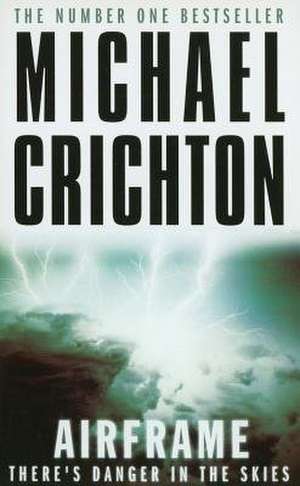
Airframe
Autor Michael Crichtonen Limba Engleză Paperback – 23 oct 1997
Ce se întâmplă atunci când un zbor de rutină de la Hong Kong la Denver se transformă într-un coșmar la mii de metri altitudine, lăsând în urmă un dezastru aviatic și o mulțime de întrebări fără răspuns? Merită menționat că, în Airframe, Michael Crichton nu se limitează la a scrie un simplu roman de suspans, ci realizează o disecție aproape chirurgicală a industriei aeronautice. Suntem de părere că forța acestui roman rezidă în modul în care autorul transformă detaliile tehnice — de la hidraulică la protocoale de întreținere — într-un mecanism de tensiune psihologică. Observăm o schimbare de perspectivă față de lucrările sale anterioare, precum Jurassic Park sau The Lost World. Dacă acolo pericolul venea din forțele naturii reînviate prin biotehnologie, aici catastrofa este rezultatul unei fuziuni toxice între erorile umane, interesele corporatiste și fragilitatea sistemelor complexe pe care ne bazăm viața în fiecare zi. Imaginați-vă tensiunea dintr-un roman precum Falling de T. J. Newman, mutată într-un decor de investigație tehnică riguroasă și intrigi politice de culise. Ritmul este unul calculat, imitând precizia unei anchete oficiale, dar păstrând acea urgență caracteristică autorului. Crichton reușește să facă din procesul de colectare a datelor o cursă contracronometru, în care adevărul este îngropat sub straturi de jargon tehnic și strategii de PR.
Preț: 59.78 lei
Preț vechi: 79.42 lei
-25%
Carte disponibilă
Livrare economică 20 noiembrie-01 decembrie
Livrare express 31 octombrie-06 noiembrie pentru 40.95 lei
Specificații
ISBN-10: 0099556316
Pagini: 431
Dimensiuni: 111 x 179 x 32 mm
Greutate: 0.24 kg
Editura: Random House
Colecția Arrow Books
Locul publicării:United Kingdom
V-ar putea interesa
-
 MicroMichael CrichtonPreț: 93.67 lei
 -
 South of NowhereJeffery DeaverPreț: 110.60 lei
 -
 PRIVATE JET_THRILLER COLLEC PBSarah GoodwinPreț: 71.15 lei
 -
 DisclosureMichael Crichton-25%Preț: 59.25 lei79.32 lei
 -
 Dead or AliveGrant BlackwoodPreț: 96.69 lei
 -
 Mastering the Art of French Cooking: Volume1Julia Child-34%Preț: 82.13 lei124.85 lei
 -
 Paul of DuneBrian HerbertPreț: 88.29 lei
 -
 Sea of FireSteve PieczenikPreț: 55.02 lei
 -
 Red RabbitTom ClancyPreț: 77.58 lei
 -
 War of EaglesJeff RovinPreț: 55.54 lei
 -
 The Casual VacancyJ. K. Rowling-23%Preț: 63.07 lei81.52 lei
 -
 Sandworms of DuneBrian HerbertPreț: 71.40 lei
 -
 Paul of DuneBrian HerbertPreț: 87.21 lei
 -
 Preț: 65.76 lei
 -
 Safe EnoughLee Child-18%Preț: 59.33 lei72.39 leiRecomandat
De ce să citești această carte
Recomandăm această carte cititorilor care apreciază realismul tehnic și thrillerele care explorează sistemele de siguranță globală. Este o lectură esențială pentru cei fascinați de aviație și de modul în care marile corporații gestionează crizele. Veți câștiga o perspectivă detaliată asupra a ceea ce se întâmplă în spatele ușilor închise ale unei anchete aviatice, totul sub semnătura unui maestru al genului techno-thriller.
Despre autor
Michael Crichton (1942–2008) a fost un autor și regizor american, considerat părintele genului techno-thriller. Absolvent de medicină la Harvard, Crichton și-a folosit cunoștințele științifice profunde pentru a scrie romane care explorează adesea eșecurile tehnologiei și consecințele catastrofale ale interacțiunii umane cu aceasta. Cu peste 200 de milioane de exemplare vândute, opera sa include titluri de referință precum Jurassic Park, Congo și The Andromeda Evolution. A fost, de asemenea, creatorul celebrului serial medical „ER”, demonstrând o capacitate unică de a îmbina rigoarea factuală cu narațiunea alertă.
Notă biografică
Descriere
Extras
LAX
5:57 a.m.
Daniel Greene was the duty officer at the FAA Flight Standards District Office on Imperial Highway, half a mile from LAX. The local FSDOs--or Fizdos, as they were called--supervised the flight operations of commercial carriers, checking everything from aircraft maintenance to pilot training. Greene had come in early to clear the paper off his desk; his secretary had quit the week before, and the office manager refused to replace her, citing orders from Washington to absorb attrition. So now Greene went to work, muttering. Congress was slashing the FAA budget, telling them to do more with less, pretending the problem was productivity and not workload. But passenger traffic was up four percent a year, and the commercial fleet wasn't getting younger. The combination made for a lot more work on the ground. Of course, the FSDOs weren't the only ones who were strapped. Even the NTSB was broke; the Safety Board only got a million dollars a year for aircraft accidents, and--
The red phone on his desk rang, the emergency line. He picked it up; it was a woman at traffic control.
"We've just been informed of an incident on an inbound foreign carrier," she said.
"Uh-huh." Greene reached for a notepad. "Incident" had a specific meaning to the FAA, referring to the lower category of flight problems that carriers were required to report. "Accidents" involved deaths or structural damage to the aircraft and were always serious, but with incidents, you never knew. "Go ahead."
"It's TransPacific Flight 545, incoming from Hong Kong to Denver. Pilot's requested emergency landing at LAX. Says they encountered turbulence during flight."
"Is the plane airworthy?"
"They say it is," Levine said. "They've got injuries, and they've requested forty ambulances."
"Forty?"
"They've also got two stiffs."
"Great." Greene got up from his desk. "When's it due in?"
"Eighteen minutes."
"Eighteen minutes--Jeez, why am I getting this so late?"
"Hey, the captain just told us, we're telling you. I've notified EMS and alerted the fire crews."
"Fire crews? I thought you said the plane's okay."
"Who knows?" the woman said. "The pilot is not making much sense. Sounds like he might be in shock. We hand off to the tower in seven minutes."
"Okay," Greene said. "I'm on my way."
He grabbed his badge and his cell phone and went out the door. As he passed Karen, the receptionist, he said, "Have we got anybody at the international terminal?"
"Kevin's there."
"Beep him," Greene said. "Tell him to get on TPA 545, inbound Hong Kong, landing in fifteen. Tell him to stay at the gate--and don't let the flight crew leave."
"Got it," she said, reaching for the phone.
Greene roared down Sepulveda Boulevard toward the airport. Just before the highway ran beneath the runway, he looked up and saw the big TransPacific Airlines widebody, identifiable by its bright yellow tail insignia, taxiing toward the gate. TransPacific was a Hong Kong-based charter carrier. Most of the problems the FAA had with foreign airlines occurred with charters. Many were low-budget operators that didn't match the rigorous safety standards of the scheduled carriers. But TransPacific had an excellent reputation.
At least the bird was on the ground, Greene thought. And he couldn't see any structural damage to the widebody. The plane was an N-22, built by Norton Aircraft in Burbank. The plane had been in revenue service five years, with an enviable dispatch and safety record.
Greene stepped on the gas and rushed into the tunnel, passing beneath the giant aircraft.
He sprinted through the international building. Through the windows, he saw the TransPacific jet pulled up to the gate, and the ambulances lined up on the concrete below. The first of them was already driving out, its siren whining.
Greene came to the gate, flashed his badge, and ran down the ramp. Passengers were disembarking, pale and frightened. Many limped, their clothes torn and bloody. On each side of the ramp, paramedics clustered around the injured.
As he neared the plane, the nauseating odor of vomit grew stronger. A frightened TransPac stewardess pushed him back at the door, chattering at him rapidly in Chinese. He showed her his badge and said, "FAA! Official business! FAA!" The stewardess stepped back, and Greene slid past a mother clutching an infant and stepped into the plane.
He looked at the interior, and stopped. "Oh my God," he said softly. "What happened to this plane?"
From the Hardcover edition.