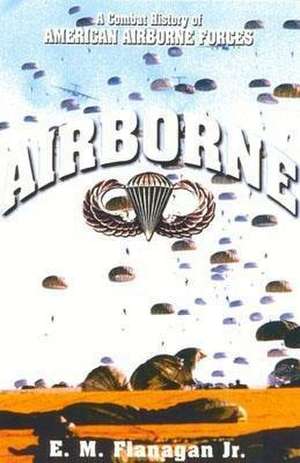
Airborne: A Combat History of American Airborne Forces
Autor E.M. Flanagan, Jr.en Limba Engleză Hardback – 31 dec 2002
On the nights of June 5 and 6, 1944, the parachutes and gliders of six regiments of American airborne infantry filled the dark sky over Normandy. Paratroopers and glidermen of the 101st Airborne Division Screaming Eagles were literally dropping into battle for the first time, harbingers of the vast Allied D-day armada. Moments later, they were joined by the veteran All Americans of the 82d Airborne Division, who had first jumped into combat almost a year earlier in Sicily.
For the American airborne troopers, the road to victory in Europe led through the ill-conceived Arnhem campaign and on to the Bulge, where the American paratroopers saved the day for the Allies. The 17th Airborne Division “bounced the Rhine” in the last airborne operation in Europe and fought across Germany until VE Day with their band of brothers.
In the Pacific, the Angels of the 11th Airborne Division saw hard combat in the Philippines. The independent 503d Regimental Combat Team fulfilled General MacArthur’s promise to return when it daringly parachuted onto the small area known as Topside on the rocky fortress island of Corregidor.
Following World War II, the airborne fought with distinction in Korea, Vietnam, and the Gulf War. Along the way American paratroopers have also given yeoman service on smaller battlefields such as the Dominican Republic, Grenada, and Panama. Written by a former paratrooper, Airborne is the definitive combat history of these elite forces.
Preț: 186.74 lei
Puncte Express: 280
Carte indisponibilă temporar
Doresc să fiu notificat când acest titlu va fi disponibil:
Se trimite...
Specificații
ISBN-13: 9780891416883
ISBN-10: 0891416889
Pagini: 496
Dimensiuni: 165 x 242 x 36 mm
Greutate: 0.81 kg
Editura: Random House Publishing Group
Colecția Presidio Press
ISBN-10: 0891416889
Pagini: 496
Dimensiuni: 165 x 242 x 36 mm
Greutate: 0.81 kg
Editura: Random House Publishing Group
Colecția Presidio Press
Recenzii
“A DETAILED AND FASCINATING BOOK . . . A fine military history from the beginnings of the first real American airborne activities in the early days of World War II through Korea, Vietnam, and the first Gulf War.”
—Tampa Tribune & Times
From the Trade Paperback edition.
—Tampa Tribune & Times
From the Trade Paperback edition.
Notă biografică
E. M. Flanagan Jr. is America’s leading expert on airborne history. He is the author of many books, including Rakkasans and Corregidor. A World War II combat veteran with the 11th Airborne Division in the Philippines, he commanded troops at all levels up from company to field army during his thirty-six-year career. Flanagan retired from active duty in 1978 as a lieutenant general. He lives in Beaufort, South Carolina.
Extras
Lieutenant William T. Ryder crouched in the open cargo door
of a C-33 transport aircraft flying at an altitude of about
1,500 feet over an open field just to the south of Fort Benning's
Lawson airfield. It was 3 August 1940, a calm, warm
summer day. Lieutenant Ryder was strapped into a T-4, a
twenty-eight-foot backpack parachute whose rip cord was attached
by a static line to an overhead anchor cable that ran the
length of the cargo compartment of the plane. On his chest, attached
to his main harness, was a smaller twenty-two-foot
parachute in a rectangular canvas pack. This was his reserve,
which, if his main chute failed to open properly, he could activate
by pulling a handle sticking out of the right-hand side of the
parachute. He wore an Army Air Corps one-piece twill coverall,
what looked like a soft, old-fashioned football helmet
strapped under his chin, and shin-high, laced brown boots with
straps across the instep. Kneeling beside Lieutenant Ryder on the
floor of the plane was W. O. Harry "Tug" Wilson, the Army Air
Corps' most experienced jumper, a parachute expert who, with
a team of four other Air Corps riggers and trainers, had been
working with Lieutenant Ryder and his Parachute Test Platoon
for the previous two months. Wilson leaned far out of the plane's
door, his face rippling in the 110-mile-an- hour wind, looking
for the "go point," red panels on the forward edge of the drop
zone (DZ). As the plane neared the drop zone, the pilot throttled
back to the jump speed of about ninety miles per hour and flew
directly above the go point. Wilson tapped the lieutenant's left
leg sharply, and Ryder thrust himself out the door, an exhila-
rating event he had been thinking constantly about during the
preceding few months. Just below the plane, two seconds later,
as his static line pulled the parachute silk out of his backpack,
Ryder felt the welcome jolt of the parachute's opening shock
(common to the T-4 and its successor, the
T-5, widely used throughout World War II). He floated down,
landed safely with his feet apart to the width of his hips, and did
a front roll--standard landing procedure in those days. Bill Ryder
had just made U.S. Army airborne history by being the
army's first paratrooper and leading the army's first parachute
unit, the Parachute Test Platoon, on its first jump. General Ryder
wrote years later:
although Tug was jumpmaster, I wanted to be at the door
with him as each man made his first jump. This would not
only give me a chance to observe closely each man's reactions
and performance, but somehow it seemed proper and
fitting to do so. Accordingly, it was arranged that after I'd
jumped, the plane would land and pick me up so that I could
be with each jumper as planned . . . the plane landed, and I
re-embarked to join the first jump unit. As we climbed and
circled for the next jumper, I conveyed to the men as best I
could, the elation, satisfaction and confidence I'd experienced
from my jump. As we headed towards Lawson, I joined
Tug by the door and, with eager anticipation, awaited the
historic occasion of the first enlisted man's qualifying
"parachutist" jump.
The man who would become the U.S. Army's first enlisted
paratrooper earned that distinction by a fluke. In the Parachute
Test Platoon's barracks the night before the initial jump, the
forty-eight men of the platoon (nine more than the standard
thirty-nine-man infantry platoon of 1940, to compensate for
expected casualties and dropouts) drew numbers from a steel
helmet to determine who would become the army's first enlisted
paratrooper.
"Tug called the man to the door," General Ryder wrote:
He stood up and moved quietly to join us. Properly he
hooked up, checked equipment, and calmly crouched in the
door, awaiting Tug's command. But when it came, he remained
immobile. Tug again shouted, "Go!" and slapped his
backside, thinking perhaps that the first command had not
been heard. But the man remained fixed and made no move.
Quietly, we moved him from the door and placed him in a
rear seat. It was vital that every parachutist jump willingly
and with determination, on his own volition. A hesitant or
balky jumper in combat could be a disaster.
Then Wilson motioned the number two man, Pvt. William M.
"Red" King, to the head of the line. "Red King," wrote General
Ryder, "one of the men who had taken a 'bust' from rank of corporal
to be an eligible volunteer, had drawn the No. 2 position.
Red was a flamboyant, devil-may-care type whose enthusiasm
and vitality boosted morale throughout our training. He moved
smartly to the door when called and, on Tug's command, leaped
immediately and vigorously from the door, thus earning the distinction
of becoming the first U.S. Army soldier to jump as a
parachutist."
The Parachute Test Platoon's first two jumps were individual,
"tap-out" jumps. General Ryder writes further that
during the next six weeks we managed a jump per week,
except for a week in early September, when we underwent
a concentrated demolitions course. These included both mass
and individual jumps made from lower altitudes. We were
relieved from the 1,500-foot altitude constraint prescribed
for Air Corps training jumps, and allowed to jump
at 750 feet to obtain tighter landing patterns in our mass
jumps. Accordingly, by late September 1940, Test Platoon
members had completed five individual/mass jumps that
were to become the qualification standard for a parachutist's
rating.
of a C-33 transport aircraft flying at an altitude of about
1,500 feet over an open field just to the south of Fort Benning's
Lawson airfield. It was 3 August 1940, a calm, warm
summer day. Lieutenant Ryder was strapped into a T-4, a
twenty-eight-foot backpack parachute whose rip cord was attached
by a static line to an overhead anchor cable that ran the
length of the cargo compartment of the plane. On his chest, attached
to his main harness, was a smaller twenty-two-foot
parachute in a rectangular canvas pack. This was his reserve,
which, if his main chute failed to open properly, he could activate
by pulling a handle sticking out of the right-hand side of the
parachute. He wore an Army Air Corps one-piece twill coverall,
what looked like a soft, old-fashioned football helmet
strapped under his chin, and shin-high, laced brown boots with
straps across the instep. Kneeling beside Lieutenant Ryder on the
floor of the plane was W. O. Harry "Tug" Wilson, the Army Air
Corps' most experienced jumper, a parachute expert who, with
a team of four other Air Corps riggers and trainers, had been
working with Lieutenant Ryder and his Parachute Test Platoon
for the previous two months. Wilson leaned far out of the plane's
door, his face rippling in the 110-mile-an- hour wind, looking
for the "go point," red panels on the forward edge of the drop
zone (DZ). As the plane neared the drop zone, the pilot throttled
back to the jump speed of about ninety miles per hour and flew
directly above the go point. Wilson tapped the lieutenant's left
leg sharply, and Ryder thrust himself out the door, an exhila-
rating event he had been thinking constantly about during the
preceding few months. Just below the plane, two seconds later,
as his static line pulled the parachute silk out of his backpack,
Ryder felt the welcome jolt of the parachute's opening shock
(common to the T-4 and its successor, the
T-5, widely used throughout World War II). He floated down,
landed safely with his feet apart to the width of his hips, and did
a front roll--standard landing procedure in those days. Bill Ryder
had just made U.S. Army airborne history by being the
army's first paratrooper and leading the army's first parachute
unit, the Parachute Test Platoon, on its first jump. General Ryder
wrote years later:
although Tug was jumpmaster, I wanted to be at the door
with him as each man made his first jump. This would not
only give me a chance to observe closely each man's reactions
and performance, but somehow it seemed proper and
fitting to do so. Accordingly, it was arranged that after I'd
jumped, the plane would land and pick me up so that I could
be with each jumper as planned . . . the plane landed, and I
re-embarked to join the first jump unit. As we climbed and
circled for the next jumper, I conveyed to the men as best I
could, the elation, satisfaction and confidence I'd experienced
from my jump. As we headed towards Lawson, I joined
Tug by the door and, with eager anticipation, awaited the
historic occasion of the first enlisted man's qualifying
"parachutist" jump.
The man who would become the U.S. Army's first enlisted
paratrooper earned that distinction by a fluke. In the Parachute
Test Platoon's barracks the night before the initial jump, the
forty-eight men of the platoon (nine more than the standard
thirty-nine-man infantry platoon of 1940, to compensate for
expected casualties and dropouts) drew numbers from a steel
helmet to determine who would become the army's first enlisted
paratrooper.
"Tug called the man to the door," General Ryder wrote:
He stood up and moved quietly to join us. Properly he
hooked up, checked equipment, and calmly crouched in the
door, awaiting Tug's command. But when it came, he remained
immobile. Tug again shouted, "Go!" and slapped his
backside, thinking perhaps that the first command had not
been heard. But the man remained fixed and made no move.
Quietly, we moved him from the door and placed him in a
rear seat. It was vital that every parachutist jump willingly
and with determination, on his own volition. A hesitant or
balky jumper in combat could be a disaster.
Then Wilson motioned the number two man, Pvt. William M.
"Red" King, to the head of the line. "Red King," wrote General
Ryder, "one of the men who had taken a 'bust' from rank of corporal
to be an eligible volunteer, had drawn the No. 2 position.
Red was a flamboyant, devil-may-care type whose enthusiasm
and vitality boosted morale throughout our training. He moved
smartly to the door when called and, on Tug's command, leaped
immediately and vigorously from the door, thus earning the distinction
of becoming the first U.S. Army soldier to jump as a
parachutist."
The Parachute Test Platoon's first two jumps were individual,
"tap-out" jumps. General Ryder writes further that
during the next six weeks we managed a jump per week,
except for a week in early September, when we underwent
a concentrated demolitions course. These included both mass
and individual jumps made from lower altitudes. We were
relieved from the 1,500-foot altitude constraint prescribed
for Air Corps training jumps, and allowed to jump
at 750 feet to obtain tighter landing patterns in our mass
jumps. Accordingly, by late September 1940, Test Platoon
members had completed five individual/mass jumps that
were to become the qualification standard for a parachutist's
rating.