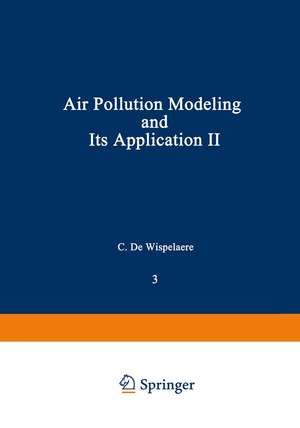
Air Pollution Modeling and Its Application II: Nato - Challenges of Modern Society, cartea 3
Editat de C. De Wispelaereen Limba Engleză Paperback – 24 apr 2012
Din seria Nato - Challenges of Modern Society
-
 Preț: 385.79 lei
 -
 Preț: 405.03 lei
 - 18%
 Preț: 1286.79 lei
 -
 Preț: 376.59 lei
 - 5%
 Preț: 353.69 lei
 - 18%
 Preț: 1293.89 lei
 - 5%
 Preț: 391.43 lei
 - 18%
 Preț: 1294.63 lei
 -
 Preț: 452.31 lei
 - 5%
 Preț: 1462.03 lei
 - 18%
 Preț: 982.79 lei
 -
 Preț: 382.10 lei
 -
 Preț: 402.84 lei
 - 18%
 Preț: 1200.52 lei
 - 18%
 Preț: 987.23 lei
 -
 Preț: 383.03 lei
 -
 Preț: 408.01 lei
 -
 Preț: 390.23 lei
 -
 Preț: 420.79 lei
 -
 Preț: 414.09 lei
 -
 Preț: 380.44 lei
Preț: 417.78 lei
Puncte Express: 627
Carte tipărită la comandă
Livrare economică 03-17 decembrie
Livrare prin curier în România Termenul estimat este afișat lângă disponibilitate.
Transport gratuit pentru acest produs Plată online sau ramburs, în funcție de opțiunile comenzii.
Retur gratuit în 14 zile Comandă securizată și suport în română.
Specificații
ISBN-13: 9781468479430
ISBN-10: 1468479431
Pagini: 888
Ilustrații: 873 p.
Dimensiuni: 178 x 254 x 47 mm
Greutate: 1.51 kg
Ediția:Softcover reprint of the original 1st ed. 1983
Editura: Springer Us
Colecția Springer
Seria Nato - Challenges of Modern Society
Locul publicării:New York, NY, United States
ISBN-10: 1468479431
Pagini: 888
Ilustrații: 873 p.
Dimensiuni: 178 x 254 x 47 mm
Greutate: 1.51 kg
Ediția:Softcover reprint of the original 1st ed. 1983
Editura: Springer Us
Colecția Springer
Seria Nato - Challenges of Modern Society
Locul publicării:New York, NY, United States
V-ar putea interesa
-
 Air Pollution Modeling and Its Application VC. De Wispelaere-18%Preț: 1286.79 lei1569.25 lei
 -
 Dinero the Frog Learns to Save EnergyLeticia Colon De MejiasPreț: 48.70 lei
 -
 -15%Preț: 677.64 lei797.22 lei
 -
 Air Pollution Modeling and Its Application IVC. De WisepelacrePreț: 420.79 lei
 -
 Air Pollution Modeling and Its Application IIIC. De WispelaerePreț: 408.01 lei
 -
 Air Pollution Modeling and Its Application IC. De WispelaerePreț: 405.03 lei
 -
 Basic and Applied Aspects of Noise-Induced Hearing LossRichard J. Salvi-15%Preț: 638.29 lei750.94 lei
 -
 Air Pollution Modeling and Its Application VC. De Wispelaere-18%Preț: 1295.18 lei1579.49 lei
 -
 Air Quality HandbookBernie Goldman-18%Preț: 682.87 lei832.77 lei
 -
 Encyclopedia of Air PollutionRaven Brennan-18%Preț: 732.77 lei893.62 lei
 -
 Environmental Contamination HandbookEmma Layer-15%Preț: 556.78 lei655.03 lei
 -
 Essential Topics on Air PollutionRaven Brennan-18%Preț: 761.92 lei929.16 lei
 -
 Modelling and Control of Air PollutionRaven Brennan-15%Preț: 630.80 lei742.12 lei
 -
 Recent Update on Organic PollutantsBruce Horak-15%Preț: 630.22 lei741.45 lei
 -
 Water Quality Management and Pollution ControlBruce Horak-15%Preț: 408.35 lei480.41 lei
 -
 -18%Preț: 732.23 lei892.97 lei
 -
 Preț: 58.19 lei
 -
 -18%Preț: 1131.48 lei1379.85 lei
Public țintă
ResearchCuprins
I : Physical-Chemical Reactions in Plumes.- 1. Chemical transformation in plumes.- 2. A comparison between chemically reacting plume models and windtunnel experiments.- 3. Air pollutant reactions in major plumes transported over the North Sea.- 4. Solutions to the equation for surface depletion of a gaussian plume.- 5. Mathematical modeling of chemically reactive plumes in an urban environment.- 6. Chemical modeling studies of the long-range dispersion of power-plant plumes.- 7. A comparison of the regional scale effects on in-cloud conversion of SO2 to SO4= in an eight layer diabatic model with a single layer model.- 8. The washout of hydrogen fluoride.- 9. Performance evaluation of the empirical kinetic modeling approach (EKMA).- 10. Urban visual air quality : modeled and perceived.- 2 : Air Trajectory Models for Air Pollution Transport.- 11. A gaussian trajectory model for hazard evaluation for prolonged releases from nuclear reactors.- 12. Application of trajectory model to regional transport characterization.- 13. Refined air pollution model for calculating daily regional patterns and transfrontier exchanges of airborne sulfur in central and western Europe.- 14. On a method of evaluation of performance of a trajectory model for long-range transport of atmospheric pollutants.- 15. The pseudo-spectral technique in the computation of seasonal average concentrations and its comparison with the trajectory technique.- 16. A mesoscale air pollution transport model : outline and preliminary results.- 17. Initial evaluation of Canadian and United States regional models for transboundary air pollution.- 18. Comparison of an eulerian with a lagrangian type numerical air pollution dispersion model.- 19. Analysis of particles trajectories during a land-sea breeze cycle using two-dimensional numerical mesoscale models.- 20. Verification of a three-dimensional transport model using tetroon data from projects state and neros.- 21. A new trajectory model and its practical application for accident and risk assessments.- 22. A finite element flow model over the Alsace plain.- 23. Modifications of trajectory models needed for pollutant source-receptor analysis.- 24. Sensitivity analysis of a climatological air trajectory model.- 3 : Advanced Mathematical Techniques in Air Pollution Modeling.- 25. A model for pollutant concentration prediction in complex terrain.- 26. Pollutant dispersion in the Ekman layer using moment-reduced transport equations.- 27. A simple model for dispersion of non-buoyant particles inside a convective boundary layer.- 28. Dispersion from fugitive sources.- 29. A comparison with experimental data of several models for dispersion of heavy vapor clouds.- 30. Application of the sulfur transport eulerian model (STEM) to a sure data set.- 31. Particle simulation of inhomogeneous turbulent diffusion.- 32. The apt computer program for the numerical solution of problems in atmospheric dispersion.- 33. A three dimensional, finite element model for simulating heavier-than-air gaseous releases over variable terrain.- 34. Numerical solution of three-dimensional and time-dependent advection-diffusion equations by “orthogonal collocation on multiple elements”.- 35. Analysis of a finite release of a pollutant followed by an abrupt change of wind direction.- 36. Two-dimensional unsteady gravity currents.- 37. Lagrangian modeling of air pollutants dispersion from a point source.- 38. Physical and mathematical simulation of Pb dispersion in and around a Pb industry in an urbanized area.- 4 : Evaluation of Model Performance in PracticalApplications.- 39. Observations and simulations of carbon monoxide concentrations in the wake of an urban garage.- 40. Influence of meteorological input data on the comparison between calculated and measured aerosol ground level concentrations and depositions.- 41. EPRI plume model validation project results for a plains site power plant.- 42. Comparison of sulfur dioxide estimates from the model ram with St. Louis raps measurements.- 43. Large scale validation of a bi-gaussian dispersion model in a multiple source urban and industrial area.- 44. Development and validation of a multi-source plume downwash model.- 45. Dispersion modeling studies in some major urban areas in the U.K..- 46. Results from elevated-source urban area dispersion experiments compared to model calculations.- 47. Influences of data bases on model performance.- 5 : Particular Studies in the Field of Air Pollution Modeling.- 48. Hydraulic modeling of the atmospheric boundary layer at large length scale ratios : capabilities and limitations.- 49. Formation of cloud particles from large hot plume in controlled experiments.- 50. Accounting for moisture effects in the prediction of buoyant plumes.- 51. Plume behavior in stable air.- Participants.- Author Index.