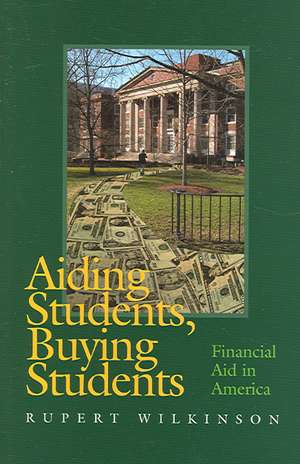
Aiding Students, Buying Students: Financial Aid in America
Autor Rupert Wilkinsonen Limba Engleză Hardback – 28 oct 2005
In the words of Joe Paul Case, Dean and Director of Financial Aid, Amherst College, "Wilkinson has mined the archives of dozens of institutions to create a mosaic that details the progress of student assistance from the 17th century to the present. He gives particular attention to the origins of need-based assistance, from the charitable benevolence of early colleges to the regulation-laden policies of the federal government. He gives due consideration to institutional motive--he challenges the egalitarian platitudes of affluent colleges and questions the countervailing market and economic forces that may imperil need-based aid at less competitive institutions. By drawing on scores of personal interviews and exchanges of correspondence with aid practitioners, Wilkinson fleshes out recent decades, helping the reader to understand new trends in the provision of aid."
Preț: 462.32 lei
Preț vechi: 600.41 lei
-23%
Puncte Express: 693
Preț estimativ în valută:
81.76€ • 95.94$ • 70.91£
81.76€ • 95.94$ • 70.91£
Carte tipărită la comandă
Livrare economică 10-24 martie
Specificații
ISBN-13: 9780826515025
ISBN-10: 0826515029
Pagini: 360
Dimensiuni: 152 x 229 x 30 mm
Greutate: 0.69 kg
Editura: Vanderbilt University Press
Colecția Vanderbilt University Press
ISBN-10: 0826515029
Pagini: 360
Dimensiuni: 152 x 229 x 30 mm
Greutate: 0.69 kg
Editura: Vanderbilt University Press
Colecția Vanderbilt University Press
V-ar putea interesa
-
 University Adaptation in Difficult Economic TimesPaola Mattei-11%Preț: 504.42 lei566.75 lei
 -
 Preț: 448.66 lei
 -
 Developing a Winning Grant ProposalDonald OrlichPreț: 317.79 lei
 -
 Handbook of the Economics of EducationEric A. Hanushek-23%Preț: 622.10 lei807.92 lei
 -
 The Assault on Universities: A Manifesto for ResistanceMichael BaileyPreț: 196.39 lei
 -
 The Research Funding ToolkitJacqueline AldridgePreț: 359.97 lei
 -
 -15%Preț: 623.84 lei733.93 lei
 -
 -31%Preț: 910.88 lei1314.92 lei
 -
 -31%Preț: 1106.70 lei1599.91 lei
 -
 -26%Preț: 996.38 lei1347.43 lei
 -
 Students Money MattersGWENDA THOMASPreț: 141.31 lei
 -
 A Practical Guide to the Pupil PremiumMarc Rowland-22%Preț: 68.46 lei88.26 lei
Notă biografică
Rupert Wilkinson, former Professor of American Studies and History at the University of Sussex, England, has taught at Brandeis, Smith, and Wesleyan. Author or editor of eight other books on elites and on American culture, he has published articles on student aid in the College Board Review and the Journal of Student Financial Aid.
Recenzii
. . . insightful . . . Wilkinson's timely, readable, and even entertaining book contains rich appendixes, a glossary, notes, and bibliography. It deserves reading and discussion by college administrators, higher education officials, and public policy makers. . . . Highly recommended.
--Choice
The media, higher education leaders, state and federal policy makers, administrators all will benefit from Wilkinson's analysis.
--Lawrence E. Gladieux, Former Washington Director, The College Board
. . . a superb history of student-aid policies and practices in a dynamic environment influenced by social, cultural, economic, and political forces.
-- Academe
. . . engaging and comprehensive . . . Bringing past, present, and future together in the concluding chapter, Wilkinson summarizes the lessons of three and one-half centuries and succinctly outlines the messages they hold for the continuing story of student financial aid in the United States.
--History of Education Quarterly
With an understanding of budgetary processes and pressures, this book explores how aid developed in America and plays out for students and schools alike. Through an engaging narrative the book's author blends stories with data. Don't be daunted by the fact that the first chapter begins in 1641--this is not a dry recounting of dates and events. Rather, in noting the conflicting purposes of student aid, the book connects past people and events to present ideas and practices.
--University Business
--Choice
The media, higher education leaders, state and federal policy makers, administrators all will benefit from Wilkinson's analysis.
--Lawrence E. Gladieux, Former Washington Director, The College Board
. . . a superb history of student-aid policies and practices in a dynamic environment influenced by social, cultural, economic, and political forces.
-- Academe
. . . engaging and comprehensive . . . Bringing past, present, and future together in the concluding chapter, Wilkinson summarizes the lessons of three and one-half centuries and succinctly outlines the messages they hold for the continuing story of student financial aid in the United States.
--History of Education Quarterly
With an understanding of budgetary processes and pressures, this book explores how aid developed in America and plays out for students and schools alike. Through an engaging narrative the book's author blends stories with data. Don't be daunted by the fact that the first chapter begins in 1641--this is not a dry recounting of dates and events. Rather, in noting the conflicting purposes of student aid, the book connects past people and events to present ideas and practices.
--University Business