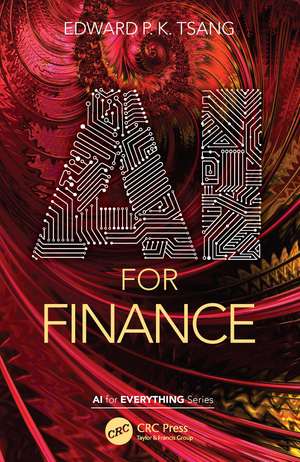
AI for Finance: AI for Everything
Autor Edward P.K. Tsangen Limba Engleză Paperback – 2 iun 2023
Moving well beyond simply speeding up computation, this book tackles AI for Finance from a range of perspectives including business, technology, research, and students. Covering aspects like algorithms, big data, and machine learning, this book answers these and many other questions.
Din seria AI for Everything
- 20%
 Preț: 204.35 lei
 - 20%
 Preț: 205.95 lei
 - 20%
 Preț: 213.08 lei
 - 5%
 Preț: 231.26 lei
 -
 Preț: 231.46 lei
 - 5%
 Preț: 168.64 lei
 - 20%
 Preț: 210.09 lei
 - 20%
 Preț: 198.40 lei
 - 20%
 Preț: 207.48 lei
 - 20%
 Preț: 199.23 lei
 - 20%
 Preț: 206.57 lei
 - 20%
 Preț: 206.49 lei
 - 20%
 Preț: 209.27 lei
 -
 Preț: 233.38 lei
 - 20%
 Preț: 206.97 lei
 -
 Preț: 254.83 lei
 - 20%
 Preț: 206.47 lei
 - 20%
 Preț: 205.95 lei
 - 20%
 Preț: 204.13 lei
 -
 Preț: 343.84 lei
 - 20%
 Preț: 193.56 lei
 - 20%
 Preț: 425.71 lei
 - 20%
 Preț: 223.93 lei
 - 20%
 Preț: 228.19 lei
 - nou
 Preț: 465.21 lei
Preț: 241.46 lei
Carte disponibilă
Livrare economică 17 noiembrie-01 decembrie
Livrare express 31 octombrie-06 noiembrie pentru 15.93 lei
Specificații
ISBN-10: 1032384433
Pagini: 126
Ilustrații: 5 Line drawings, black and white; 1 Halftones, black and white; 6 Illustrations, black and white
Dimensiuni: 129 x 198 x 9 mm
Greutate: 0.14 kg
Ediția:1
Editura: CRC Press
Colecția CRC Press
Seria AI for Everything
V-ar putea interesa
-
 AI-Powered Content Marketing and SEOCatherine SedaPreț: 200.73 lei
 -
 Just Enough Data Science and Machine LearningMark LevenePreț: 352.28 lei
 -
 The AI PlaybookEric Siegel-16%Preț: 184.62 lei219.54 lei
 -
 Brands in the Age of AIMark Kingsley-18%Preț: 113.75 lei138.20 lei
 -
 Advances in Financial Machine LearningMarcos Lopez de PradoPreț: 327.22 lei
 -
 Preț: 172.68 lei
 -
 -19%Preț: 451.98 lei558.00 lei
 -
 Preț: 105.17 lei
 -
 AI Investing For DummiesPaul Mladjenovic-20%Preț: 142.50 lei178.13 lei
 -
 NeuroaiA K PradeepPreț: 183.90 lei
 -
 Artificial Intelligence For DummiesJohn Paul MuellerPreț: 140.45 lei
 -
 Preț: 218.57 lei
 -
 Preț: 171.38 lei
 -
 Project Management with AI For DummiesDaniel Stanton-20%Preț: 140.32 lei175.39 lei
 -
 Preț: 142.20 lei
 -
 Between You and AIAndrea IorioPreț: 158.27 lei
 -
 Preț: 404.96 lei
 -
 How to Make AI UsefulMagnus ReinerPreț: 94.13 lei
 -
 HBR Guide to Generative AI for ManagersElisa Farri-20%Preț: 105.26 lei131.58 lei
Public țintă
General, Postgraduate, Professional, Undergraduate Advanced, and Undergraduate CoreRecenzii
“AI is an important part of finance today. Students who want to join the finance industry should read this book. The trained eyes will also find a lot of insights in the book. I cannot think of any other book that teaches computational finance at a beginner's level but at the same time is useful to practitioners.” --Amadeo Alentorn, PhD, Head of Systematic Equities at Jupiter Asset Management
"AI for Finance is an excellent primer for experts and newcomers seeking to unlock the potential of AI. The book combines deep thinking with a bird’s eye view of the whole field - the ideal text to get inspired and apply AI. A big thank you to Edward Tsang, a pioneer of AI and quantitative finance, for making the concepts and usage of AI easily accessible to academics and practitioners." --Richard Olsen, Founder and CEO of Lykke, co-founder of OANDA, and pioneer in high frequency finance and fintech
“Without a doubt, AI symbolizes the future of finance and, in this important book, Professor Tsang provides an excellent account of its mechanics, concepts and strategies. Books featuring AI in finance are rare so practitioners and students would do well to read it to gain focus and valuable insights into this fast-evolving technology. Congratulations to Professor Tsang for providing a readable and engaging work in a complex technology that will appeal to all levels of readers!” --Dr David Norman, Founder of the TTC Institute
"The use of AI/ML in the financial industry is now more than a hype. In financial institutions there are numerous active transformation programs to introduce AI/ML enabled products in areas such as risk, trading and advanced analytics. In this book, Edward, one of the early adopters of AI in finance, has provided an insightful guide for both finance practitioners and academics. I can see this book becoming a major reference in real-world applied AI in finance. Directional Change (Chapter 6) should be of particular interest to data scientists in finance, as how one collects data determines what one can reason about." -- Dr Ali Rais Shaghaghi, Lead Data Scientist at NatWest Group.
Notă biografică
Edward P. K. Tsang is a retired professor and a freelance consultant. With a first degree in finance and a PhD in AI, he has broad interests in constraint satisfaction, optimization, AI and finance.
Cuprins
1. AI-Finance Synergy, 2. Machine Learning Knows No Boundaries?, 3.Machine Learning in Finance, 4. Modelling, Simulation and Machine Learning, 5. Portfolio Optimization, 6. Financial Data: Beyond Time Series, 7. Over the Horizon