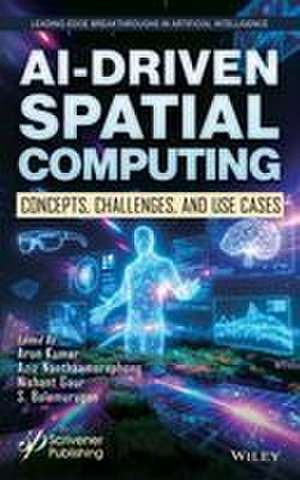
AI-Driven Spatial Computing
Editat de Arun Kumar, Aziz Nanthaamornphong, Nishant Gaur, S. Balamuruganen Limba Engleză Hardback – 22 dec 2026
Industries are increasingly leveraging automation and cutting-edge innovations to streamline operations and meet evolving demands. Today, Industry 5.0 emphasizes collaboration between humans and machines, enabling greater creativity, customization, and innovation. This volume explores a significant advancement in artificial intelligence: adaptive, AI-driven systems capable of learning and evolving in real time. Unlike traditional AI, which relies on static data and predefined models, adaptive AI responds dynamically to changing conditions, making it especially valuable in complex, unpredictable environments. This book explores the transformative fusion of artificial intelligence with spatial computing technologies, providing a comprehensive understanding of how intelligent systems interpret, interact with, and simulate physical environments. It presents a cohesive framework that demonstrates how AI augments spatial awareness and decision-making in complex, dynamic settings, delving into critical technical and ethical issues that arise from integrating AI into spatial systems. These include concerns about data privacy and surveillance, algorithmic bias in location-based services, the computational complexity of real-time 3D perception, and the lack of standardized platforms for interoperability across spatial devices. The text also examines infrastructure constraints such as bandwidth limitations, latency in edge processing, and the security vulnerabilities of AI-driven spatial networks. Each case study illustrates the tangible benefits of spatial intelligence, providing readers with actionable insights into emerging opportunities and strategic implementations in this rapidly evolving field.
Readers will find the volume:
- Serves as a pioneering resource at the intersection of artificial intelligence and spatial technologies;
- Provides a timely synthesis of how AI techniques can enhance spatial awareness, decision-making, and interactivity in physical and virtual environments;
- Contributes to the maturation of spatial computing as an AI-augmented field, bringing together geoinformatics, robotics, and data science;
- Emphasizes technological integration and methodological and ethical frameworks needed for sustainable innovation.
Engineers, research scholars and students, IT professionals, network administrators, artificial intelligence and deep learning experts, and government research aagencies looking to the future AI applications.
Preț: 1287.81 lei
Preț vechi: 1609.77 lei
-20% Precomandă
Carte nepublicată încă
Specificații
ISBN-10: 1394422520
Pagini: 432
Ediția:1. Auflage
Editura: John Wiley & Sons, Inc.
Notă biografică
Aziz Nanthaamornphong, PhD is the Dean of the College of Computing at the Prince of Songkla University, Phuket, Thailand. He has published more than 150 research articles in international journals and is known for structured thinking, strategic execution, and the ability to translate complex ideas into practical outcomes. His expertise spans artificial intelligence, data science, and advanced communication systems, with applied work in smart tourism, healthcare, and digital transformation.
Nishant Gaur, PhD is an Associate Professor in the Department of Physics at JECRC University, Jaipur, India, with more than 25 years of experience. He has published more than 80 publications in international journals and conferences of repute. His research focuses on advanced 5G and beyond-5G technologies, exploring areas like hybrid machine learning algorithms for enhancing signal detection, reducing peak-to-average power ratios, and optimizing power efficiency.
S. Balamurugan, PhD is the Director of Research at iRCS, an Indian Technological Research and Consulting Firm. He has published 100 books, 300 papers in international journals and conferences, and 300 patents. With 20 years of research on various cutting-edge technologies, he provides expert guidance in technology forecasting and decision-making for leading companies and startups.
Cuprins
Series Preface xxiii
Preface xxv
Acknowledgement xxix
Part I: AI-Driven Spatial Computing: Concepts 1
1 Sustainability and Environmental Impact of Digital Twins and the Metaverse 3
Amit Kumar Jain and Garima Mathur
1.1 Introduction 4
1.2 Foundational Concepts 8
1.3 Environmental Impacts of Digital Twins and Metaverse Infrastructure 13
1.4 Advantages and Sustainability Applications 16
1.5 Case Studies: Sustainable Use of Digital Twins and Metaverse in Real-World Applications 20
1.6 Future Scope 25
1.7 Recommendations 28
1.8 Applications of Digital Twins and the Metaverse in Sustainability 30
1.9 Limitations and Future Scope 32
1.10 Conclusions 34
2 AI for Climate Modeling and Disaster Management 41
Amit Kumar Jain and Garima Mathur
2.1 Introduction 42
2.2 The Role of AI in Climate Science 44
2.3 AI Techniques in Climate Modeling 48
2.4 AI-Based Climate Prediction Models 51
2.5 AI in Disaster Risk Reduction 54
2.6 Data Sources and Processing Techniques 57
2.7 Case Studies and Real-World Applications 60
2.8 Challenges and Ethical Considerations 63
2.9 Future Trends and Research Directions 67
2.10 Conclusion 71
3 AI-Powered Language Learning Tools: A Study of Efficacy in ESL Classrooms 75
Anubhav Tripathee, Vishnu Kumar Sharma and Nidhi Bhatnagar
3.1 Introduction 76
3.2 Literature Review 77
3.3 Research Methodology 82
3.4 Contributions of This Paper 86
3.5 Applications of AI in ESL Classrooms 87
3.6 Limitations of This Paper 89
3.7 Future Work 89
3.8 Conclusion 91
4 Evolution of 5G Networks: Key Technologies, Spectrum Utilization, and Future Prospects 95
Arun Kumar, Nishant Gaur and Aziz Nanthaamornphong
4.1 Introduction 96
4.2 Recent Updates in the 5G Field 97
4.3 Key Points for Arrangement of 5G Network 98
4.4 Key Technologies in 5G Cellular Communication 100
4.5 Channel Estimation in 5G Cellular Communication 104Contents xiii
4.6 Application of 5G 105
4.7 Conclusion 106
5 Design and Implementation of a Neuro-Controlled Robot Using Neural Communication Interface 111
G. Pius Agbulu, S. Gunasekar and H. Ndwabe
5.1 Introduction 111
5.2 System Architecture 113
5.3 Signal Processing and Feature Extraction 114
5.4 Actor-Critic Decision-Making 116
5.5 Command Mapping and Communication 117
5.6 Results and Discussion 118
5.7 Conclusion 120
Part II: Driven Spatial Computing: Challenges 123
6 Smart Water Cities in the Brahmaputra Basin: AI Applications for Climate-Resilient Water Governance in Guwahati 125
Jyotsna Choudhury and Jesmine Ahmed
6.1 Introduction 126
6.2 Literature Review 128
6.3 Methodology and Limitation 132
6.4 Guwahati's Hydro-Urban Profile 133
6.5 Climate Risk and Disaster Vulnerabilities 135
6.6 AI for Climate Modeling and Disaster Management in Guwahati 136
6.7 AI for Smart Water Infrastructure in Guwahati 139
6.8 Governance, Policy, and Institutional Integration 143xiv Contents
6.9 Findings and Discussion 146
6.10 Conclusion and Future Research Direction 152
7 The Impact of Artificial Intelligence on Human Identity: A Humanist-Posthumanist Perspective 159
Nidhi Bhatnagar, Parveen Bala and Rashi Mehta
7.1 Introduction 160
7.2 Objectives of the Study 161
7.3 Literature Review 162
7.4 Research Gap 165
7.5 Methodology 167
7.6 Purpose of the Study 169
7.7 Findings and Discussion 169
7.8 Conclusion 171
8 Secure Data Handling in AI-Driven Spatial Computing 175
Vinay Kishor and Rashi Bhargava
8.1 Introduction (The Intersection of Artificial Intelligence, Spatial Computing, and Data Security) 176
8.2 The Role of AI in Spatial Data Processing 179
8.3 Challenges and Future Research 183
8.4 Limitations of the Paper 184
8.5 Future Work 185
8.6 Applications for the Project 186
8.7 Conclusion 187
9 Stochastic Planning Approaches and Ecological Footprint for Sustainable EV Charging Infrastructure 191
Shah Faisal, Govind Rai Goyal and Bhanu Pratap Soni
9.1 Introduction 192
9.2 Overview of EV Charging Infrastructure 194
9.3 EV Charging Station 195
9.4 EV Charging Strategy 201
9.5 Charging Station Infrastructure Strategy 204
9.6 Field Study on the Environmental Impact of EV-Charging Infrastructure in India 209
9.7 Uncertainty in Policy and Market Framework 215
9.8 Conclusion 216
10 Synergistic Roles of Edge AI and Cloud AI in Advancing Spatial Intelligence: Architectures, Applications, and Challenges 221
Sneh Lata
10.1 Introduction 222
10.2 Foundations of Spatial Computing 224
10.3 Enabling Technologies 231
10.4 Conceptual Framework for AI-Driven Spatial Computing 240
10.5 Applications and Use Cases of AI-Driven Spatial Computing 251
10.6 Challenges and Future Directions in AI-Driven Spatial Computing 257
10.7 Conclusion 262
11 Balancing Privacy and Efficiency in Indoor Localization: A SafeLoc-Inspired Model Compression Approach 265
S. Sowjanya Chintalapati, Sriram Parabrahmachari, S. Sathvika, V. Madhavi and M. Vedik Reddy
11.1 Introduction 266
11.2 Literature Survey 267
11.3 Identified Gaps in the Literature 269
11.4 Methodology 269
11.5 Pruning and Quantization 270
11.6 Framework of the Proposed Model 271
11.7 Mathematical Formulation of SafeLoc 272
11.8 Expected Benefits 273
11.9 Experimental Setup 273
11.10 Results and Discussion 275
11.11 Privacy and Data Protection 278
11.12 Conclusion and Future Scope 279
Part III: AI-Driven Spatial Computing: Use Cases 285
12 Federated and Edge-Enabled Spatial AI for Privacy-Preserving Climate Resilience and Disaster Management 287
S. Sowjanya Chintalapati, Sriram Parabrahmachari, S. Sathvika, V. Madhavi and M. Vedik Reddy
12.1 Introduction 288
12.2 Literature Survey 289
12.3 Methodology 291
12.4 Workflow of Proposed Model 293
12.5 Experimental Setup 295
12.6 Results and Discussion 297
12.7 Ethical Considerations 298
12.8 Conclusion and Future Scope 299
13 Spatial AI in Literature Teaching: Redefining Pedagogical Space through Immersive Technologies 305
Vishnu Kumar Sharma, Parveen Bala and Abhishek Singh
13.1 Introduction 306
13.2 Hypothesis 306
13.3 Methodology 307
13.4 Literature Review 308
13.5 Spatial AI Applications and Cognition-Cum-Creativity 311
13.6 Findings 313
13.7 Conclusion 317
13.8 Limitations 318
13.9 Future Work 318
14 Artificial Intelligence in Smart Cities: Toward Sustainable and Intelligent Urban Ecosystems 323
Sowmya Bhat, Shashikala R. and Jayashree M.
14.1 Introduction 324
14.2 Scope, Objectives, and Chapter Organization 326
14.3 Background and Key Concepts 327
14.4 Literature Review 330
14.5 Reference Architecture for AI-Enabled Smart Cities 332
14.6 Representative Use Cases and Case Studies 334
14.7 Evaluation Metrics, Benchmarking, and Sustainability Considerations 336
14.8 Contributions 339
14.9 Limitations 340
14.10 Future Work and Applications 341
14.11 Conclusions 342
15 Artificial Intelligence in Agriculture: Current Applications, Challenges, and Future Prospects 347
Saurabh Dave, Shalini Sujit Kumar, Poonam Hariyani, Vinay Kumar and Hardik Pathak
15.1 Introduction 348
15.2 Classification and Analysis of Applications of IoT in Agriculture 355
15.3 Discussion: Toward Scalable and Fair AI Adoption in Agriculture 356
15.4 Agricultural Practices and Artificial Intelligence Technologies 359
15.5 Sustainability and Efficiency Impacts 360
15.6 Applications of AI in Agriculture 362
15.7 Limitations and Research Gaps 363
15.8 Future Work 364
15.9 Conclusion 367
16 Benefits and Efficiency Combination of Blockchain and 6G Wireless Communication Network Technology 373
Arun Kumar, Nishant Gaur and Aziz Nanthaamornphong
16.1 Introduction 374
16.2 Related Research 375
16.3 Approaches, Difficulties: 6G Networks 376
16.4 Blockchain Empowering 6G Networks 379
16.5 The Security Structure of Blockchain-Enabled 6G Networks 379
16.6 Effectual Execution of Blockchain-6G Network 380
16.7 Future Research Scope 382
16.8 Conclusion 385
References 386
Index 389