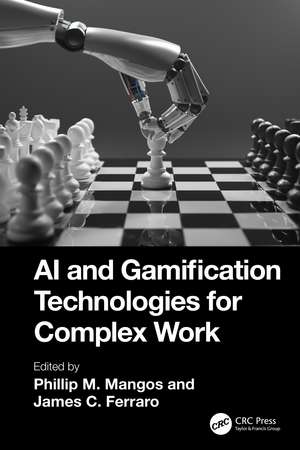
AI and Gamification Technologies for Complex Work
Editat de Phillip M. Mangos, James C. Ferraroen Limba Engleză Hardback – 10 sep 2025
AI and Gamification Technologies for Complex Work uncovers the use of artificial intelligence (AI) and machine learning (ML) for the purposes of creating adaptive, personalized training for individuals who work in complex jobs. It covers adaptive simulation-based training, fighting skill decay through game-based training, and additional uses of AI/ML and other tools in measuring human performance. Insights from professionals and experts in the fields of simulation and training provide readers with information about current applications of AI/ML in creating adaptive or personalized training, as well as investigations into the future of simulation and game-based training, as virtual and augmented realities proliferate modern training programs.
The book looks at how data science, AI, and ML contribute to adaptive training systems and the reader is encouraged to look further into the engines that drive adaptive training while devising their own systems for training in complex jobs. This book is ideal for professionals in human factors engineering and psychology, artificial intelligence, military training and simulation, game development, data science, modeling and simulation and industrial and organizational psychology.
Preț: 500.47 lei
Preț vechi: 680.42 lei
-26%
Puncte Express: 751
Preț estimativ în valută:
88.57€ • 103.51$ • 76.90£
88.57€ • 103.51$ • 76.90£
Carte disponibilă
Livrare economică 30 ianuarie-13 februarie
Livrare express 15-21 ianuarie pentru 655.78 lei
Preluare comenzi: 021 569.72.76
Specificații
ISBN-13: 9781032650760
ISBN-10: 1032650761
Pagini: 222
Ilustrații: 82
Dimensiuni: 156 x 234 x 17 mm
Greutate: 0.57 kg
Ediția:1
Editura: CRC Press
Colecția CRC Press
ISBN-10: 1032650761
Pagini: 222
Ilustrații: 82
Dimensiuni: 156 x 234 x 17 mm
Greutate: 0.57 kg
Ediția:1
Editura: CRC Press
Colecția CRC Press
Public țintă
Professional ReferenceNotă biografică
Phillip M. Mangos, PhD, is the CEO and Chief Scientist of Adaptive Immersion Technologies, a Florida-based business focused on the synthesis of predictive data modeling and analytics, simulation, and assessment technology to optimize human performance. He holds a BS in Psychology from the University of South Florida and a PhD in Industrial/Organizational and Human Factors from Wright State University. With a diverse career background, he has worked as a team member to support projects in aviation, law enforcement, transportation, intelligence, information technology, and utilities industries.
James C. Ferraro, PhD, is a Senior Human Factors Research Scientist at Adaptive Immersion Technologies. He specializes in intelligent simulations and game-based assessments to improve human performance in complex, automated systems. He holds a PhD in Human Factors and Cognitive Psychology and an MA in Applied Experimental and Human Factors Psychology from the University of Central Florida. His research focuses on human-machine interaction, trust in automation, and performance prediction. Dr. Ferraro has contributed to government-sponsored projects and co-edited multiple book series on human performance and simulation, with numerous publications in the field.
James C. Ferraro, PhD, is a Senior Human Factors Research Scientist at Adaptive Immersion Technologies. He specializes in intelligent simulations and game-based assessments to improve human performance in complex, automated systems. He holds a PhD in Human Factors and Cognitive Psychology and an MA in Applied Experimental and Human Factors Psychology from the University of Central Florida. His research focuses on human-machine interaction, trust in automation, and performance prediction. Dr. Ferraro has contributed to government-sponsored projects and co-edited multiple book series on human performance and simulation, with numerous publications in the field.
Cuprins
- A Theoretical Framework for Performance Analysis in Competency-Based Experiential Learning Environments
- Instruction Intervention in Game-Based Assessment of Unmanned Systems Operator Performance
- Game-Based Small Team Training: A Guide to Implementing Adaptive Game-Based Simulation Training
- Game-Based Tools for Highly Automated Work: Trends, Challenges, and Opportunities
- Artificial Intelligence Explainability: A Human Factors Approach
- Using Artificial Intelligence to Train Human Intelligence: Theory and Practice in the Design of Adaptive Training Systems
- From Manual to Machine Learning: Reflecting on the Development of an Adaptive Training System for a Military Decision-Making Task
- Exploring Cognitive Science Foundations for AI-Driven Healthcare Simulation
- Augmenting Rater Judgment Using Artificial Intelligence
- AI and the Employee Lifecycle: What We Know and What May Come
Descriere
The medium through which training in the workplace is delivered has been changing in recent years to offer a more personalized and immersive experience.