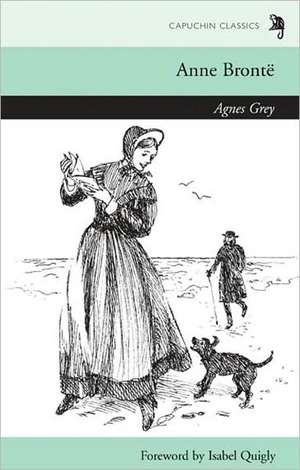
Agnes Grey
Autor Anne Brontëen Limba Engleză Paperback – 15 oct 2010 – vârsta până la 18 ani
Preț: 83.83 lei
Puncte Express: 126
Carte indisponibilă temporar
Doresc să fiu notificat când acest titlu va fi disponibil:
Se trimite...
Specificații
ISBN-13: 9781907429095
ISBN-10: 1907429093
Pagini: 224
Dimensiuni: 131 x 197 x 20 mm
Greutate: 0.28 kg
Editura: CAPUCHIN CLASSICS
Locul publicării:United Kingdom
ISBN-10: 1907429093
Pagini: 224
Dimensiuni: 131 x 197 x 20 mm
Greutate: 0.28 kg
Editura: CAPUCHIN CLASSICS
Locul publicării:United Kingdom
V-ar putea interesa
-
 Jane EyreCharlotte BrontePreț: 24.60 lei
 -
 CLASSICS AGNES GREYAnne BrontëPreț: 29.16 lei
 -
 Tenant of Wildfell HallAnne BrontePreț: 24.60 lei
 -
 Jane EyreCharlotte BrontePreț: 24.60 lei
 -
 The Bronte SistersCharlotte BrontëPreț: 163.15 lei
 -
 The Tenant of Wildfell HallAnne Brontë-17%Preț: 54.76 lei65.72 lei
 -
 VilletteCharlotte Brontë-16%Preț: 56.24 lei66.61 lei
 -
 The ProfessorCharlotte BrontëPreț: 56.59 lei
 -
 Pride and PrejudiceJane Austen-18%Preț: 35.91 lei43.72 lei
 -
 Jane EyreCharlotte BrontePreț: 44.01 lei
 -
 VilletteCharlotte BrontePreț: 38.98 lei
 -
 -31%Preț: 205.84 lei296.31 lei
 -
 Anne of the IslandLucy Maud MontgomeryPreț: 43.26 lei
 -
 Agnes GreyActon BellPreț: 64.89 lei
 -
 -19%Preț: 57.78 lei71.30 lei
 -
 Agnes Grey/The Tenant of Wildfell HallAnne Bronte-16%Preț: 105.98 lei125.67 lei
 -
 VilletteCharlotte BrontePreț: 38.05 lei
 -
 The ProfessorCharlotte BrontePreț: 36.14 lei
 -
 Agnes GreyAnne BrontePreț: 35.79 lei
 -
 Jane Eyre The Graphic NovelCharlotte BrontePreț: 74.40 lei
 -
 Anne Bronte ReimaginedAdelle Hay-20%Preț: 56.99 lei71.16 lei
Descriere
Descriere de la o altă ediție sau format:
'How delightful it would be to be a governess!'When the young Agnes Grey takes up her first post as governess she is full of hope; she believes she only has to remember 'myself at their age' to win her pupils' love and trust. Instead she finds the young children she has to deal with completely unmanageable. They are, as she observes to her mother, 'unimpressible, incomprehensible creatures'. In writing her first novel, Anne Brontë drew on her own experiences, and one can trace in the work many of the trials of the Victorian governess, often stranded far from home, and treated with little respect by her employers, yet expected to control and educate her young charges. Agnes Grey looks at childhood from nursery to adolescence, and it also charts the frustrations of romantic love, as Agnes starts to nurse warmer feelings towards the local curate, Mr Weston.The novel combines astute dissection of middle-class social behaviour and class attitudes with a wonderful study of Victorian responses to young children which has parallels with debates about education that continue to this day. ABOUT THE SERIES: For over 100 years Oxford World's Classics has made available the widest range of literature from around the globe. Each affordable volume reflects Oxford's commitment to scholarship, providing the most accurate text plus a wealth of other valuable features, including expert introductions by leading authorities, helpful notes to clarify the text, up-to-date bibliographies for further study, and much more.
'How delightful it would be to be a governess!'When the young Agnes Grey takes up her first post as governess she is full of hope; she believes she only has to remember 'myself at their age' to win her pupils' love and trust. Instead she finds the young children she has to deal with completely unmanageable. They are, as she observes to her mother, 'unimpressible, incomprehensible creatures'. In writing her first novel, Anne Brontë drew on her own experiences, and one can trace in the work many of the trials of the Victorian governess, often stranded far from home, and treated with little respect by her employers, yet expected to control and educate her young charges. Agnes Grey looks at childhood from nursery to adolescence, and it also charts the frustrations of romantic love, as Agnes starts to nurse warmer feelings towards the local curate, Mr Weston.The novel combines astute dissection of middle-class social behaviour and class attitudes with a wonderful study of Victorian responses to young children which has parallels with debates about education that continue to this day. ABOUT THE SERIES: For over 100 years Oxford World's Classics has made available the widest range of literature from around the globe. Each affordable volume reflects Oxford's commitment to scholarship, providing the most accurate text plus a wealth of other valuable features, including expert introductions by leading authorities, helpful notes to clarify the text, up-to-date bibliographies for further study, and much more.
Notă biografică
Sally Shuttleworth has edited several long-standing editions for OWC including Lorna Doone, North and South and Jane Eyre (introduction and revised notes). Her book The Mind of the Child: Child Development in Literature, Science, and Medicine, 1840-1900 is forthcoming from OUP, 2010.
Recenzii
Agnes Grey was one of a trio of novels that defined the “governess novel” in 1847 and 1848. Alongside Jane Eyre and Vanity Fair, Agnes Grey may be the most radical of the three. Agnes Grey is the younger daughter of a clergyman and his wife of modest means, cherished but also infantilized. When her father’s mercantile investment goes disastrously wrong, Agnes decides to contribute to the family’s financial rebuilding by working as a governess, despite her mother’s and sister’s misgivings about her fitness for such work. Her first position is indeed trying, as the parents and children are uncouth and even cruel. Her second position is slightly more congenial, but she is still manipulated and ignored. Yet Agnes perseveres and begins to build relationships outside the family, most importantly with a kind, empathetic young curate. As life brings more trials to Agnes and her family, we watch her persist on her steady path of hope and determination.
This Broadview Edition provides extensive historical documents on the novel’s reception, the role of the governess in Victorian England, and contemporary debates about thetreatment of non-human animals.
“This engaging new edition makes a strong case for the radical nature of Anne Brontë’s novel and for its place as a seminal feminist work. It contains a wealth of important material for students, especially texts from the Victorian period about the plight of governesses and the issues of animal cruelty and animal rights—key historical contexts for the novel. The introduction provides an excellent grounding in the period and in the place of Anne Brontë’s novel in relation to its era and to the books of her more-famous sisters. It’s a timely and necessary contribution to Brontë studies.” — Deborah Lutz, University of Louisville
“Anne Brontë has been the frequent recipient of barbed faint praise that inevitably positions her as ‘the other’ Brontë sister. But in this well-conceived and reader-friendly new edition of Anne’s debut 1847 novel, Agnes Grey, Robin Inboden lays out a persuasive case for why we should care about Brontë’s writing for its own sake. Even if we may not quite join late-Victorian Irish novelist George Moore in his startling judgment that Agnes Grey is ‘the most perfect prose narrative in English literature,’ Inboden’s resourcefully intelligent editorial work allows us to appreciate this novel for the rich and fascinating text that it is. Especially welcome here is the extensive appendix containing a range of materials contextualizing the novel in relation to the early-Victorian animal welfare movement.” — Ivan Kreilkamp, Indiana University
“Broadview’s edition of Agnes Grey is a welcome contribution to the rehabilitation of Anne Brontë’s reputation and her place in Victorian literary and cultural studies.… Broadview’s editions are wonderfully affordable and feature a wealth of secondary sources, reception history, and criticism in their apparatus, making them extremely valuable and relevant for teaching and research. Robin Inboden’s new edition provides teachers, students, and literary scholars with a most welcome resource, well-timed to coincide with Anne’s bicentenary year.” — Deborah A. Logan, Victorians: A Journal of Culture and Literature
This Broadview Edition provides extensive historical documents on the novel’s reception, the role of the governess in Victorian England, and contemporary debates about thetreatment of non-human animals.
“This engaging new edition makes a strong case for the radical nature of Anne Brontë’s novel and for its place as a seminal feminist work. It contains a wealth of important material for students, especially texts from the Victorian period about the plight of governesses and the issues of animal cruelty and animal rights—key historical contexts for the novel. The introduction provides an excellent grounding in the period and in the place of Anne Brontë’s novel in relation to its era and to the books of her more-famous sisters. It’s a timely and necessary contribution to Brontë studies.” — Deborah Lutz, University of Louisville
“Anne Brontë has been the frequent recipient of barbed faint praise that inevitably positions her as ‘the other’ Brontë sister. But in this well-conceived and reader-friendly new edition of Anne’s debut 1847 novel, Agnes Grey, Robin Inboden lays out a persuasive case for why we should care about Brontë’s writing for its own sake. Even if we may not quite join late-Victorian Irish novelist George Moore in his startling judgment that Agnes Grey is ‘the most perfect prose narrative in English literature,’ Inboden’s resourcefully intelligent editorial work allows us to appreciate this novel for the rich and fascinating text that it is. Especially welcome here is the extensive appendix containing a range of materials contextualizing the novel in relation to the early-Victorian animal welfare movement.” — Ivan Kreilkamp, Indiana University
“Broadview’s edition of Agnes Grey is a welcome contribution to the rehabilitation of Anne Brontë’s reputation and her place in Victorian literary and cultural studies.… Broadview’s editions are wonderfully affordable and feature a wealth of secondary sources, reception history, and criticism in their apparatus, making them extremely valuable and relevant for teaching and research. Robin Inboden’s new edition provides teachers, students, and literary scholars with a most welcome resource, well-timed to coincide with Anne’s bicentenary year.” — Deborah A. Logan, Victorians: A Journal of Culture and Literature
Cuprins
Acknowledgements
Introduction
Anne Brontë: A Brief Chronology
A Note on the Text
Agnes Grey
Appendix A: Other Writings by and about Anne Brontë
Introduction
Anne Brontë: A Brief Chronology
A Note on the Text
Agnes Grey
Appendix A: Other Writings by and about Anne Brontë
- 1. From Charlotte Brontë to Ellen Nussey (letter, 15 April 1839)
- 2. From Anne Brontë, Diary Paper (30 July 1841)
- 3. From Charlotte Brontë to Ellen Nussey (letter, 7 August 1841)
- 4. From Anne Brontë, Diary Paper (31 July 1845)
- 5. Anne Brontë, “The Bluebell” (22 August 1840)
- 6. Acton Bell [Anne Brontë], “Appeal” (28 August 1840)
- 7. Anne Brontë, “Lines Written at [Thorp] Green” (19 August 1841)
- 8. Acton Bell [Anne Brontë], “Lines Composed in a Wood on a Windy Day” (30 December 1842)
- 9. From Ellen Nussey, “Reminiscences of Charlotte Brontë” (1871)
- 10. From Currer Bell [Charlotte Brontë], “Biographical Notice of Ellis and Acton Bell” (1850)
- 1. From Spectator (18 December 1847)
- 2. From Henry F. Chorley, Athenaeum (25 December 1847)
- 3. From Douglas Jerrold’s Weekly Newspaper (15 January 1848)
- 4. From New Monthly Magazine (January 1848)
- 5. From Atlas (22 January 1848)
- 6. From Portland [Maine] Transcript (5 January 1850)
- 7. From Graham’s Magazine [Philadelphia] (1 February 1850)
- 8. From W.C. Roscoe, “Miss Brontë,” National Review (July 1857)
- 9. From Mary Augusta Ward, “Introduction,” The Tenant of Wildfell Hall (1900)
- 10. From George Moore, Conversations in Ebury Street (1910)
- 1. Maria Smith Abdy, “A Governess Wanted,” Metropolitan Magazine (May 1836)
- 2. From George Stephen, The Guide to Service: The Governess (1844)
- 3. From “Hints on the Modern Governess System,” Fraser’s Magazine (November 1844)
- 1. From Isaac Watts, A Discourse on the Education of Children and Youth (1725)
- 2. From Thomas Erskine, Speech … On … Preventing … Cruelty to Animals (1809)
- 3. From “Society for the Prevention of Cruelty to Animals,” Times (17 June 1824)
- 4. From Sarah Burdett, The Rights of Animals (1839)
- 5. From Charlotte Elizabeth [Tonna], Kindness to Animals (c. 1845)
- 6. C.S., “The Lost Nestlings,” A Mother’s Lessons in Kindness to Animals (c. 1862)