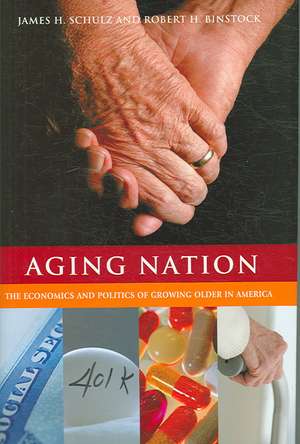
Aging Nation: The Economics and Politics of Growing Older in America
Autor James H. Schulz, Robert H. Binstocken Limba Engleză Hardback – 30 oct 2006
Deserving poor or greedy geezers? The debate rages on. In a period of huge government deficits and the impending retirement of some 76 million Baby Boomers, understanding the economic, political, and social issues related to the aging population is paramount. The policy debates have never been more contentious; they range from deciding who should receive limited subsidized housing and medical services to the ongoing battle over saving Social Security and other entitlement programs. If the doom-and-gloomers have their way, the elderly will be put out to pasture, with inadequate health care and financial resources, and a crumbling social welfare infrastructure that will implode under the strain of intergenerational conflict. This book debunks most aging crises put forth by merchants of doom and offers a new policy focus for our nation.
In Aging Nation, renowned experts in the field, James Schulz and Robert Binstock, agree that there is considerable cause for concern, but with a variety of sound policies and programs in place and smart individual choices, the elderly can prosper, and a demographic tsunami is not inevitable. Drawing from the most current data, the authors provide in-depth analysis of the nation's evolving private and public policies on retirement, faltering employer pensions, health care, workplace conditions, and entitlement programs, and consider such timely issues as poverty among the elderly, rejoining the workforce after retirement, Social Security and health care reform, and the rise of the elderly as a powerful political force. Dispelling popular myths and misconceptions that are perpetrated by politicians and pundits alike, they provide a comprehensive and balanced assessment of these issues and their impact on everyone, old and young.
Preț: 349.59 lei
Preț vechi: 438.81 lei
-20%
Puncte Express: 524
Carte tipărită la comandă
Livrare economică 05-19 decembrie
Livrare prin curier în România Termenul estimat este afișat lângă disponibilitate.
Transport gratuit de la 400.00 lei Plată online sau ramburs, în funcție de opțiunile comenzii.
Retur gratuit în 14 zile Comandă securizată și suport în română.
Specificații
ISBN-13: 9780275984151
ISBN-10: 027598415X
Pagini: 296
Dimensiuni: 156 x 235 x 27 mm
Greutate: 0.6 kg
Ediția:New.
Editura: Bloomsbury Publishing
Colecția Praeger
Locul publicării:New York, United States
ISBN-10: 027598415X
Pagini: 296
Dimensiuni: 156 x 235 x 27 mm
Greutate: 0.6 kg
Ediția:New.
Editura: Bloomsbury Publishing
Colecția Praeger
Locul publicării:New York, United States
V-ar putea interesa
-
 -21%Preț: 136.49 lei173.07 lei
 -
 The Psychology of Ageing: From Mind to SocietyGary ChristopherPreț: 339.93 lei
 -
 -5%Preț: 500.98 lei527.34 lei
 -
 Mothers and Others - The Evolutionary Origins of Mutual UnderstandingSarah Blaffer HrdyPreț: 185.67 lei
 -
 -15%Preț: 688.41 lei809.89 lei
 -
 The SAGE Handbook of Social GerontologyDale DanneferPreț: 472.55 lei
 -
 China, Aging & TheoryJason L Powell-26%Preț: 395.07 lei531.57 lei
 -
 Challenges for Unemployed Older WorkersEarl J Curtis-27%Preț: 999.17 lei1362.19 lei
 -
 Preț: 344.01 lei
 -
 Preț: 272.08 lei
 -
 Preț: 277.39 lei
 -
 -23%Preț: 229.02 lei297.66 lei
Cuprins
Preface
1. Baby Boomers and the Merchants of Doom
2. The Phony Threat of Population Aging
3. The Search for Security with Dignity
4. Dealing with Risk
5. The Company Pension: Altruism or Self-Interest?
6. The Pension Lottery: Personal Pension Accounts
7. To Work or Not to Work: That Is the Question
8. Health and Longevity: What Lies Ahead?
9. A Gerontocracy? The Politics of Aging
10. Framing the Issues for an Aging Nation
Notes
Index
1. Baby Boomers and the Merchants of Doom
2. The Phony Threat of Population Aging
3. The Search for Security with Dignity
4. Dealing with Risk
5. The Company Pension: Altruism or Self-Interest?
6. The Pension Lottery: Personal Pension Accounts
7. To Work or Not to Work: That Is the Question
8. Health and Longevity: What Lies Ahead?
9. A Gerontocracy? The Politics of Aging
10. Framing the Issues for an Aging Nation
Notes
Index
Recenzii
At the core of Aging Nation is a description and assessment of the strengths and weaknesses of major programs affecting the elderly (past and current) and rising generations. . . . Chapters 3 through 9 offer the clearest, most judicious assessment of the U.S. political economy in an aging society that I have read. For the quality of these analytic chapters alone, Aging Nation merits wide classroom adoption in gerontology, policy, and social science classes at the undergraduate and graduate levels.
[E]xtremely valuable and timely contributions to the struggle against the conservative attack on the nation's relatively modest efforts to ensure a minimum level of collective well-being. These books are analytically rigorous and lucid counterattacks against what Hacker calls the crusaders for personal responsibility and Schulz and Binstock call the merchants of doom.' (Reviewed in conjunction with The Great Risk Shift, Jacob S. Hacker, Oxford University Press.)
Writing for the general public, Schulz and Binstock describe changes occurring in the US due to the aging of baby boomers and how their retirement decisions will be affected. They also discuss situations they will need to consider and address areas usually covered in separate books: Social Security history, policy issues, reform proposals, health care issues, work and retirement policy, private pensions, and the politics of aging. In particular, they aim to aid readers in figuring out the truth behind pessimistic warnings of future problems in health care and policy for the elderly and describe how these focus on the wrong issues. Instead, they focus on system-wide health-care cost issues, retirement and personal pensions, problems with raising the retirement age, and the myth that the country will be ruled by the aged.
An insightful book about growing old in America by two of the country's leading policy gerontologists is must reading, especially because 76 million baby boomers are approaching retirement. Perhaps more to the point, can a balance be struck between the deserving poor and what is perceived to be greedy geezers?. . . This is a remarkable book that merits our immediate and full attention. The authors point out that instead of giving in to negative Nellies, the time has come for expert analysis, balanced viewpoints and a united effort so that we can secure our futures. Dispelling popular myths and misconceptions, Aging Nation maps out a comprehensive, sensible plan that deserves our consideration.
. . . this book provides a well-reasoned and readable antidote to the more hyperbolic and even hysterical claims of the 'doomsayers' documented by the authors. But more more than that, this is a thorough, insightful, and readable analysis of the key elements of financial security in retirement--Social Security, private pensions, employment, and health and long-term care.
[E]xtremely valuable and timely contributions to the struggle against the conservative attack on the nation's relatively modest efforts to ensure a minimum level of collective well-being. These books are analytically rigorous and lucid counterattacks against what Hacker calls the crusaders for personal responsibility and Schulz and Binstock call the merchants of doom.' (Reviewed in conjunction with The Great Risk Shift, Jacob S. Hacker, Oxford University Press.)
Writing for the general public, Schulz and Binstock describe changes occurring in the US due to the aging of baby boomers and how their retirement decisions will be affected. They also discuss situations they will need to consider and address areas usually covered in separate books: Social Security history, policy issues, reform proposals, health care issues, work and retirement policy, private pensions, and the politics of aging. In particular, they aim to aid readers in figuring out the truth behind pessimistic warnings of future problems in health care and policy for the elderly and describe how these focus on the wrong issues. Instead, they focus on system-wide health-care cost issues, retirement and personal pensions, problems with raising the retirement age, and the myth that the country will be ruled by the aged.
An insightful book about growing old in America by two of the country's leading policy gerontologists is must reading, especially because 76 million baby boomers are approaching retirement. Perhaps more to the point, can a balance be struck between the deserving poor and what is perceived to be greedy geezers?. . . This is a remarkable book that merits our immediate and full attention. The authors point out that instead of giving in to negative Nellies, the time has come for expert analysis, balanced viewpoints and a united effort so that we can secure our futures. Dispelling popular myths and misconceptions, Aging Nation maps out a comprehensive, sensible plan that deserves our consideration.
. . . this book provides a well-reasoned and readable antidote to the more hyperbolic and even hysterical claims of the 'doomsayers' documented by the authors. But more more than that, this is a thorough, insightful, and readable analysis of the key elements of financial security in retirement--Social Security, private pensions, employment, and health and long-term care.