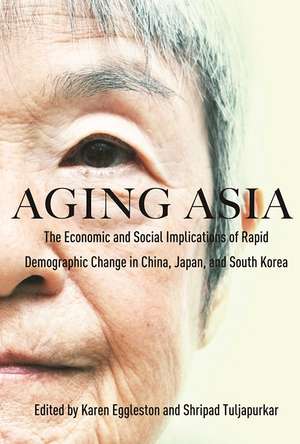
Aging Asia
Editat de Karen Egglestonen Limba Engleză Paperback – 24 iul 2011
In the past fifty years, two factors have led to global population aging: a decline in fertility to levels close to—or even below—replacement and a decline in mortality that has increased world average life expectancy by nearly 67 percent. As the population skews toward fewer young people and more elderly who live longer postretirement lives, demographic changes—labor force participation, savings, economic growth, living arrangements, marriage markets, and social policy—are transforming society in fundamental, irreversible ways. Nowhere are these effects of aging and demographic change more acute—nor their long-term effects more potentially significant—than in the Asia-Pacific region. How will these developments impact the economies and social protection systems of Japan, South Korea, China, and, by extension, the United States?
To assess this question, Aging Asia showcases cutting-edge, policy-relevant research. The first section focuses on demographic trends and their economic implications; the second section approaches select topics from a global comparative perspective, including social insurance financing, medical costs, and long-term care.
To assess this question, Aging Asia showcases cutting-edge, policy-relevant research. The first section focuses on demographic trends and their economic implications; the second section approaches select topics from a global comparative perspective, including social insurance financing, medical costs, and long-term care.
Preț: 239.42 lei
Puncte Express: 359
Carte tipărită la comandă
Livrare economică 30 noiembrie-14 decembrie
Livrare prin curier în România Termenul estimat este afișat lângă disponibilitate.
Transport gratuit de la 400.00 lei Plată online sau ramburs, în funcție de opțiunile comenzii.
Retur gratuit în 14 zile Comandă securizată și suport în română.
Specificații
ISBN-13: 9781931368209
ISBN-10: 1931368201
Pagini: 213
Dimensiuni: 153 x 228 x 15 mm
Greutate: 0.32 kg
Editura: Walter H. Shorenstein Asia-Pacific Research Center
ISBN-10: 1931368201
Pagini: 213
Dimensiuni: 153 x 228 x 15 mm
Greutate: 0.32 kg
Editura: Walter H. Shorenstein Asia-Pacific Research Center
V-ar putea interesa
-
 Global Politics and Financial GovernanceRandall GermainPreț: 283.79 lei
 -
 Governing Through StandardsS. Ponte-18%Preț: 734.95 lei896.28 lei
 -
 Genesis of the Financial CrisisMacdonaldPreț: 388.17 lei
 -
 Preț: 392.97 lei
 -
 Preț: 396.25 lei
 -
 -15%Preț: 647.98 lei762.34 lei
 -
 Marx's Theory of Price and Its Modern RivalsH. Nicholas-15%Preț: 665.80 lei783.29 lei
 -
 In the Grip of TransitionT. BrukPreț: 387.33 lei
 -
 An Introduction to Sustainable DevelopmentJennifer Elliott-8%Preț: 453.53 lei492.97 lei
 -
 Shop Floor Bargaining and the StateSteven TollidayPreț: 305.07 lei
 -
 Welfare, Choice and Solidarity in TransitionJanos KornaiPreț: 342.78 lei
 -
 The Political Economy of Public Sector GovernanceAnthony Michael BertelliPreț: 229.14 lei
 -
 Preț: 224.96 lei
 -
 Preț: 277.06 lei
 -
 Understanding the Crisis in GreeceM. MitsopoulosPreț: 374.71 lei
 -
 I.O.U.: Why Everyone Owes Everyone and No One Can PayJohn LanchesterPreț: 114.49 lei
 -
 Preț: 373.07 lei
Notă biografică
Karen Eggleston is the director of the Asia Health Policy Program (AHPP) at Shorenstein APARC, Stanford University.
Shripad Tuljapurkar is professor of biology and the Dean & Virginia Morrison Professor of Population Studies at Stanford University. He also directs demographic programs at Stanford's Center for the Demography, Economics and Health of Aging, and the Stanford Center for Population Research in the Institute for Research in the Social Sciences.
Shripad Tuljapurkar is professor of biology and the Dean & Virginia Morrison Professor of Population Studies at Stanford University. He also directs demographic programs at Stanford's Center for the Demography, Economics and Health of Aging, and the Stanford Center for Population Research in the Institute for Research in the Social Sciences.
Descriere
In the past fifty years, two factors have led to global population aging: a decline in fertility to levels close to—or even below—replacement and a decline in mortality that has increased world average life expectancy by nearly 67 percent. As the population skews toward fewer young people and more elderly who live longer postretirement lives, demographic changes—labor force participation, savings, economic growth, living arrangements, marriage markets, and social policy—are transforming society in fundamental, irreversible ways. Nowhere are these effects of aging and demographic change more acute—nor their long-term effects more potentially significant—than in the Asia-Pacific region. How will these developments impact the economies and social protection systems of Japan, South Korea, China, and, by extension, the United States?
To assess this question, Aging Asia showcases cutting-edge, policy-relevant research. The first section focuses on demographic trends and their economic implications; the second section approaches select topics from a global comparative perspective, including social insurance financing, medical costs, and long-term care.
To assess this question, Aging Asia showcases cutting-edge, policy-relevant research. The first section focuses on demographic trends and their economic implications; the second section approaches select topics from a global comparative perspective, including social insurance financing, medical costs, and long-term care.